State · Middle East and North Africa

Sultanate of Rum

1077 – 1307 · 230 years

Became Karamanids and Ramadanid Emirate

The Seljuk Turks' sultanate in Anatolia, built on conquered Byzantine lands, that fought the Crusades and fell under the Mongols.

The Sultanate of Rum was a Sunni, Turco-Persian state that the Seljuk Turks built on conquered Byzantine Anatolia after Manzikert in 1071. Suleiman ibn Qutalmish broke it away from the Seljuk Empire in 1077, ruling from Nicaea, then Iconium. At its height, in the late 12th and early 13th centuries, it held Byzantine ports on two seas and grew rich on caravan trade. After the Mongols crushed it at Köse Dağ in 1243, its sultans were Ilkhanate vassals.

What the record holds

The record dates its beginning to 1077.↑ When the borders dataset first draws it, in 1094, it held 366,700 km².↓

Its line counts 25 rulers, covering 1074 – 1308, the median reign 9 years; 9 of 20 handovers were irregular.↓ The best known of them are Kilij Arslan I, Suleiman ibn Qutalmish and Kayqubad I.↓ Most of the 38 rows the atlas files under it are people.↓

It was replaced by Karamanids and the Ramadanid Emirate in 1307, 230 years after it began.↓

From Wikipedia’s article, retold · CC BY-SA 4.0

230 years

Longer than the Polish–Lithuanian Commonwealth, shorter than the Golden Horde

367,000 km²

At its height in 1094 · about the size of Germany

25 rulers

the Sultan of Rum

14 wars and battles

More per century than 90% of states · 38 entries in all

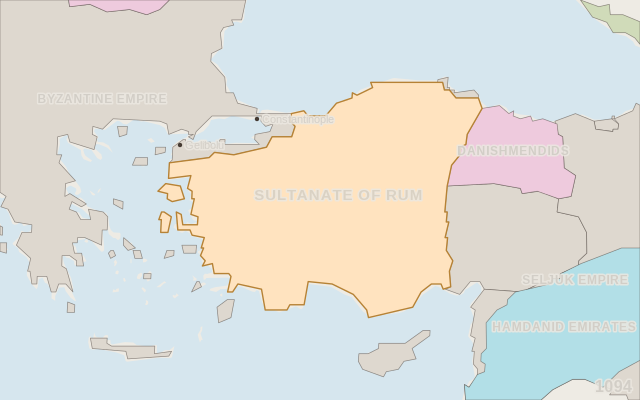
Map: Sultanate of Rum in 1094, its borders in gold among its neighbours
Battle of Dorylaeum (1097), 1097Siege of Nicaea, 1097Crusade of 1101, 1101Battle of Myriokephalon, 1176Mongol conquest of Anatolia, 1241 – 133511001150120012501300
Beside it on the map in 1094: Byzantine Empire, Seljuk Empire, Hamdanid dynasty, Danishmendids, Kingdom of Galicia–Volhynia and Kingdom of Georgia.How far it reached, year by year: its ground inside the borders Cliopatria draws (CC BY 4.0), measured on an equal-area grid; the map shows it at its largest, with the cities of the year.

The story

Four acts, 1077 – 1307

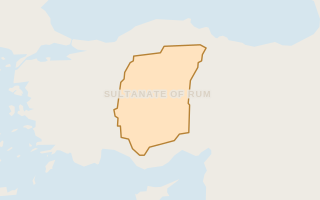
Sultanate of Rum in 1106, at the end of act I
I1077 – 1107

Founding and the First Crusade

Suleiman ibn Qutalmish wins Nicaea and, for a while, Nicomedia, and Malikshah recognises his sultanate as a vassal in 1084. Kilij Arslan I beats the People's Crusade in 1096 but loses to the First Crusade and falls back on Konya. He routs three crusading armies in 1101 and dies in 1107 after taking Mosul.

Watch this act on the live map, from 1077
Sultanate of Rum in 1191, at the end of act II
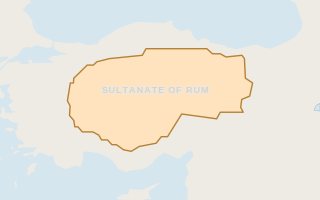
II1107 – 1192129,000 → 252,000 km²

Konya and the Crusaders

Another Rum Seljuk, Malik Shah, seizes Konya, until Kilij Arslan's son Mesud I takes it in 1116 with Danishmend help. Under Mesud I and then Kilij Arslan II, who reigns until 1192, the sultanate fights at Myriokephalon in 1176 and at Iconium in 1190.

Watch this act on the live map, from 1107
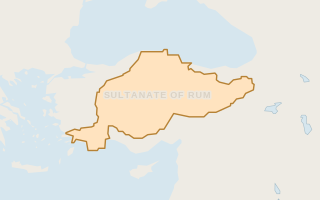
Sultanate of Rum in 1242, at the end of act III
III1192 – 1243258,000 → 347,000 km²

Height and the Mongol blow

Winning harbours on the Mediterranean and the Black Sea, the sultanate reaches its height, stretches east to Lake Van and absorbs the Danishmendids, Saltukids and Artuqids. A network of caravanserai carries trade from Iran and Central Asia. Kaykhusraw II puts down Baba Ishak's rising, but the Mongols take Erzurum and crush him at Köse Dağ in 1243.

Watch this act on the live map, from 1192
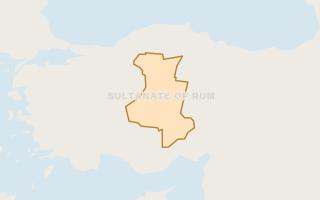
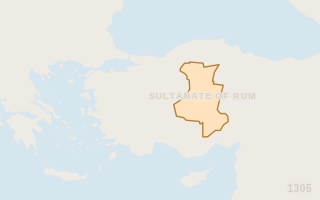
Sultanate of Rum in 1305, last mappedSultanate of Rum in 1094, at its largest
The rise and the fall in one frame: drag across it from 1094, at its largest at 366,700 km², to 1305, last mapped at 71,700 km². Open the live map in 1094 or 1305.

Before and after

After it

Where it sits in time

3000 BCE2000 BCE1000 BCE110002000Karamanids: 1250 – 1487Ramadanid Emirate: 1352 – 1608Sultanate of Rum: 1077 – 1307

Five thousand years, 3000 BCE to 2026; the state in gold, what it replaced or followed and what replaced or followed it in grey.

Its people

Lives across the Sultanate of Rum

105011001150120012501300
Statesmen and generalsWriters, artists and thinkersLived on after it endedAll its people on the timeline →

How it was governed

25 sultans

25 sultans on record, 1074 to 1308; a reign lasted 9 years at the median. Each bar is a reign, as long as it lasted.

Suleiman ibn Qutalmish · 1074 – 1086 · died in battleKilij Arslan I · 1092 – 1107 · died by accidentMalik Shah of Rum · 1107 – 1116 · died by accidentMesud I · 1116 – 1156 · died in office, manner not recordedKilij Arslan II · 1156 – 1192 · died in office, manner not recordedKaykhusraw I · 1192 – 1196 · left office aliveSuleiman II of Rum · 1196 – 1204 · died in office, manner not recordedTughril ibn Kilij Arslan II · 1202 – 1225 · no death date to read the end againstKilij Arslan III · 1204 – 1205 · died in office, manner not recordedKaykhusraw I · 1205 – 1211 · died in battleKaykaus I · 1211 – 1220 · died in office, manner not recordedKayqubad I · 1220 – 1237 · died in office, manner not recordedKaykhusraw II · 1237 – 1246 · died in office, manner not recordedKaykaus II · 1246 – 1262 · left office aliveKayqubad II · 1249 – 1257 · died in office, manner not recordedKilij Arslan IV · 1249 – 1266 · the term ends after the recorded deathKaykhusraw III · 1266 – 1284 · executed, the article saysMesud II · 1284 – 1297 · left office aliveKayqubad III · 1297 – 1303 · died in office, manner not recordedMesud II · 1303 – 1306 · left office aliveMesud III · 1307 – 1308 · died in office, manner not recorded11001150120012501300
a second row: a reign that began before the last had ended — rival claimants, or a shared throne
How their terms ended, where it is known (19 of 21):Killed 3Died in office 12Left office alive 4Not on record 2
Every term, with how it ended and its source

Rulers

How 21 reigns ended - choose one to show only those

How they died, where the record says: died in battle 3 · died by accident 2.

RulerReignLengthHow it ended · sourceTo the ruler before
11th century · 2 reigns · 1 killed or removed
Suleiman ibn Qutalmish · aged 331074 – 108612 yearsdied in battleWikidata's manner of death
Kilij Arslan I · aged 131092 – 110715 yearsdied by accidentWikidata's manner of deathdied by accidentchild
12th century · 5 reigns
Malik Shah of Rum · aged 111107 – 11169 yearsdied by accidentWikidata's manner of deathdied by accidentchild
Mesud I · aged 211116 – 115640 yearsdied in officeread off the dates alonesibling
Kilij Arslan II · aged 431156 – 119236 yearsdied in officeread off the dates alonechild
Kaykhusraw I · aged 151192 – 11964 yearsleft office aliveread off the dates alonedied in battlechild
Suleiman II of Rum · aged 261196 – 12048 yearsdied in officeread off the dates alonesibling
13th century · 12 reigns · 2 killed or removed
Tughril ibn Kilij Arslan II1202 – 122523 yearsending not on recordsibling
Kilij Arslan III · aged 141204 – 12051 yeardied in officeread off the dates alone
Kaykhusraw I · aged 281205 – 12116 yearsdied in battleWikidata's manner of death
Kaykaus I · aged 211211 – 12209 yearsdied in officeread off the dates alonechild
Kayqubad I · aged 321220 – 123717 yearsdied in officeread off the dates alonesibling
Kaykhusraw II · aged 161237 – 12469 yearsdied in officeread off the dates alonechild
Kaykaus II · aged 121246 – 126216 yearsleft office aliveread off the dates alonechild
Kayqubad II · aged 101249 – 12578 yearsdied in officeread off the dates alonesibling
Kilij Arslan IV · aged 191249 – 126617 yearsdates disagreeread off the dates alonesibling
Kaykhusraw III · aged 71266 – 128418 yearsexecutedread from the ruler's own articlechild
Mesud II · aged 241284 – 129713 yearsleft office aliveread off the dates alone
Kayqubad III · aged 171297 – 13036 yearsdied in officeread off the dates alone
14th century · 2 reigns
Mesud II · aged 431303 – 13063 yearsleft office aliveread off the dates alone
Mesud III1307 – 13081 yeardied in officeread off the dates alonechild

25 rulers, 19 with terms dated as terms, covering 1074 – 1308. Median reign 9 years. 9 of 20 handovers irregular - a killing, a deposition, a rival claimant, a rising or a coup beside it. A blank in the last column means no kin on record, which is coverage, never “unrelated”.

Flags and arms, in order

  • Double-headed eagle of the Sultanate of Rum
    coat of arms, undatedDouble-headed eagle of the Sultanate of Rum · CC0
  • Seljuk Lion and Sun
    coat of arms, undatedSeljuk Lion and Sun · CC0

Its world

Rivals, and who else stood

Who it fought most

Wars and battles both took part in, on whichever side: the record names who took part, not who fought whom.

Meanwhile, elsewhere

The best-known states of other regions that stood while it did; the band is the Sultanate of Rum’s own years.

105011001150120012501300

How it compares

Among 3,073 states

Stood longer than 66% of 3,073 states
Sultanate of Rum · 230 yearsPolish–Lithuanian CommonwealthGolden HordeHow long it stood, among the states with a recorded end or still standing.
Held more ground at its peak than 69% of 1,464 states
Sultanate of Rum · 366,700 km²GermanyZimbabweThe most ground it held, among the states with a border in Cliopatria.
Had more wars on record per century than 90% of 3,073 states
Sultanate of Rum · 0.9Wars recorded per century, among the states, counting the wars the atlas hosts under each.

Why it fell

Why did the Sultanate of Rum fall?

Historians still argue. Here is what the atlas records about its last century:

÷4.6

its land, between 1207 and 1306

1284

Kaykhusraw III, killed in office

What led to it, and what came of it

Battle of Manzikert · Argued · 1071 · “Byzantine defeat at Manzikert opened Anatolia to Turkish settlement, on which the Sultanate of Rum was founded.”Battle of ManzikertSultanate of Rum · 1077 – 1307Sultanate of RumRamadanid Emirate · Linked · 1352 – 1608Ramadanid EmirateKaramanids · Linked · 1250 – 1487Karamanids110012001300140015001600
arguedlinked

Open the investigation: every row with its evidence, the conditions at the time, the theories condition by condition, and the succession analysed.

Its centuries in the record

1000 – 1099: 7 recorded — 3 wars and battles, 0 risings, regime changes and massacres, 4 other10001100 – 1199: 12 recorded — 5 wars and battles, 0 risings, regime changes and massacres, 7 other11001200 – 1299: 18 recorded — 6 wars and battles, 0 risings, regime changes and massacres, 12 other12001300 – 1399: 1 recorded — 0 wars and battles, 0 risings, regime changes and massacres, 1 other1300

Wars and battles in red, risings, coups and massacres beside them, everything else in grey, by the century each began in. A tall bar is partly a fact about Wikipedia: better-documented centuries hold more.

Each century’s own page:1000 – 10991100 – 11991200 – 12991300 – 1399

Keep exploring

Share this page
Copy link
Embed the map
Cite this page

How this page is made

Drawn from Wikidata (Q975405, CC0), the opening and history of its English Wikipedia article retold by the atlas (CC BY-SA 4.0), borders from Cliopatria (CC BY 4.0), coast and rivers from Natural Earth, cities from Reba, Reitsma & Seto 2016 (CC BY 4.0), symbols from Wikimedia Commons, each under its own licence. Data built 2026-11-26 · Pastlas v2.47.1, by Oleh Voronko; the published atlas and its data are for non-commercial use.

How to read it

Areas are measured on an equal-area grid from borders simplified to about five kilometres. “c.” marks an approximate date, and a date known to the century is never printed to the year. Counts are what the atlas holds, and they follow Wikipedia’s coverage: a busy century is partly a fact about the record.

Something wrong?

Tell us and name the entry. We fix the data, not just this page.

Report a problem