State · East and Southeast Asia

Khmer Empire

802 – 1431 · 629 years

The empire of Angkor, whose god-kings ruled much of mainland Southeast Asia from hydraulic cities and raised Angkor Wat and the Bayon.

The Khmer Empire, which its people called Kambuja, grew out of Chenla; its capitals were hydraulic cities in today's northern Cambodia. Its era began in 802 CE, when Jayavarman II proclaimed himself universal ruler in the Phnom Kulen mountains, and at its height it ruled or held as vassals most of mainland Southeast Asia. Angkor, its best-known capital, remained its heart until it fell to the Siamese Ayutthaya Kingdom in 1431.

What the record holds

The record dates its beginning to 802.↑ Its borders are first mapped in 800, around 5,400 km².↓

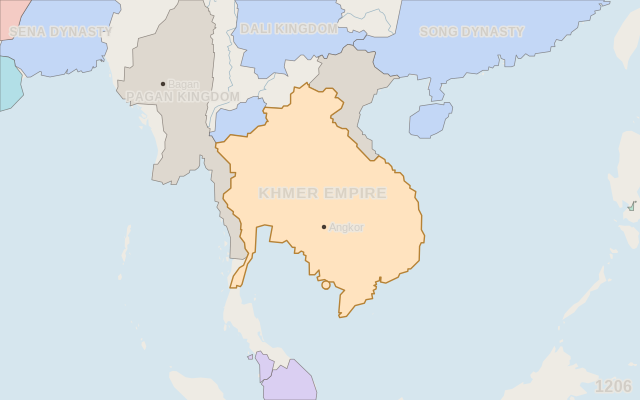
Its ground peaked in 1206 at 956,600 km².↓ Its highest office was held by 13 rulers, covering 780 – 1463, the median reign 21 years; 2 of 12 handovers were irregular.↓ Among them, Suryavarman II, Jayavarman VII and Jayavarman II are the best known.↓ The atlas files 12 rows under it, most of them people.↓ It ended in 1431, 629 years after it began.↑

From Wikipedia’s article, retold · CC BY-SA 4.0

629 years

Longer than the Ottoman Empire, shorter than the House of Habsburg

957,000 km²

At its height in 1206 · about the size of Venezuela

13 rulers

the King of the Khmer Empire

Map: Khmer Empire in 1206, its borders in gold among its neighbours
100012001400
Beside it on the map in 1206: Song dynasty, Pagan Kingdom, Dali Kingdom, Sena dynasty, Đại Việt and Srivijaya.How far it reached, year by year: its ground inside the borders Cliopatria draws (CC BY 4.0), measured on an equal-area grid; the map shows it at its largest, with the cities of the year.

The story

Four acts, 802 – 1431

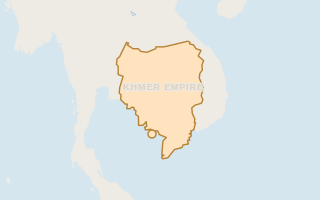
Khmer Empire in 888, at the end of act I
I802 – 8895,400 → 399,000 km²

The universal ruler

Jayavarman II, who had beaten a series of rival kings in the old lands of Chenla, declares himself universal ruler and holds court at Mahendraparvata, north of the Tonlé Sap lake. He lays the foundations of the Angkor period, and Jayavarman III and Indravarman I reign after him.

Watch this act on the live map, from 802
Khmer Empire in 1112, at the end of act II
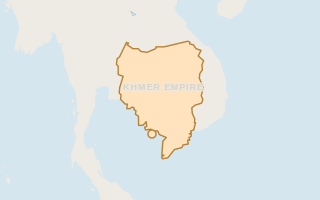
II889 – 1113399,000 → 399,000 km²

Yasodharapura

Yasovarman I builds Yasodharapura, the first city of the Angkor area, with its temple on Phnom Bakheng and the vast East Baray reservoir. Early in the 10th century the empire fractures and Jayavarman IV moves the capital to Koh Ker, until Rajendravarman II brings the palace back.

Watch this act on the live map, from 889
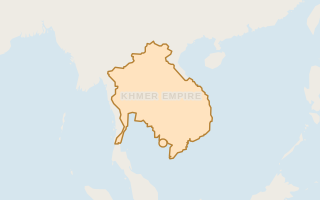
Khmer Empire in 1218, at the end of act III
III1113 – 1219399,000 → 957,000 km²

Angkor Wat and Angkor Thom

Suryavarman II reunites the empire and builds Angkor Wat for Vishnu, though his wars on Champa and Dai Viet fail. After a run of short, violent reigns, Champa takes Angkor; Jayavarman VII wins it back, reigns from 1181 and defeats the Chams in 1203, taking much of their land.

Watch this act on the live map, from 1113
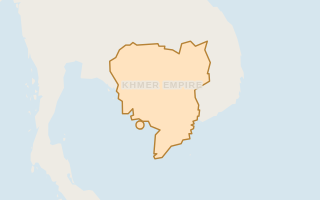
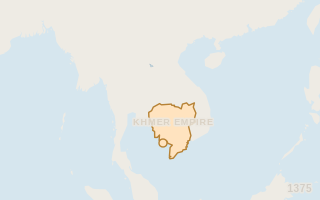
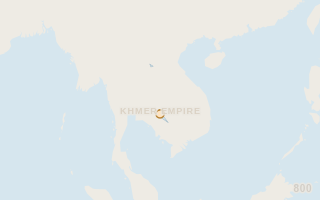
Khmer Empire in 1375, last mappedKhmer Empire in 800, first mapped
The rise and the fall in one frame: drag across it from 800, first mapped at 5,400 km², to 1375, last mapped at 241,400 km². Open the live map in 800 or 1375.

Where it sits in time

3000 BCE2000 BCE1000 BCE110002000Khmer Empire: 802 – 1431

Five thousand years, 3000 BCE to 2026; the state in gold.

Its people

Lives across the Khmer Empire

1100120013001400
Statesmen and generalsLived on after it endedAll its people on the timeline →

How it was governed

13 kings

13 kings on record, 780 to 1463; a reign lasted 21 years at the median. Each bar is a reign, as long as it lasted.

Jayavarman II · 780 – 850 · no death date to read the end againstJyeṣṭhāryā of Sambhupura · 803 – 803 · no death date to read the end againstJayavarman III · 850 – 877 · no death date to read the end againstIndravarman I · 877 – 890 · no death date to read the end againstYasovarman I · 889 – 910 · no death date to read the end againstHarshavarman I · 910 – 923 · no death date to read the end againstSuryavarman I · 1002 – 1050 · no death date to read the end againstSuryavarman II · 1113 – 1150 · no death date to read the end againstJayavarman VII · 1181 – 1218 · no death date to read the end againstJayavarman IX · 1327 – 1336 · no death date to read the end againstTrasak Paem · 1336 – 1340 · no death date to read the end againstThommasaok Reachea · 1373 – 1393 · no death date to read the end againstPonhea Yat · 1394 – 1463 · no death date to read the end against100012001400
a second row: a reign that began before the last had ended — rival claimants, or a shared throne
How their terms ended, where it is known (0 of 13):Not on record 13
Every term, with how it ended and its source

Rulers

RulerReignLengthHow it ended · sourceTo the ruler before
8th century · 1 reign
Jayavarman II780 – 85070 yearsending not on record
9th century · 4 reigns
Jyeṣṭhāryā of Sambhupura803 – 803under a yearending not on record
Jayavarman III850 – 87727 yearsending not on record
Indravarman I877 – 89013 yearsending not on record
Yasovarman I889 – 91021 yearsending not on recorddied of natural causeschild
10th century · 1 reign
Harshavarman I910 – 92313 yearsending not on recordchild
11th century · 1 reign
Suryavarman I1002 – 105048 yearsending not on record
12th century · 2 reigns
Suryavarman II1113 – 115037 yearsending not on record
Jayavarman VII1181 – 121837 yearsending not on record
14th century · 4 reigns
Jayavarman IX1327 – 13369 yearsending not on record
Trasak Paem1336 – 13404 yearsending not on recordin-law
Thommasaok Reachea1373 – 139320 yearsending not on record
Ponhea Yat1394 – 146369 yearsending not on record

13 rulers, 13 with terms dated as terms, covering 780 – 1463. Median reign 21 years. 2 of 12 handovers irregular - a killing, a deposition, a rival claimant, a rising or a coup beside it. A blank in the last column means no kin on record, which is coverage, never “unrelated”.

Its world

Who else stood

Meanwhile, elsewhere

The best-known states of other regions that stood while it did; the band is the Khmer Empire’s own years.

800100012001400

How it compares

Among 3,073 states

Stood longer than 91% of 3,073 states
Khmer Empire · 629 yearsOttoman EmpireHouse of HabsburgHow long it stood, among the states with a recorded end or still standing.
Held more ground at its peak than 84% of 1,464 states
Khmer Empire · 956,600 km²VenezuelaEgyptThe most ground it held, among the states with a border in Cliopatria.

Why it fell

Why did the Khmer Empire fall?

Historians still argue. Here is what the atlas records about its last century:

÷2.1

its land, between 1331 and 1430

Its centuries in the record

800 – 899: 3 recorded — 0 wars and battles, 0 risings, regime changes and massacres, 3 other800900 – 999: 2 recorded — 0 wars and battles, 0 risings, regime changes and massacres, 2 other9001000 – 1099: 2 recorded — 0 wars and battles, 0 risings, regime changes and massacres, 2 other10001100 – 1199: 1 recorded — 0 wars and battles, 0 risings, regime changes and massacres, 1 other11001200 – 1299: 0 recorded — 0 wars and battles, 0 risings, regime changes and massacres, 0 other12001300 – 1399: 4 recorded — 0 wars and battles, 0 risings, regime changes and massacres, 4 other13001400 – 1499: 0 recorded — 0 wars and battles, 0 risings, regime changes and massacres, 0 other1400

Wars and battles in red, risings, coups and massacres beside them, everything else in grey, by the century each began in. A tall bar is partly a fact about Wikipedia: better-documented centuries hold more.

Each century’s own page:800 – 899900 – 9991000 – 10991100 – 11991200 – 12991300 – 13991400 – 1499

Keep exploring

Share this page
Copy link
Embed the map
Cite this page

How this page is made

Drawn from Wikidata (Q201705, CC0), the opening and history of its English Wikipedia article retold by the atlas (CC BY-SA 4.0), borders from Cliopatria (CC BY 4.0), coast and rivers from Natural Earth, cities from Reba, Reitsma & Seto 2016 (CC BY 4.0). Data built 2026-11-26 · Pastlas v2.47.1, by Oleh Voronko; the published atlas and its data are for non-commercial use.

How to read it

Areas are measured on an equal-area grid from borders simplified to about five kilometres. “c.” marks an approximate date, and a date known to the century is never printed to the year. Counts are what the atlas holds, and they follow Wikipedia’s coverage: a busy century is partly a fact about the record.

Something wrong?

Tell us and name the entry. We fix the data, not just this page.

Report a problem