North Yemen civil war
war · 1962 – 1970
State · Middle East and North Africa
The  Yemen Arab Republic began in 1962, replacing the
 Kingdom of Yemen.↓ When the borders dataset first draws it, in 1962, it held 151,600 km².↓
The record names 6 rulers in its line, covering 1962 – 1990; 4 of 5 handovers were irregular.↓ The best known of them are  Ali Abdullah Saleh,
 Ibrahim al-Hamdi and
 Abdullah al-Sallal.↓ Most of the 17 rows the atlas files under it are people.↓
It was replaced by Yemen in 1990, 28 years after it began.↓ Its end fits “Demographic-structural breakdown”, every condition present.↓
Best known for
28 years
Longer than South Vietnam, shorter than the Republic of Artsakh
152,000 km²
At its height in 1962 · about the size of Tunisia
6 rulers
the President of Yemen Arab Republic
2 wars and battles
More per century than 96% of states · 17 entries in all
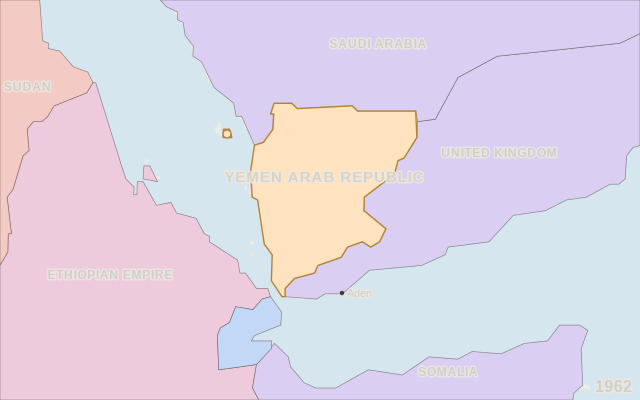
 Ethiopian Empire,
 United Kingdom,
 Saudi Arabia,
 Somalia,
 Sudan and
 French Fifth Republic.How far it reached, year by year: its ground inside the borders Cliopatria draws (CC BY 4.0), measured on an equal-area grid; the map shows it at its largest, with the cities of the year.
The story
The best-known wars, battles, risings and changes of regime the record files under it; a war within a war is folded into it.
war · 1962 – 1970
adverse regime change · 5 November 1967
war · 26 September 1972
adverse regime change · 13 June 1974
The states the record files it as replacing or following, and those that replaced or followed it - Wikidata's own statements, each read from this state's side.
Kingdom of Yemen · replaces · 1918 – 1970Yemen · replaced by · 1990 – presentFive thousand years, 3000 BCE to 2026; the state in gold, what it replaced or followed and what replaced or followed it in grey.
Its people
One axis for everyone, so you can see who knew whom: the best-known, ordered by birth.
 Abdul Rahman al-Eryanipresident
 Abdullah al-Sallalpresident · revolutionary
 Abdul Karim Abdullah al-Arashipresident
 Ahmad al-Ghashmipresident1941 – 1978
 Ibrahim al-Hamdipresident · military personnel1943 – 1977
 Muhammad Miftahpolitician
 Yahya Sareemilitary officer
 Tawakkol Karmanpolitician
 Abdul-Malik al-Houthipolitician
 Muhammad al-Houthipolitician
 Saleh Ali al-Sammadpolitician
How it was governed
6 presidents on record, 1962 to 1990. Each bar is a reign, as long as it lasted.
The line of President of Yemen Arab Republic.
| Ruler | Reign | Length | How it ended · source | To the ruler before |
|---|---|---|---|---|
| 20th century · 6 reigns · 4 killed or removed | ||||
| Abdullah al-Sallal · aged 45 | 1962 – 1967 | 5 years | deposedread from the ruler's own article | |
| Abdul Rahman al-Eryani · aged 57 | 1967 – 1974 | 7 years | deposedread from the ruler's own article | |
| Ibrahim al-Hamdi · aged 31 | 1974 – 1977 | 3 years | killed in officeWikidata's manner of death | |
| Ahmad al-Ghashmi · aged 36 | 1977 – 1978 | 1 year | killed in officeWikidata's manner of death | |
| Abdul Karim Abdullah al-Arashi · aged 44 | 1978 – 1978 | under a year | left office aliveread off the dates alone | |
 Ali Abdullah Saleh · aged 31 | 1978 – 1990 | 12 years | left office aliveread off the dates alone | |
6 rulers, 6 with terms dated as terms, covering 1962 – 1990. Only 28 years of the line are dated - too short for a median. 4 of 5 handovers irregular - a killing, a deposition, a rival claimant, a rising or a coup beside it. The violent-handover count is withheld: power changed hands so often that any rising falls beside one (exposure 0.62, limit 0.6). A blank in the last column means no kin on record, which is coverage, never “unrelated”.
The line of Prime Minister of Yemen Arab Republic, drawn and never measured: a cabinet is not a reign.
 Abdul Latif Dayfallah | lived 1930 – 2019 |
| Abdullah al-Sallal | 1962 – 1963 |
Each symbol with the years its own statement gives; the timeline flies the one of the year on screen.

 Ali Abdullah Saleh12 yrsAbdul Rahman al-Eryani7 yrsAbdullah al-Sallal5 yrsIbrahim al-Hamdi3 yrsAhmad al-Ghashmi1 yrs
Its world
The best-known states of other regions that stood while it did; the band is the Yemen Arab Republic’s own years.
 United StatesAmericas and Oceania
 MexicoAmericas and Oceania
 FinlandEurope
 ItalyEurope
 JapanEast and Southeast Asia
 People's Republic of ChinaEast and Southeast Asia
 IndiaSouth Asia
 South AfricaSub-Saharan Africa
How it compares
Each column is a share of the states; gold is the Yemen Arab Republic.
Why it fell
Historians still argue. Here is what the atlas records about its last century:
1978
Ahmad al-Ghashmi, killed in office
The investigation's own picture: 2 causes the record names and 1 result, the strongest six of each at their own years, joined to the state by the kind of claim - a recorded statement solid, the article's sentence dashed, a theory dash-dot.
Open the investigation: every row with its evidence, the conditions at the time, the theories condition by condition, and the succession analysed.
Of 5 theories of why states fall, 1 has every condition present at this ending and 2 some of them; each is applied by its own logic, condition by condition, and whether its authors named this case is a footnote.
Goldstone 1991 · Turchin & Nefedov 2009
Applies by its own logic: 2 of its 3 conditions held here (it needs 2), and this is the kind of outcome it predicts — unrest, adverse regime change or the state's ending.
17 entries the atlas files under it, all in 1900 – 1999.
“Yemen Arab Republic”, Pastlas, a historical atlas, 2026-11-26. https://app.pastlas.com/state/yemen-arab-republic/
Drawn from Wikidata (Q267584, CC0), borders from Cliopatria (CC BY 4.0), coast and rivers from Natural Earth, cities from Reba, Reitsma & Seto 2016 (CC BY 4.0), symbols from Wikimedia Commons, each under its own licence. Data built 2026-11-26 · Pastlas v2.47.1, by Oleh Voronko; the published atlas and its data are for non-commercial use.
Areas are measured on an equal-area grid from borders simplified to about five kilometres. “c.” marks an approximate date, and a date known to the century is never printed to the year. Counts are what the atlas holds, and they follow Wikipedia’s coverage: a busy century is partly a fact about the record.