My Lai massacre
atrocity · 16 March 1968
State · East and Southeast Asia
1955 – 1975 · 20 years
Came after  Nguyễn dynasty and State of Vietnam · became
 Provisional Revolutionary Government of the Republic of South Vietnam
The anti-communist Republic of Vietnam, ruled from Saigon through coups and war until North Vietnamese forces captured its capital.
The Republic of Vietnam, known as South Vietnam, grew out of the State of Vietnam after the 1954 partition. Ngô Đình Diệm deposed Bảo Đại through a fraud-ridden referendum in 1955 and proclaimed himself president, ruling in an authoritarian way until a coup killed him in 1963. Military governments followed, then Nguyễn Văn Thiệu from 1967. A member of the Western Bloc, recognised by 95 countries, it fought a communist insurgency and North Vietnam until 1975.
South Vietnam began in 1955, after the Nguyễn dynasty and the State of Vietnam.↓ When the borders dataset first draws it, in 1956, it held 180,700 km².↓
The record names 4 rulers in its line, covering 1955 – 1975; 1 of 2 handovers was irregular.↓ The best known of them are  Ngo Dinh Diem,
 Nguyễn Văn Thiệu and
 Dương Văn Minh.↓ Most of the 40 rows the atlas files under it are wars and battles.↓
It was followed by the Provisional Revolutionary Government of the Republic of South Vietnam in 1975, 20 years after it began.↓
From Wikipedia’s article, retold · CC BY-SA 4.0
Best known for
20 years
Longer than the Weimar Republic, shorter than the Republic of Artsakh
181,000 km²
At its height in 1956 · about the size of Uruguay
4 rulers
the President of South Vietnam
23 wars and battles
40 entries in all
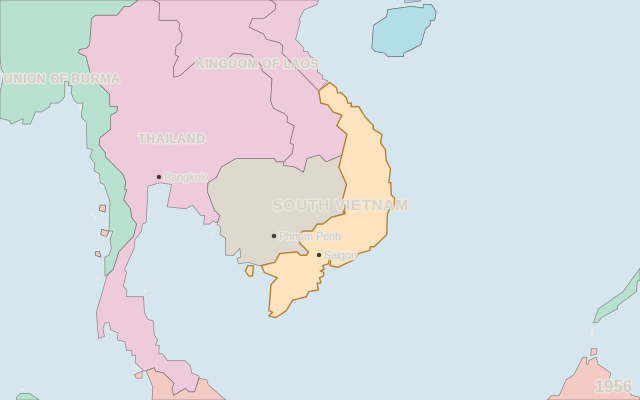
 Thailand,
 Union of Burma,
 Kingdom of Laos,
 Cambodia,
 British Empire and
 North Vietnam.How far it reached, year by year: its ground inside the borders Cliopatria draws (CC BY 4.0), measured on an equal-area grid; the map shows it at its largest, with the cities of the year.
The story
The best-known wars, battles, risings and changes of regime the record files under it; a war within a war is folded into it.
atrocity · 16 March 1968
battle · 21 January 1968
battle · 30 January 1968
battle · 30 January 1968
battle · 30 April 1975
With Operation Frequent Wind within it.
The states the record files it as replacing or following, and those that replaced or followed it - Wikidata's own statements, each read from this state's side.
Nguyễn dynasty · follows · 1802 – 1945Provisional Revolutionary Government of the Republic of South Vietnam · followed by · 1969 – 1976Five thousand years, 3000 BCE to 2026; the state in gold, what it replaced or followed and what replaced or followed it in grey.
Its people
One axis for everyone, so you can see who knew whom: the best-known, ordered by birth.
The best-known people the record files under it, by how many Wikipedias write about them.
 Ngo Dinh Diemruler · 1901 – 1963
 Nguyễn Văn Thiệuruler · 1923 – 2001
 Dương Văn Minhruler · 1916 – 2001
 Trần Văn Hươngruler · 1902 – 1982
How it was governed
4 presidents on record, 1955 to 1975. Each bar is a reign, as long as it lasted.
The line of President of South Vietnam.
| Ruler | Reign | Length | How it ended · source | To the ruler before |
|---|---|---|---|---|
| 20th century · 3 reigns · 1 killed or removed | ||||
| Ngo Dinh Diem · aged 54 | 1955 – 1963 | 8 years | killed in officeWikidata's manner of death | |
| Nguyễn Văn Thiệu · aged 42 | 1965 – 1975 | 10 years | left office aliveread off the dates alonedied of natural causes | |
| Dương Văn Minh · aged 59 | 1975 – 1975 | under a year | left office aliveread off the dates alonedied of natural causes | |
4 rulers, 3 with terms dated as terms, covering 1955 – 1975. Only 20 years of the line are dated - too short for a median. 1 of 2 handovers irregular - a killing, a deposition, a rival claimant, a rising or a coup beside it. The violent-handover count is withheld: power changed hands so often that any rising falls beside one (exposure 0.67, limit 0.6). A blank in the last column means no kin on record, which is coverage, never “unrelated”.
Each symbol with the years its own statement gives; the timeline flies the one of the year on screen.


 Nguyễn Văn Thiệu10 yrsNgo Dinh Diem8 yrsDương Văn Minh0 yrs
Its world
Wars and battles both took part in, on whichever side: the record names who took part, not who fought whom.
 United StatesVietnam War21North VietnamVietnam War11
 Khmer RepublicVietnam War4
 AustraliaVietnam War4
 New ZealandVietnam War4ThailandVietnam War4
 People's Republic of ChinaVietnam War3
The best-known states of other regions that stood while it did; the band is South Vietnam’s own years.
United StatesAmericas and Oceania MexicoAmericas and Oceania
 FinlandEurope
 TurkeyMiddle East and North Africa
 ItalyEurope
 IndiaSouth Asia
 EgyptMiddle East and North Africa
 South AfricaSub-Saharan Africa
How it compares
Each column is a share of the states; gold is South Vietnam.
Why it fell
Thiệu resigned on 21 April 1975, and Dương Văn Minh, soon made president, gave up Saigon to the North's forces on 30 April.
Historians still argue. Here is what the atlas records about its last century:
1963
Ngo Dinh Diem, killed in office
Replaced by Republic, 1975. Read from the article's section “lead” by its grammar; the claim is only that the article says so.
It was succeeded by the communist-controlled Republic of South Vietnam in 1975.
One sentence of the English Wikipedia article, CC BY-SA 4.0.
The investigation's own picture: 5 causes the record names and 1 result, the strongest six of each at their own years, joined to the state by the kind of claim - a recorded statement solid, the article's sentence dashed, a theory dash-dot.
Open the investigation: every row with its evidence, the conditions at the time, the theories condition by condition, and the succession analysed.
40 entries the atlas files under it, all in 1900 – 1999.
“South Vietnam”, Pastlas, a historical atlas, 2026-11-26. https://app.pastlas.com/state/south-vietnam/
Drawn from Wikidata (Q180573, CC0), the opening and history of its English Wikipedia article retold by the atlas (CC BY-SA 4.0), borders from Cliopatria (CC BY 4.0), coast and rivers from Natural Earth, cities from Reba, Reitsma & Seto 2016 (CC BY 4.0), symbols from Wikimedia Commons, each under its own licence, and one sentence of the article, quoted. Data built 2026-11-26 · Pastlas v2.47.1, by Oleh Voronko; the published atlas and its data are for non-commercial use.
Areas are measured on an equal-area grid from borders simplified to about five kilometres. “c.” marks an approximate date, and a date known to the century is never printed to the year. Counts are what the atlas holds, and they follow Wikipedia’s coverage: a busy century is partly a fact about the record.