State · East and Southeast Asia

Khmer Republic

1970 – 1975 · 5 years

Came after Kingdom of Cambodia · became Democratic Kampuchea

The Khmer Republic began in 1970, after the Kingdom of Cambodia.↓ Its highest office was held by 15 rulers, covering 1962 – 1979; 4 of 16 handovers were irregular.↓ Among them, Pol Pot, Lon Nol and Nuon Chea are the best known.↓

Continue reading

In 1975, after 5 years, it was followed by Democratic Kampuchea.↓ 2 theories of why states fall have every condition present at its end: “Demographic-structural breakdown” and “The five conditions of revolution”.↓

5 years

Longer than the Confederate States of America, shorter than Freetown

15 rulers

the Prime Minister of Cambodia

Its borders aren’t on record

The borders dataset does not draw the Khmer Republic. The live map still shows where it stood among the states of its years.

Find it on the live map

The story

Its key moments

Before and after

Before it

After it

Where it sits in time

3000 BCE2000 BCE1000 BCE110002000Kingdom of Cambodia: 1953 – 1970Democratic Kampuchea: 1976 – 1979Khmer Republic: 1970 – 1975

Five thousand years, 3000 BCE to 2026; the state in gold, what it replaced or followed and what replaced or followed it in grey.

How it was governed

15 ministers

15 ministers on record, 1962 to 1979. Each bar is a reign, as long as it lasted.

Norodom Kantol · 1962 – 1966 · left office aliveLon Nol · 1966 – 1967 · left office aliveSon Sann · 1967 – 1968 · left office alivePenn Nouth · 1968 – 1969 · left office aliveLon Nol · 1969 – 1971 · left office aliveCheng Heng · 1970 – 1972 · left office aliveSisowath Sirik Matak · 1971 – 1972 · left office aliveSơn Ngọc Thành · 1972 – 1972 · left office aliveHang Thun Hak · 1972 – 1973 · left office aliveIn Tam · 1973 – 1973 · left office aliveLong Boret · 1973 – 1975 · executed, the article saysSak Sutsakhan · 1975 – 1975 · left office alivePeter Khoy Saukam · 1975 – 1975 · left office alivePenn Nouth · 1975 – 1976 · left office aliveKhieu Samphan · 1976 – 1976 · no death date to read the end againstNuon Chea · 1976 – 1976 · left office alivePol Pot · 1976 – 1979 · left office alive197019711972197319741975
a second row: a reign that began before the last had ended — rival claimants, or a shared throne
How their terms ended, where it is known (16 of 17):Killed 1Left office alive 15Not on record 1
Every term, with how it ended and its source

Rulers

How 17 reigns ended - choose one to show only those

How they died, where the record says: died of natural causes 2 · executed 1.

RulerReignLengthHow it ended · sourceTo the ruler before
20th century · 17 reigns · 1 killed or removed
Norodom Kantol · aged 421962 – 19664 yearsleft office aliveread off the dates alone
Lon Nol · aged 531966 – 19671 yearleft office aliveread off the dates alonedied of natural causes
Son Sann · aged 561967 – 19681 yearleft office aliveread off the dates alone
Penn Nouth · aged 621968 – 19691 yearleft office aliveread off the dates alone
Lon Nol · aged 561969 – 19712 yearsleft office aliveread off the dates alonedied of natural causes
Cheng Heng · aged 541970 – 19722 yearsleft office aliveread off the dates alone
Sisowath Sirik Matak · aged 571971 – 19721 yearleft office aliveread off the dates aloneexecuted
Sơn Ngọc Thành · aged 641972 – 1972under a yearleft office aliveread off the dates alone
Hang Thun Hak · aged 481972 – 19731 yearleft office aliveread off the dates alone
In Tam · aged 511973 – 1973under a yearleft office aliveread off the dates alone
Long Boret · aged 401973 – 19752 yearsexecutedread from the ruler's own article
Sak Sutsakhan · aged 471975 – 1975under a yearleft office aliveread off the dates alone
Peter Khoy Saukam · aged 601975 – 1975under a yearleft office aliveread off the dates alone
Penn Nouth · aged 691975 – 19761 yearleft office aliveread off the dates alone
Khieu Samphan · aged 451976 – 1976under a yearending not on record
Nuon Chea · aged 501976 – 1976under a yearleft office aliveread off the dates alone
Pol Pot · aged 511976 – 19793 yearsleft office aliveread off the dates alone

15 rulers, 15 with terms dated as terms, covering 1962 – 1979. Only 17 years of the line are dated - too short for a median. 4 of 16 handovers irregular - a killing, a deposition, a rival claimant, a rising or a coup beside it. The violent-handover count is withheld: power changed hands so often that any rising falls beside one (exposure 0.94, limit 0.6). A blank in the last column means no kin on record, which is coverage, never “unrelated”.

Flags and arms, in order

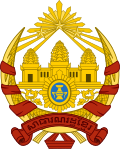
  • Coat of arms of the Khmer Republic
    coat of arms, undatedCoat of arms of the Khmer Republic · CC BY-SA 4.0 · Vectored by FOX 52
  • Flag of the Khmer Republic
    flag, undatedFlag of the Khmer Republic · Public domain

Its world

Rivals, and who else stood

Who it fought most

Wars and battles both took part in, on whichever side: the record names who took part, not who fought whom.

How it compares

Among 3,073 states

Stood longer than 13% of 3,073 states
Khmer Republic · 5 yearsConfederate States of AmericaFreetownHow long it stood, among the states with a recorded end or still standing.

Why it fell

Why did the Khmer Republic fall?

Historians still argue. Here is what the atlas records about its last century:

1975

Long Boret, killed in office

What led to it, and what came of it

Kingdom of Cambodia · Linked · 1953 – 1970 · “Following the removal of Sihanouk, the Kingdom of Cambodia and later the Khmer Republic had aligned themselves with South Vietnam (Republic of Vietnam) in the…”Kingdom of CambodiaNorth Vietnam · In the article · 1945 · “Lon Nol's brother Lon Nil was among a number of government officials who were murdered by demonstrators. Following the coup, North Vietnam and th”North VietnamKhmer Republic · 1970 – 1975Khmer RepublicDemocratic Kampuchea · Linked · 1976 – 1979Democratic Kampuchea19401950196019701980
in the articlelinked

Open the investigation: every row with its evidence, the conditions at the time, the theories condition by condition, and the succession analysed.

Theories that apply to its ending

  • Demographic-structural breakdown

    Goldstone 1991 · Turchin & Nefedov 2009

    Applies by its own logic: 2 of its 3 conditions held here (it needs 2), and this is the kind of outcome it predicts — unrest, adverse regime change or the state's ending.

    • overlapping reigns — rival claimants — within 20 y, or 3 or more changes of ruler within 20 y, or 2 or more reigns of two years or less within 20 y, or a monarch deposed or killed within 20 y — rivalClaimants -1; handovers 13; shortReigns 12
    • a war the state is fighting, still under way, or a war the state fought, ended within 10 y — warOngoing
  • The five conditions of revolution

    Goldstone 2014 · Goldstone 2001

    Applies by its own logic: 4 of its 5 conditions held here (it needs 4), and this is the kind of outcome it predicts — unrest, adverse regime change or the state's ending.

    • GDP per capita down 5% over 5 y, or a war the state is fighting, still under way, or a war the state fought, ended within 5 y, or famine within 5 y in the state — warOngoing
    • an elite group among the regime's opposition within 5 y, or an elite group left the regime's support over 10 y, or a monarch deposed or killed within 10 y, or overlapping reigns — rival claimants — within 10 y, or 2 or more reigns of two years or less within 10 y — the military (1970); rivalClaimants -1; shortReigns 12
    • anti-system movements at 3 or more of 4 within 5 y — a very high level, a real and present threat (1970)
    • a foreign patron left the regime's support, or its foreign policy became its own, within 5 y — the state regained its foreign-policy autonomy (1975)

In the record

2 entries the atlas files under it, all in 1900 – 1999.

Keep exploring

Share this page
Copy link
Cite this page

How this page is made

Drawn from Wikidata (Q1054184, CC0), symbols from Wikimedia Commons, each under its own licence. Data built 2026-11-26 · Pastlas v2.47.1, by Oleh Voronko; the published atlas and its data are for non-commercial use.

How to read it

Areas are measured on an equal-area grid from borders simplified to about five kilometres. “c.” marks an approximate date, and a date known to the century is never printed to the year. Counts are what the atlas holds, and they follow Wikipedia’s coverage: a busy century is partly a fact about the record.

Something wrong?

Tell us and name the entry. We fix the data, not just this page.

Report a problem