State · Sub-Saharan Africa

São Tomé and Príncipe

1975 – present · 51 years · still standing

Came after Portuguese São Tomé and Príncipe

Gulf of Guinea islands, once Africa's foremost sugar exporter, that left Portuguese rule peacefully and settled into stable democracy.

São Tomé and Príncipe lies in the Gulf of Guinea, two small archipelagos off the coast of Gabon. Uninhabited until Portuguese explorers landed in 1470, the islands served the Atlantic slave trade and grew sugar, later coffee and cocoa. They won independence peacefully in 1975 under one-party communist rule; since that system ended in 1990, the country has counted among Africa's steadiest democracies.

What the record holds

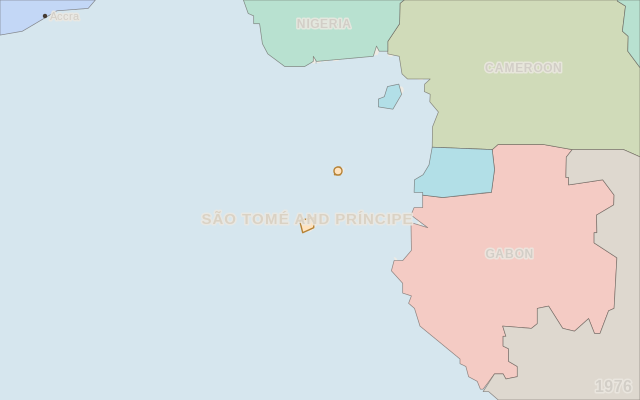
It was founded in 1975, replacing Portuguese São Tomé and Príncipe.↓ Its borders are first mapped in 1976, around 1,500 km².↓

Its line counts 8 rulers, covering 1975 – 2021; 5 of 10 handovers were irregular.↓ Among them, Evaristo Carvalho, Manuel Pinto da Costa and Fradique de Menezes are the best known.↓ The atlas files 29 rows under it, most of them people.↓

From Wikipedia’s article, retold · CC BY-SA 4.0

51 years

Longer than the German Empire, shorter than Hungarians

1,500 km²

At its height in 1976

8 rulers

the President of São Tomé and Príncipe

Map: São Tomé and Príncipe in 1976, its borders in gold among its neighbours
1988 São Tomé and Príncipe coup attempt, 19881995 São Tomé and Príncipe coup d'état, 19952003 São Tomé and Príncipe coup d'état, 20031985199019952000200520102015
Beside it on the map in 1976: Gabon, Cameroon, Republic of the Congo, Nigeria, Equatorial Guinea and Ghana.How far it reached, year by year: its ground inside the borders Cliopatria draws (CC BY 4.0), measured on an equal-area grid; the map shows it at its largest, with the cities of the year.

The story

Three acts, 1975 – present

III2001 – present

Oil hopes and an army revolt

Fradique de Menezes won the presidency in 2001, and a string of short-lived opposition governments followed. In July 2003 the army held power for a week, protesting corruption and fearing that coming oil revenues would be shared unfairly; an accord restored de Menezes. Pinto da Costa returned as president in 2011, and a coup was attempted in 2022.

Watch this act on the live map, from 2001

Before and after

Before it

  • Portuguese São Tomé and Príncipe · replaces

Where it sits in time

3000 BCE2000 BCE1000 BCE110002000São Tomé and Príncipe: 1975 – 2026

Five thousand years, 3000 BCE to 2026; the state in gold.

Its people

Lives across São Tomé and Príncipe

19401960198020002020
Statesmen and generalsAll its people on the timeline →

How it was governed

8 presidents

8 presidents on record, 1975 to 2021. Each bar is a reign, as long as it lasted.

Manuel Pinto da Costa · 1975 – 1991 · no death date to read the end againstLeonel Mário d'Alva · 1991 – 1991 · no death date to read the end againstMiguel Trovoada · 1991 – 1995 · no death date to read the end againstManuel Quintas de Almeida · 1995 – 1995 · left office aliveMiguel Trovoada · 1995 – 2001 · no death date to read the end againstFradique de Menezes · 2001 – 2003 · no death date to read the end againstFernando Pereira · 2003 – 2003 · no death date to read the end againstFradique de Menezes · 2003 – 2011 · no death date to read the end againstManuel Pinto da Costa · 2011 – 2016 · no death date to read the end againstEvaristo Carvalho · 2016 – 2021 · left office aliveCarlos Vila Nova · 2021 – … · still in office19801990200020102020
How their terms ended, where it is known (3 of 11):Left office alive 2In office 1Not on record 8
Every term, with how it ended and its source

Rulers

How 11 reigns ended - choose one to show only those
RulerReignLengthHow it ended · sourceTo the ruler before
20th century · 5 reigns
Manuel Pinto da Costa · aged 381975 – 199116 yearsending not on record
Leonel Mário d'Alva · aged 561991 – 1991under a yearending not on record
Miguel Trovoada · aged 551991 – 19954 yearsending not on record
Manuel Quintas de Almeida · aged 381995 – 1995under a yearleft office aliveread off the dates alone
Miguel Trovoada · aged 591995 – 20016 yearsending not on record
21st century · 6 reigns
Fradique de Menezes · aged 592001 – 20032 yearsending not on record
Fernando Pereira · aged 402003 – 2003under a yearending not on record
Fradique de Menezes · aged 612003 – 20118 yearsending not on record
Manuel Pinto da Costa · aged 742011 – 20165 yearsending not on record
Evaristo Carvalho · aged 752016 – 20215 yearsleft office aliveread off the dates alone
Carlos Vila Nova · aged 622021 – in officein office since 2021still in office

8 rulers, 8 with terms dated as terms, covering 1975 – 2021. Only 46 years of the line are dated - too short for a median. 5 of 10 handovers irregular - a killing, a deposition, a rival claimant, a rising or a coup beside it. The violent-handover count is withheld: power changed hands so often that any rising falls beside one (exposure 0.77, limit 0.6). A blank in the last column means no kin on record, which is coverage, never “unrelated”.

Heads of government

The line of Prime Minister of São Tomé and Príncipe, drawn and never measured: a cabinet is not a reign.

Carlos Graçalived 1931 – 2013
Leonel Mário d'Alvalived 1935 – …
Miguel Trovoadalived 1936 – …
Celestino Rocha da Costalived 1938 – 2010
Daniel Daio1991 – 1992
Norberto Costa Alegre1992 – 1994
Evaristo Carvalho1994 – 1994
Armindo Vaz d'Almeida1995 – 1996
Raúl Bragança Neto1996 – 1999
Guilherme Posser da Costa1999 – 2001
Evaristo Carvalho2001 – 2002
Maria das Neves2002 – 2004
Gabriel Costa2002 – 2002
Damião Vaz d'Almeida2004 – 2005
Maria do Carmo Silveira2005 – 2006
Tomé Vera Cruz2006 – 2008
Patrice Trovoada2008 – 2008
Joaquim Rafael Branco2008 – 2010
Patrice Trovoada2010 – 2012
Gabriel Costa2012 – 2014
Patrice Trovoada2014 – 2018
Jorge Bom Jesus2018 – 2022
Patrice Trovoada2022 – …
Américo Ramos2025 – …

Flags and arms, in order

  • Flag of São Tomé and Príncipe
    flag, from 1975Flag of São Tomé and Príncipe · Public domain
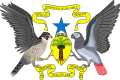
  • Coat of arms of São Tomé and Príncipe
    coat of arms, from 1975Coat of arms of São Tomé and Príncipe · CC BY-SA 4.0 · Josedar

Its world

Who else stood

Meanwhile, elsewhere

The best-known states of other regions that stood while it did; the band is São Tomé and Príncipe’s own years.

198020002020

How it compares

Among 3,073 states

Stood longer than 34% of 3,073 states
São Tomé and Príncipe · 51 yearsGerman EmpireHungariansHow long it stood, among the states with a recorded end or still standing.
Held more ground at its peak than 4% of 1,464 states
São Tomé and Príncipe · 1,500 km²BahrainLuxembourgThe most ground it held, among the states with a border in Cliopatria.

How it began

How did São Tomé and Príncipe begin?

What led to it, and what came of it

Portuguese São Tomé and Príncipe · Linked · 1470 – 1975Portuguese São Tomé and PríncipeSão Tomé and Príncipe · 1975 – 2026São Tomé and Príncipe160018002000
linked

Open the investigation: every row with its evidence, the conditions at the time, the theories condition by condition, and the succession analysed.

Its centuries in the record

1900 – 1999: 26 recorded — 0 wars and battles, 2 risings, regime changes and massacres, 24 other19002000 – 2099: 3 recorded — 0 wars and battles, 2 risings, regime changes and massacres, 1 other2000

Wars and battles in red, risings, coups and massacres beside them, everything else in grey, by the century each began in. A tall bar is partly a fact about Wikipedia: better-documented centuries hold more.

Each century’s own page:1900 – 19992000 – 2099

Keep exploring

Share this page
Copy link
Embed the map
Cite this page

How this page is made

Drawn from Wikidata (Q1039, CC0), the opening and history of its English Wikipedia article retold by the atlas (CC BY-SA 4.0), borders from Cliopatria (CC BY 4.0), coast and rivers from Natural Earth, cities from Reba, Reitsma & Seto 2016 (CC BY 4.0), symbols from Wikimedia Commons, each under its own licence. Data built 2026-11-26 · Pastlas v2.47.1, by Oleh Voronko; the published atlas and its data are for non-commercial use.

How to read it

Areas are measured on an equal-area grid from borders simplified to about five kilometres. “c.” marks an approximate date, and a date known to the century is never printed to the year. Counts are what the atlas holds, and they follow Wikipedia’s coverage: a busy century is partly a fact about the record.

  • Still standing: the span runs to the year of the build, 2026.

Something wrong?

Tell us and name the entry. We fix the data, not just this page.

Report a problem