State · Europe

Prince-Bishopric of Utrecht

1024 – 1528 · 504 years

Became Lordship of Utrecht

The Prince-Bishopric of Utrecht began in 1024.↑ The record names 14 rulers in its line, covering 1228 – 1534, the median reign 7 years; none of its 13 handovers was irregular.↓ The best known of them are Willem van Enckevoirt, David of Burgundy and Frederick IV of Baden.↓ Most of the 12 rows the atlas files under it are people.↓

Continue reading

Its own article says it was conquered, in 1528.↓ In 1528, after 504 years, it was replaced by the Lordship of Utrecht.↓

504 years

Longer than Hittites, shorter than the Abbasid Caliphate

14 rulers

the Bishop of Utrecht

Its borders aren’t on record

The borders dataset does not draw the Prince-Bishopric of Utrecht. The live map still shows where it stood among the states of its years.

Find it on the live map

The story

Its key moments

Before and after

After it

  • Lordship of Utrecht · replaced by

Where it sits in time

3000 BCE2000 BCE1000 BCE110002000Prince-Bishopric of Utrecht: 1024 – 1528

Five thousand years, 3000 BCE to 2026; the state in gold.

Its people

Lives across the Prince-Bishopric of Utrecht

1200130014001500
Writers, artists and thinkersStatesmen and generalsLived on after it endedAll its people on the timeline →

How it was governed

14 bishops

14 bishops on record, 1228 to 1534; a reign lasted 7 years at the median. Each bar is a reign, as long as it lasted.

Wilbrand of Oldenburg · 1228 – … · no end recordedJohn I, Bishop-Elect of Utrecht · 1267 – 1290 · left office aliveJohn II van Sierck · 1291 – 1296 · left office aliveNiccolò Capocci · 1341 – 1342 · left office aliveJohn of Arkel · 1342 – … · no end recordedArnold II of Horne · 1371 – 1378 · left office aliveFrederick of Blankenheim · 1393 – 1423 · died in office, manner not recordedZweder van Culemborg · 1425 – 1432 · left office aliveRudolf van Diepholt · 1432 – 1455 · died in office, manner not recordedDavid of Burgundy · 1457 – 1496 · died in office, manner not recordedFrederick IV of Baden · 1496 – 1517 · died in office, manner not recordedPhilip of Burgundy · 1517 – 1524 · died in office, manner not recordedHenry of the Palatinate · 1524 – 1529 · resigned or stood down, the article saysWillem van Enckevoirt · 1529 – 1534 · died in office, manner not recorded11001200130014001500
How their terms ended, where it is known (12 of 14):Died in office 6Left office alive 6Not on record 2
Every term, with how it ended and its source

Rulers

How 14 reigns ended - choose one to show only those
RulerReignLengthHow it ended · sourceTo the ruler before
13th century · 3 reigns
Wilbrand of Oldenburg · aged 531228 – —no end recordedending not on record
John I, Bishop-Elect of Utrecht1267 – 129023 yearsleft office aliveread off the dates alone
John II van Sierck1291 – 12965 yearsleft office aliveread off the dates alone
14th century · 4 reigns
Niccolò Capocci · aged 411341 – 13421 yearleft office aliveread off the dates alone
John of Arkel · aged 281342 – —no end recordedending not on record
Arnold II of Horne · aged 321371 – 13787 yearsleft office aliveread off the dates alone
Frederick of Blankenheim · aged 381393 – 142330 yearsdied in officeread off the dates alone
15th century · 4 reigns
Zweder van Culemborg · aged 251425 – 14327 yearsleft office aliveread off the dates alone
Rudolf van Diepholt · aged 321432 – 145523 yearsdied in officeread off the dates alone
David of Burgundy · aged 311457 – 149639 yearsdied in officeread off the dates alone
Frederick IV of Baden · aged 381496 – 151721 yearsdied in officeread off the dates alone
16th century · 3 reigns
Philip of Burgundy · aged 531517 – 15247 yearsdied in officeread off the dates alone
Henry of the Palatinate · aged 371524 – 15295 yearsresignedread from the ruler's own article
Willem van Enckevoirt · aged 651529 – 15345 yearsdied in officeread off the dates alone

14 rulers, 14 with terms dated as terms, covering 1228 – 1534. Median reign 7 years. 0 of 13 handovers irregular - a killing, a deposition, a rival claimant, a rising or a coup beside it. A blank in the last column means no kin on record, which is coverage, never “unrelated”.

Flags and arms, in order

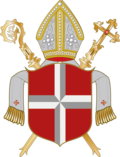
  • Wappen Bistum Utrecht
    coat of arms, undatedWappen Bistum Utrecht · Attribution · David Liuzzo
  • Flag of the prince-bishopric of Utrecht
    flag, undatedFlag of the prince-bishopric of Utrecht · Public domain

Its world

Who else stood

Meanwhile, elsewhere

The best-known states of other regions that stood while it did; the band is the Prince-Bishopric of Utrecht’s own years.

1000120014001600

How it compares

Among 3,073 states

Stood longer than 86% of 3,073 states
Prince-Bishopric of Utrecht · 504 yearsHittitesAbbasid CaliphateHow long it stood, among the states with a recorded end or still standing.

Why it fell

Why did the Prince-Bishopric of Utrecht fall?

Historians still argue. Here is what the atlas records about its last century:

How it ended, as its article says

Conquered by Habsburg troops in 1528, 1528. Read from the article's section “History - Dissolution” by its grammar; the claim is only that the article says so.

The Prince-Bishopric of Utrecht was conquered by Habsburg troops in 1528.

One sentence of the English Wikipedia article, CC BY-SA 4.0.

What led to it, and what came of it

Prince-Bishopric of Utrecht · 1024 – 1528Prince-Bishopric of UtrechtLordship of Utrecht · Linked · 1528 – 1795Lordship of Utrecht10001200140016001800
linked

Open the investigation: every row with its evidence, the conditions at the time, the theories condition by condition, and the succession analysed.

Its centuries in the record

1000 – 1099: 0 recorded — 0 wars and battles, 0 risings, regime changes and massacres, 0 other10001100 – 1199: 1 recorded — 0 wars and battles, 0 risings, regime changes and massacres, 1 other11001200 – 1299: 1 recorded — 0 wars and battles, 0 risings, regime changes and massacres, 1 other12001300 – 1399: 4 recorded — 0 wars and battles, 0 risings, regime changes and massacres, 4 other13001400 – 1499: 6 recorded — 0 wars and battles, 0 risings, regime changes and massacres, 6 other14001500 – 1599: 0 recorded — 0 wars and battles, 0 risings, regime changes and massacres, 0 other1500

Wars and battles in red, risings, coups and massacres beside them, everything else in grey, by the century each began in. A tall bar is partly a fact about Wikipedia: better-documented centuries hold more.

Each century’s own page:1000 – 10991100 – 11991200 – 12991300 – 13991400 – 14991500 – 1599

Keep exploring

Share this page
Copy link
Cite this page

How this page is made

Drawn from Wikidata (Q707767, CC0), symbols from Wikimedia Commons, each under its own licence, and one sentence of the article, quoted. Data built 2026-11-26 · Pastlas v2.47.1, by Oleh Voronko; the published atlas and its data are for non-commercial use.

How to read it

Areas are measured on an equal-area grid from borders simplified to about five kilometres. “c.” marks an approximate date, and a date known to the century is never printed to the year. Counts are what the atlas holds, and they follow Wikipedia’s coverage: a busy century is partly a fact about the record.

Something wrong?

Tell us and name the entry. We fix the data, not just this page.

Report a problem