State · Europe

Kingdom of the Suebi

409 – 585 · 176 years

Came after Western Roman Empire and Hispania · became Visigothic Kingdom and Galicia in the Visigothic Kingdom

The Kingdom of the Suebi began in 409, replacing the Western Roman Empire and Hispania.↓ When the borders dataset first draws it, in 414, it held 53,400 km².↓

Continue reading

Its ground peaked in 441 at 248,400 km².↓ Its highest office was held by 20 rulers, covering 409 – 586, the median reign 4 years; 5 of 17 handovers were irregular.↓ Among them, Liuvigild, Hermeric and Rechila are the best known.↓ The atlas files 18 rows under it, most of them people.↓

It was replaced by the Visigothic Kingdom and the Galicia in the Visigothic Kingdom in 585, 176 years after it began.↓

176 years

Longer than the Mongol Empire, shorter than the Russian Empire

248,000 km²

At its height in 441 · about the size of Guinea

20 rulers

the king of the Suebi

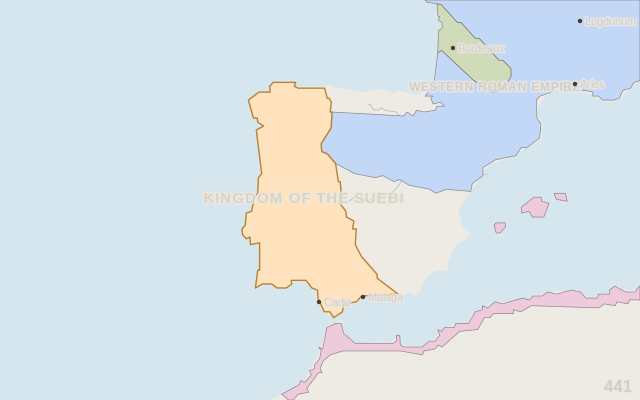
Map: Kingdom of the Suebi in 441, its borders in gold among its neighbours
450500550
Beside it on the map in 441: Western Roman Empire, Vandal Kingdom and Visigothic Kingdom.How far it reached, year by year: its ground inside the borders Cliopatria draws (CC BY 4.0), measured on an equal-area grid; the map shows it at its largest, with the cities of the year.

The story

Its key moments

Before and after

Before it

After it

  • Galicia in the Visigothic Kingdom · replaced by
  • Kingdom of Toledo · replaced by
  • Visigothic Kingdom · replaced by · 476 – 718

Where it sits in time

3000 BCE2000 BCE1000 BCE110002000Western Roman Empire: 395 – 476Visigothic Kingdom: 476 – 718Kingdom of the Suebi: 409 – 585

Five thousand years, 3000 BCE to 2026; the state in gold, what it replaced or followed and what replaced or followed it in grey.

Its people

Lives across the Kingdom of the Suebi

400450500550
Statesmen and generalsAll its people on the timeline →

How it was governed

20 kings

20 kings on record, 409 to 586; a reign lasted 4 years at the median. Each bar is a reign, as long as it lasted.

Hermeric · 409 – 438 · left office aliveRechila · 438 – 448 · died in office, manner not recordedRechiar · 448 – 456 · executedFramta · 456 – 457 · died in office, manner not recordedMaldras · 456 – 459 · killedFrumar · 459 – 463 · died in office, manner not recordedRichimund · 459 – 463 · died in office, manner not recordedRemismund · 463 – … · no end recordedHermeneric · 500 – 500 · died in office, manner not recordedVeremund · 500 – 500 · died in office, manner not recordedTheodemund · 500 – 550 · died in office, manner not recordedChararic (Suebian king) · 550 – 559 · the term ends after the recorded deathTheodemir (Suebian king) · 559 – 570 · died in office, manner not recordedMiro · 570 – 583 · died in office, manner not recordedEboric · 583 – 584 · died in office, manner not recordedAudeca · 584 – 585 · died in office, manner not recordedMalaric · 585 – 586 · died in office, manner not recordedLiuvigild · 585 – 586 · died in office, manner not recorded450500550
a second row: a reign that began before the last had ended — rival claimants, or a shared throne
How their terms ended, where it is known (16 of 18):Killed 2Died in office 13Left office alive 1Not on record 2
Every term, with how it ended and its source

Rulers

How 18 reigns ended - choose one to show only those

How they died, where the record says: executed 1 · killed 1.

RulerReignLengthHow it ended · sourceTo the ruler before
5th century · 11 reigns · 2 killed or removed
Hermeric · aged 29409 – 43829 yearsleft office aliveread off the dates alone
Rechila · aged 68438 – 44810 yearsdied in officeread off the dates alonechild
Rechiar · aged 33448 – 4568 yearsexecutedWikidata's manner of deathchild
Framta456 – 4571 yeardied in officeread off the dates alone
Maldras456 – 4593 yearskilled in officeWikidata's manner of death
Frumar459 – 4634 yearsdied in officeread off the dates alone
Richimund459 – 4634 yearsdied in officeread off the dates alone
Remismund463 – —no end recordedending not on record
Hermeneric500 – 500under a yeardied in officeread off the dates alone
Veremund · aged 50500 – 500under a yeardied in officeread off the dates alone
Theodemund · aged 50500 – 55050 yearsdied in officeread off the dates alone
6th century · 7 reigns
Chararic (Suebian king)550 – 5599 yearsdates disagreeread off the dates alone
Theodemir (Suebian king) · aged 9559 – 57011 yearsdied in officeread off the dates alone
Miro570 – 58313 yearsdied in officeread off the dates alonechild
Eboric · aged 82583 – 5841 yeardied in officeread off the dates alonechild
Audeca · aged 83584 – 5851 yeardied in officeread off the dates alone
Malaric · aged 84585 – 5861 yeardied in officeread off the dates alone
Liuvigild · aged 66585 – 5861 yeardied in officeread off the dates alone

20 rulers, 18 with terms dated as terms, covering 409 – 586. Median reign 4 years. 5 of 17 handovers irregular - a killing, a deposition, a rival claimant, a rising or a coup beside it. A blank in the last column means no kin on record, which is coverage, never “unrelated”.

Flag or arms

  • Estandarte Dinastía Real Sueva
    flag, undatedEstandarte Dinastía Real Sueva · CC BY-SA 3.0 · SanchoPanzaXXI

Its world

Who else stood

Meanwhile, elsewhere

The best-known states of other regions that stood while it did; the band is the Kingdom of the Suebi’s own years.

400450500550600

How it compares

Among 3,073 states

Stood longer than 58% of 3,073 states
Kingdom of the Suebi · 176 yearsMongol EmpireRussian EmpireHow long it stood, among the states with a recorded end or still standing.
Held more ground at its peak than 63% of 1,464 states
Kingdom of the Suebi · 248,400 km²GuineaEcuadorThe most ground it held, among the states with a border in Cliopatria.

Why it fell

Why did the Kingdom of the Suebi fall?

Historians still argue. Here is what the atlas records about its last century:

What led to it, and what came of it

Gallaecia · Linked · 298 – 409GallaeciaWestern Roman Empire · Linked · 395 – 476Western Roman EmpireRoman Empire · In the article · 27 BCE · “Little is known about the Suebi who crossed the Rhine on the night of 31 December 405 AD and entered the Roman Empire.”Roman EmpireAvitus · In the article · 395 · “In response, the new emperor Avitus and the Visigoths sent a joint embassy, remembering that the peace established with Rome was also granted by the Goths.”AvitusRicimer · Coincidence · 405 – 472RicimerKingdom of the Suebi · 409 – 585Kingdom of the SuebiGalicia in the Visigothic Kingdom · Linked · 585 – 714Galicia in the Visigothic KingdomKingdom of Toledo · Linked · 549 – 711Kingdom of ToledoVisigothic Kingdom · Linked · 476 – 718Visigothic Kingdom1200400600
in the articlelinkedcoincidence

Open the investigation: every row with its evidence, the conditions at the time, the theories condition by condition, and the succession analysed.

Its centuries in the record

400 – 499: 9 recorded — 0 wars and battles, 0 risings, regime changes and massacres, 9 other400500 – 599: 7 recorded — 0 wars and battles, 0 risings, regime changes and massacres, 7 other500

Wars and battles in red, risings, coups and massacres beside them, everything else in grey, by the century each began in. A tall bar is partly a fact about Wikipedia: better-documented centuries hold more.

Each century’s own page:400 – 499500 – 599

Keep exploring

Share this page
Copy link
Embed the map
Cite this page

How this page is made

Drawn from Wikidata (Q1048918, CC0), borders from Cliopatria (CC BY 4.0), coast and rivers from Natural Earth, cities from Reba, Reitsma & Seto 2016 (CC BY 4.0), symbols from Wikimedia Commons, each under its own licence. Data built 2026-11-26 · Pastlas v2.47.1, by Oleh Voronko; the published atlas and its data are for non-commercial use.

How to read it

Areas are measured on an equal-area grid from borders simplified to about five kilometres. “c.” marks an approximate date, and a date known to the century is never printed to the year. Counts are what the atlas holds, and they follow Wikipedia’s coverage: a busy century is partly a fact about the record.

  • Wikidata records foundings in 409 and 411; the atlas draws the article's infobox.

Something wrong?

Tell us and name the entry. We fix the data, not just this page.

Report a problem