State · East and Southeast Asia

Xiongnu

301 BCE – 500 CE · 801 years

A confederation of steppe nomads, united by Modu Chanyu, that ruled the eastern steppe and fought the Han dynasty for centuries.

The Xiongnu were a confederation of nomadic peoples on the eastern Eurasian Steppe, recorded by Chinese sources from the 3rd century BCE. Modu Chanyu, leader from 209 BCE, founded their empire, and after throwing off the Yuezhi they dominated the steppes from the Mongolian Plateau. A long struggle with the Han dynasty split the confederation in two, and many Xiongnu were resettled within Han borders; their descendants later founded states in northern China.

What the record holds

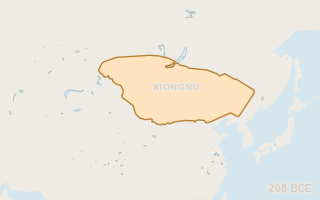
Its record opens in the 4th century BCE.↑ In 208 BCE, the first year its borders are mapped, it covered 3.68 million km².↓

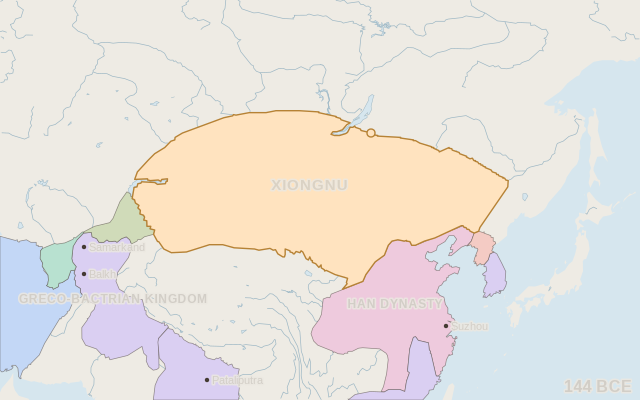
It reached its greatest extent in 144 BCE: 5.61 million km².↓ The record names 14 rulers in its line, covering 209 BCE – 174 BCE.↓ Most of the 5 rows the atlas files under it are people.↓ Its record closes in 500, after 801 years.↑

From Wikipedia’s article, retold · CC BY-SA 4.0

Best known for

801 years

Longer than the House of Habsburg, shorter than the Holy Roman Empire

5.61 million km²

At its height in 144 BCE

14 rulers

the Chanyu

2 wars and battles

More per century than 86% of states · 5 entries in all

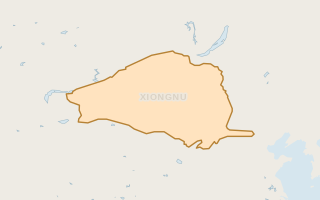
Map: Xiongnu in 144 BCE, its borders in gold among its neighbours
200 BCE100 BCE1100
Beside it on the map in 144 BCE: Han dynasty, Greco-Bactrian Kingdom, Parthian Empire, Shunga Empire, Nanyue and Yuezhi.How far it reached, year by year: its ground inside the borders Cliopatria draws (CC BY 4.0), measured on an equal-area grid; the map shows it at its largest, with the cities of the year.

The story

Four acts, 301 BCE – 500 CE

I301 – 209 BCE

Before the empire

Genetic research makes the Slab Grave people of Mongolia the main ancestors of the Xiongnu, mixed with West Eurasians. Sima Qian places them north of Wild Goose Gate before 265 BCE. Their first known leader is Touman; in 215 BCE Qin Shi Huang's general Meng Tian drives them from the Ordos Loop onto the Mongolian Plateau.

Watch this act on the live map, from 301 BCE
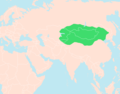
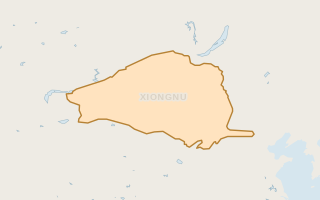
Xiongnu in 61 BCE, at the end of act II
II209 – 60 BCE

Modu's empire and the Han wars

Modu Chanyu forges the Xiongnu into a powerful confederation, organised like an army. In 200 BCE he traps Emperor Gaozu of Han at Baideng, and the Han turn to marriage alliances, sending commoner women as princesses. Emperor Wu prepares for war instead, sending Zhang Qian west to win the Yuezhi, and the Han launch long wars on the Xiongnu.

Watch this act on the live map, from 209 BCE
Xiongnu in 49, at the end of act III
III60 BCE – 50 CE2.4 million → 2.4 million km²

Civil war and submission

A disputed succession in 60 BCE brings civil war; Huhanye emerges as chanyu and in 53 BCE becomes a Han tributary, sending a son as hostage and paying homage at Chang'an. Under Huduershi the Xiongnu revive, but his choice of his son Punu as heir splits them, and in 50 CE the Southern Xiongnu submit to the Han.

Watch this act on the live map, from 60 BCE
IV50 – 500

Southern Xiongnu and their heirs

The Southern chanyu holds court in Xihe Commandery, and his people are resettled in eight frontier commanderies beside Chinese settlers, living on Han trade and subsidies and guarding the frontier. The Xiongnu name slowly fades, but their descendants found Han-Zhao in 304 CE, then Xia and perhaps Northern Liang, before the Northern Wei unify northern China in 439 CE.

Watch this act on the live map, from 50
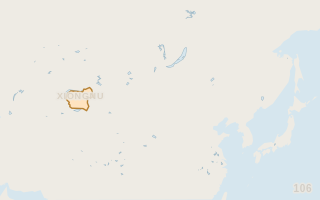
Xiongnu in 106, last mappedXiongnu in 208 BCE, first mapped
The rise and the fall in one frame: drag across it from 208 BCE, first mapped at 3.68 million km², to 106, last mapped at 211,700 km². Open the live map in 208 BCE or 106.

Where it sits in time

3000 BCE2000 BCE1000 BCE110002000Xiongnu: 301 BCE – 500

Five thousand years, 3000 BCE to 2026; the state in gold.

Its people

Lives across Xiongnu

Notable figures

How it was governed

14 chanyus

14 chanyus on record, 209 BCE to 174 BCE. Each bar is a reign, as long as it lasted.

Modu Chanyu · 209 BCE – 174 BCE · died in office, manner not recorded200 BCE1200400
How their terms ended, where it is known (1 of 1):Died in office 1
Every term, with how it ended and its source

Rulers

RulerReignLengthHow it ended · sourceTo the ruler before
3rd century BCE · 1 reign
Modu Chanyu · aged 25209 BCE – 174 BCE35 yearsdied in officeread off the dates alone

14 rulers, 1 with terms dated as terms, covering 209 BCE – 174 BCE. Only 35 years of the line are dated - too short for a median. A blank in the last column means no kin on record, which is coverage, never “unrelated”.

Its world

Rivals, and who else stood

Who it fought most

Wars and battles both took part in, on whichever side: the record names who took part, not who fought whom.

Meanwhile, elsewhere

The best-known states of other regions that stood while it did; the band is Xiongnu’s own years.

400 BCE200 BCE1200400600

How it compares

Among 3,073 states

Stood longer than 95% of 3,073 states
Xiongnu · 801 yearsHouse of HabsburgHoly Roman EmpireHow long it stood, among the states with a recorded end or still standing.
Held more ground at its peak than 98% of 1,464 states
Xiongnu · 5,606,400 km²IndiaAustraliaThe most ground it held, among the states with a border in Cliopatria.
Had more wars on record per century than 86% of 3,073 states
Xiongnu · 0.1Wars recorded per century, among the states, counting the wars the atlas hosts under each.

Why it fell

Why did Xiongnu fall?

Historians still argue. Here is what the atlas records about its last century:

Its centuries in the record

400 BCE – 301 BCE: 0 recorded — 0 wars and battles, 0 risings, regime changes and massacres, 0 other400 BCE300 BCE – 201 BCE: 1 recorded — 0 wars and battles, 0 risings, regime changes and massacres, 1 other300 BCE200 BCE – 101 BCE: 3 recorded — 2 wars and battles, 0 risings, regime changes and massacres, 1 other200 BCE100 BCE – 1 BCE: 1 recorded — 0 wars and battles, 0 risings, regime changes and massacres, 1 other100 BCE0 – 99: 0 recorded — 0 wars and battles, 0 risings, regime changes and massacres, 0 other0100 – 199: 0 recorded — 0 wars and battles, 0 risings, regime changes and massacres, 0 other100200 – 299: 0 recorded — 0 wars and battles, 0 risings, regime changes and massacres, 0 other200300 – 399: 0 recorded — 0 wars and battles, 0 risings, regime changes and massacres, 0 other300400 – 499: 0 recorded — 0 wars and battles, 0 risings, regime changes and massacres, 0 other400500 – 599: 0 recorded — 0 wars and battles, 0 risings, regime changes and massacres, 0 other500

Wars and battles in red, risings, coups and massacres beside them, everything else in grey, by the century each began in. A tall bar is partly a fact about Wikipedia: better-documented centuries hold more.

Each century’s own page:400 BCE – 301 BCE300 BCE – 201 BCE200 BCE – 101 BCE100 BCE – 1 BCE0 – 99100 – 199200 – 299300 – 399400 – 499500 – 599

Keep exploring

Share this page
Copy link
Embed the map
Cite this page

How this page is made

Drawn from Wikidata (Q188836, CC0), the opening and history of its English Wikipedia article retold by the atlas (CC BY-SA 4.0), borders from Cliopatria (CC BY 4.0), coast and rivers from Natural Earth, cities from Reba, Reitsma & Seto 2016 (CC BY 4.0). Data built 2026-11-26 · Pastlas v2.47.1, by Oleh Voronko; the published atlas and its data are for non-commercial use.

How to read it

Areas are measured on an equal-area grid from borders simplified to about five kilometres. “c.” marks an approximate date, and a date known to the century is never printed to the year. Counts are what the atlas holds, and they follow Wikipedia’s coverage: a busy century is partly a fact about the record.

Something wrong?

Tell us and name the entry. We fix the data, not just this page.

Report a problem