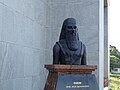
State · South Asia

Gandhara

751 BCE – 535 CE · 1,286 years

The realm of the Valley of Peshawar, where Central and South Asia meet, famed for its Buddhist civilisation and Gandharan art.

Gandhara, an ancient Indo-Aryan culture and region, lay in today's northwestern Pakistan and northeastern Afghanistan, with the Valley of Peshawar at its core. Named after a tribe of the Rigveda, it was one of the sixteen mahajanapadas in the 6th and 5th centuries BCE, then an Achaemenid satrapy. The Maurya Empire, the Indo-Greeks, Indo-Scythians and Indo-Parthians ruled it in turn, and under the Kushan Empire its influence peaked; Hunnic invasions later laid it waste.

What the record holds

Gandhara began in 751 BCE.↑ Its highest office was held by 5 rulers, covering 330 BCE – 514, the median reign under a year; 1 of 4 handovers was irregular.↓ The best known of them are Chandragupta Maurya, Kanishka and Taxiles.↓ Most of the 7 rows the atlas files under it are wars and battles.↓ Its record closes in 535, after 1,286 years.↑

From Wikipedia’s article, retold · CC BY-SA 4.0

1,286 years

Longer than Indus Valley Civilisation, shorter than Babylonia

5 rulers

the Raja

4 wars and battles

7 entries in all

Its borders aren’t on record

The borders dataset does not draw Gandhara. The live map still shows where it stood among the states of its years.

Find it on the live map

The story

Five acts, 751 BCE – 535 CE

I751 – 535 BCE

A great realm of the northwest

Late Vedic texts, the Brāhmaṇas, name Nagnajit, a Gāndhārī king, and his son Svarajit, whose house keeps to non-Brahmanical traditions; the capital, Takṣaśila, becomes an important centre. In the 6th century BCE Gandhara is a leading power of the northwest, holding the valley of Kaśmīra, and Buddhist texts count it among the sixteen Mahājanapadas.

Watch this act on the live map, from 751 BCE
II535 – 327 BCE

An Achaemenid satrapy

In c. 535 BCE Cyrus the Great begins to absorb lands west of the Indus River into the Achaemenid Empire, and c. 518 BCE the Persian army pushes on to the Jhelum River. Gandhara becomes a satrapy ruled from Pushkalavati, the Kharosthi script grows from the Aramaic alphabet, and Gandharan troops march with Xerxes I against Greece.

Watch this act on the live map, from 535 BCE
III327 – 180 BCE

Alexander and the Mauryas

In 327 BCE Alexander the Great reaches Arigaum on Gandhara's western fringe, where the Aspasians burn their city and fight hard before defeat; Gandhara is split among polities such as Taxila under Omphis. The Maurya Empire takes it in 321 BCE and makes Taxila capital of the northwest, and Ashoka is sent to quell a rising there.

Watch this act on the live map, from 327 BCE
IV180 BCE – 78 CE

Greeks, Scythians and Parthians

Demetrius I of Bactria invades before 180 BCE, founding the Indo-Greek Kingdom, and Menander I drives the Greco-Bactrians out of Gandhara. The Indo-Scythian Maues takes Gandhara and Taxila c. 80 BCE, though Indo-Greek kings return after him. Gondophares' Indo-Parthians follow in the 1st century CE, while the local Apracharajas rule from Bajaur until Kushan rule begins in 78 CE.

Watch this act on the live map, from 180 BCE
V78 – 535

Kushans, Kidarites and Huns

The Kushan Empire, reaching from Turfan to Pataliputra by the 3rd century CE, brings Gandhara's influence to its height, and Kanishka rules in 127 CE. Between 390 CE and 410 CE the Kidarites take Gandhara from the Kushans; from c. 430 CE the Alchon Huns under Khingila seize the routes over the Hindu Kush, and Mihirakula rules in 514 CE.

Watch this act on the live map, from 78

Where it sits in time

3000 BCE2000 BCE1000 BCE110002000Gandhara: 751 BCE – 535

Five thousand years, 3000 BCE to 2026; the state in gold.

Its people

Lives across Gandhara

Notable figures

How it was governed

5 rajas

5 rajas on record, 330 BCE to 514; a reign lasted 0 years at the median. Each bar is a reign, as long as it lasted.

Taxiles · 330 BCE – 330 BCE · no death date to read the end againstChandragupta Maurya · 321 BCE – 321 BCE · no death date to read the end againstSases · 46 – 46 · no death date to read the end againstKanishka · 127 – 127 · no death date to read the end againstMihirakula · 514 – 514 · no death date to read the end against500 BCE1500
How their terms ended, where it is known (0 of 5):Not on record 5
Every term, with how it ended and its source

Rulers

RulerReignLengthHow it ended · sourceTo the ruler before
4th century BCE · 2 reigns
Taxiles330 BCE – 330 BCEunder a yearending not on record
Chandragupta Maurya321 BCE – 321 BCEunder a yearending not on recorddied by suicide
1st century · 1 reign
Sases46 – 46under a yearending not on record
2nd century · 1 reign
Kanishka127 – 127under a yearending not on record
6th century · 1 reign
Mihirakula514 – 514under a yearending not on record

5 rulers, 5 with terms dated as terms, covering 330 BCE – 514. Median reign 0 years. 1 of 4 handovers irregular - a killing, a deposition, a rival claimant, a rising or a coup beside it. A blank in the last column means no kin on record, which is coverage, never “unrelated”.

Its world

Rivals, and who else stood

Who it fought most

Wars and battles both took part in, on whichever side: the record names who took part, not who fought whom.

Meanwhile, elsewhere

The best-known states of other regions that stood while it did; the band is Gandhara’s own years.

500 BCE1500

How it compares

Among 3,073 states

Stood longer than 99% of 3,073 states
Gandhara · 1,286 yearsIndus Valley CivilisationBabyloniaHow long it stood, among the states with a recorded end or still standing.

Why it fell

Why did Gandhara fall?

Historians still argue. Here is what the atlas records about its last century:

Its centuries in the record

800 BCE – 701 BCE: 0 recorded — 0 wars and battles, 0 risings, regime changes and massacres, 0 other800 BCE700 BCE – 601 BCE: 0 recorded — 0 wars and battles, 0 risings, regime changes and massacres, 0 other600 BCE – 501 BCE: 1 recorded — 0 wars and battles, 0 risings, regime changes and massacres, 1 other600 BCE500 BCE – 401 BCE: 1 recorded — 0 wars and battles, 0 risings, regime changes and massacres, 1 other400 BCE – 301 BCE: 4 recorded — 4 wars and battles, 0 risings, regime changes and massacres, 0 other400 BCE300 BCE – 201 BCE: 0 recorded — 0 wars and battles, 0 risings, regime changes and massacres, 0 other200 BCE – 101 BCE: 0 recorded — 0 wars and battles, 0 risings, regime changes and massacres, 0 other200 BCE100 BCE – 1 BCE: 0 recorded — 0 wars and battles, 0 risings, regime changes and massacres, 0 other0 – 99: 0 recorded — 0 wars and battles, 0 risings, regime changes and massacres, 0 other0100 – 199: 0 recorded — 0 wars and battles, 0 risings, regime changes and massacres, 0 other200 – 299: 0 recorded — 0 wars and battles, 0 risings, regime changes and massacres, 0 other200300 – 399: 0 recorded — 0 wars and battles, 0 risings, regime changes and massacres, 0 other400 – 499: 0 recorded — 0 wars and battles, 0 risings, regime changes and massacres, 0 other400500 – 599: 1 recorded — 0 wars and battles, 0 risings, regime changes and massacres, 1 other

Wars and battles in red, risings, coups and massacres beside them, everything else in grey, by the century each began in. A tall bar is partly a fact about Wikipedia: better-documented centuries hold more.

Each century’s own page:800 BCE – 701 BCE700 BCE – 601 BCE600 BCE – 501 BCE500 BCE – 401 BCE400 BCE – 301 BCE300 BCE – 201 BCE200 BCE – 101 BCE100 BCE – 1 BCE0 – 99100 – 199200 – 299300 – 399400 – 499500 – 599

Keep exploring

Share this page
Copy link
Cite this page

How this page is made

Drawn from Wikidata (Q213651, CC0), the opening and history of its English Wikipedia article retold by the atlas (CC BY-SA 4.0). Data built 2026-11-26 · Pastlas v2.47.1, by Oleh Voronko; the published atlas and its data are for non-commercial use.

How to read it

Areas are measured on an equal-area grid from borders simplified to about five kilometres. “c.” marks an approximate date, and a date known to the century is never printed to the year. Counts are what the atlas holds, and they follow Wikipedia’s coverage: a busy century is partly a fact about the record.

Something wrong?

Tell us and name the entry. We fix the data, not just this page.

Report a problem