Eritrean–Ethiopian War
war · 1998 – 2000
State · Sub-Saharan Africa
1995 – present · 31 years · still standing
Ethiopia as a federal republic: Africa's second most populous country, landlocked, and scarred by war with Eritrea and in Tigray.
Ethiopia's federal republic grew from the transitional government the EPRDF formed in July 1991 and the constitution of 1994, which set up a parliamentary republic with two chambers. Eritrea had left after a referendum in 1993, and a border dispute between them became a war in 1998–2000. The Tigray war of 2020–2022 was followed by a peace agreement in 2022. Landlocked in the Horn of Africa, Ethiopia counted about 138 million people by 2026, second in Africa.
The record dates its beginning to 1995.↑ Its borders are first mapped in 1992, around 1.13 million km².↓
Its highest office was held by 8 rulers, covering 1977 – 2024; 1 of 7 handovers was irregular.↓ Among them,  Sahle-Work Zewde,
 Mengistu Haile Mariam and
 Meles Zenawi are the best known.↓ The atlas files 23 rows under it, people the largest group of them.↓
From Wikipedia’s article, retold · CC BY-SA 4.0
Best known for
31 years
Longer than South Vietnam, shorter than the Republic of Artsakh
1.13 million km²
At its height in 1992 · about the size of Colombia
8 rulers
the President of Ethiopia
7 wars and battles
More per century than 99% of states · 23 entries in all
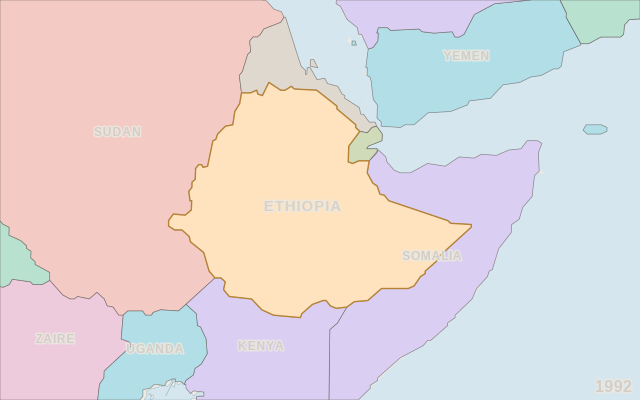
 Sudan,
 Somalia,
 Yemen,
 Kenya,
 Zaire and
 Uganda.How far it reached, year by year: its ground inside the borders Cliopatria draws (CC BY 4.0), measured on an equal-area grid; the map shows it at its largest, with the cities of the year.
The story
The best-known wars, battles, risings and changes of regime the record files under it; a war within a war is folded into it.
war · 1998 – 2000
battle · 7 October 2002
With Maersk Alabama hijacking within it.
unrest · 5 August 2016
unrest · 22 June 2019
war · 2020 – 2022
Five thousand years, 3000 BCE to 2026; the state in gold.
Its people
One axis for everyone, so you can see who knew whom: the best-known, ordered by birth.
 Girma Wolde-Giorgispresident · military personnel1924 – 2018
 Negasso Gidadapresident1943 – 2019
 Sahle-Work Zewdepresident · diplomat1950 – present
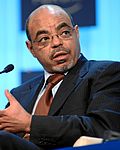 Meles Zenawipresident · military personnel1955 – 2012
 Taye Atske Selassiepresident · diplomat1956 – present
 Mulatu Teshomepresident · diplomat1957 – present
 Hailemariam Desalegnpolitician1965 – present
 Abiy Ahmedpolitician · military personnel1976 – present
How it was governed
8 presidents on record, 1977 to 2024. Each bar is a reign, as long as it lasted.
The line of President of Ethiopia - the office this state names as its head of state.
| Ruler | Reign | Length | How it ended · source | To the ruler before |
|---|---|---|---|---|
| 20th century · 4 reigns · 1 killed or removed | ||||
 Mengistu Haile Mariam · aged 40 | 1977 – 1991 | 14 years | exiledread from the ruler's own article | |
 Tesfaye Gebre Kidan · aged 54 | 1991 – 1991 | under a year | left office aliveread off the dates alonekilled | |
| Meles Zenawi · aged 36 | 1991 – 1995 | 4 years | left office aliveread off the dates alonedied of natural causes | |
| Negasso Gidada · aged 52 | 1995 – 2001 | 6 years | resignedread from the ruler's own articledied of natural causes | |
| 21st century · 4 reigns | ||||
| Girma Wolde-Giorgis · aged 77 | 2001 – 2013 | 12 years | left office aliveread off the dates alone | |
| Mulatu Teshome · aged 56 | 2013 – 2018 | 5 years | ending not on record | |
| Sahle-Work Zewde · aged 68 | 2018 – 2024 | 6 years | ending not on record | |
| Taye Atske Selassie · aged 68 | 2024 – in office | in office since 2024 | still in office | |
8 rulers, 8 with terms dated as terms, covering 1977 – 2024. Only 47 years of the line are dated - too short for a median. 1 of 7 handovers irregular - a killing, a deposition, a rival claimant, a rising or a coup beside it. The violent-handover count is withheld: power changed hands so often that any rising falls beside one (exposure 0.73, limit 0.6). A blank in the last column means no kin on record, which is coverage, never “unrelated”.
The line of Prime Minister of Ethiopia, drawn and never measured: a cabinet is not a reign.
| Hailu Yimenu | 1989 – 1991 |
 Tamrat Layne | 1991 – 1991 |
| Tesfaye Dinka | 1991 – … |
| Meles Zenawi | 1995 – 2012 |
 Hailemariam Desalegn | 2012 – 2018 |
 Abiy Ahmed | 2018 – … |
Each symbol with the years its own statement gives; the timeline flies the one of the year on screen.


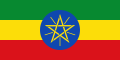

 Mengistu Haile Mariam14 yrsGirma Wolde-Giorgis12 yrsNegasso Gidada6 yrsSahle-Work Zewde6 yrsMulatu Teshome5 yrs
Its world
Wars and battles both took part in, on whichever side: the record names who took part, not who fought whom.
 Soviet UnionKorean War2SomaliaOgaden War2
The best-known states of other regions that stood while it did; the band is Ethiopia’s own years.
How it compares
Each column is a share of the states; gold is Ethiopia.
How it began
The republic was founded on the constitution of 1994, which closed the transition begun when the EPRDF convened a National Conference in July 1991.
The investigation's own picture: 8 causes the record names and 0 results, the strongest six of each at their own years, joined to the state by the kind of claim - a recorded statement solid, the article's sentence dashed, a theory dash-dot.
Open the investigation: every row with its evidence, the conditions at the time, the theories condition by condition, and the succession analysed.
Wars and battles in red, risings, coups and massacres beside them, everything else in grey, by the century each began in. A tall bar is partly a fact about Wikipedia: better-documented centuries hold more.
Each century’s own page:1900 – 19992000 – 2099
“Ethiopia”, Pastlas, a historical atlas, 2026-11-26. https://app.pastlas.com/state/ethiopia/
Drawn from Wikidata (Q115, CC0), the opening and history of its English Wikipedia article retold by the atlas (CC BY-SA 4.0), borders from Cliopatria (CC BY 4.0), coast and rivers from Natural Earth, cities from Reba, Reitsma & Seto 2016 (CC BY 4.0), symbols from Wikimedia Commons, each under its own licence. Data built 2026-11-26 · Pastlas v2.47.1, by Oleh Voronko; the published atlas and its data are for non-commercial use.
Areas are measured on an equal-area grid from borders simplified to about five kilometres. “c.” marks an approximate date, and a date known to the century is never printed to the year. Counts are what the atlas holds, and they follow Wikipedia’s coverage: a busy century is partly a fact about the record.


