The story
Its key moments
Where it sits in time
Five thousand years, 3000 BCE to 2026; the state in gold.
Dynasty · Middle East and North Africa
1244 – 1381 · 137 years
137 years
Longer than Nizhny Novgorod, shorter than the Mongol Empire
577,000 km²
At its height in 1375 · about the size of Botswana
1 war or battle
1 entries in all
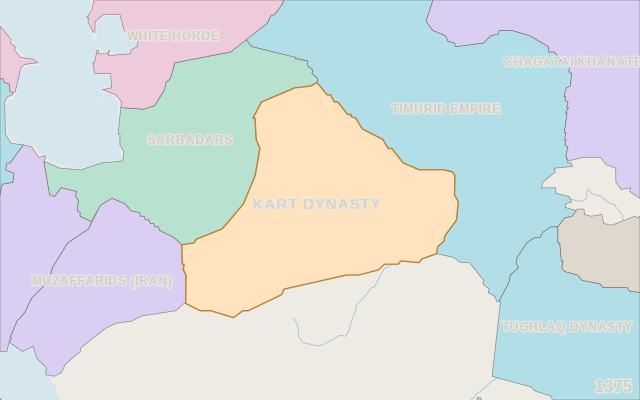
 Timurid Empire, Sarbadars, Chagatai Khanate,
 Tughlaq dynasty, Muzaffarids of Iran and White Horde.How far it reached, year by year: its ground inside the borders Cliopatria draws (CC BY 4.0), measured on an equal-area grid; the map shows it at its largest, with the cities of the year.
The story
Five thousand years, 3000 BCE to 2026; the state in gold.
Its world
The best-known states of other regions that stood while it did; the band is the Kart dynasty’s own years.
 DenmarkEurope
 SwedenEurope
 KathmanduSouth Asia
 Mongol EmpireEast and Southeast AsiaDelhi SultanateSouth Asia
How it compares
Each column is a share of the states; gold is the Kart dynasty.
Why it fell
Historians still argue. Here is what the atlas records about its last century:
1
wars and battles in its last century, more than in any before it
Of 5 theories of why states fall, 1 has every condition present at this ending; each is applied by its own logic, condition by condition, and whether its authors named this case is a footnote.
Ibn Khaldun 1377 · Turchin & Nefedov 2009
Applies by its own logic: the condition it names held here, and this is the kind of outcome it predicts — adverse regime change or the state's ending.
Wars and battles in red, risings, coups and massacres beside them, everything else in grey, by the century each began in. A tall bar is partly a fact about Wikipedia: better-documented centuries hold more.
Each century’s own page:1200 – 12991300 – 1399
“Kart dynasty”, Pastlas, a historical atlas, 2026-11-26. https://app.pastlas.com/state/kart-dynasty/
Drawn from Wikidata (Q1734616, CC0), borders from Cliopatria (CC BY 4.0), coast and rivers from Natural Earth, cities from Reba, Reitsma & Seto 2016 (CC BY 4.0). Data built 2026-11-26 · Pastlas v2.47.1, by Oleh Voronko; the published atlas and its data are for non-commercial use.
Areas are measured on an equal-area grid from borders simplified to about five kilometres. “c.” marks an approximate date, and a date known to the century is never printed to the year. Counts are what the atlas holds, and they follow Wikipedia’s coverage: a busy century is partly a fact about the record.