State · East and Southeast Asia

Goryeo

918 – 1392 · 474 years

Came after Balhae and Unified Silla · became Joseon

The Korean state that united the Later Three Kingdoms, gave Korea its name, and made Buddhism its state religion.

Goryeo was founded in 918 CE, when general Wang Kŏn was chosen by his fellow generals to replace the erratic Taebong ruler Kung Ye. It united the Later Three Kingdoms, absorbed much of Balhae's ruling class, and ruled the peninsula from modern Kaesong, a centre of trade where Buddhism flourished. It fought the Khitans and Jurchens, became a vassal of the Yuan dynasty after the Mongol invasions, and fell in 1392 to General Yi Sŏnggye, founder of Joseon.

What the record holds

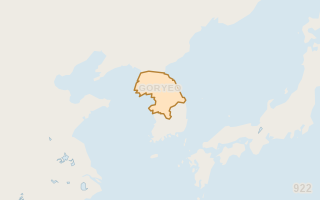
Goryeo began in 918, replacing Balhae and Unified Silla.↓ When the borders dataset first draws it, in 922, it held 81,700 km².↓

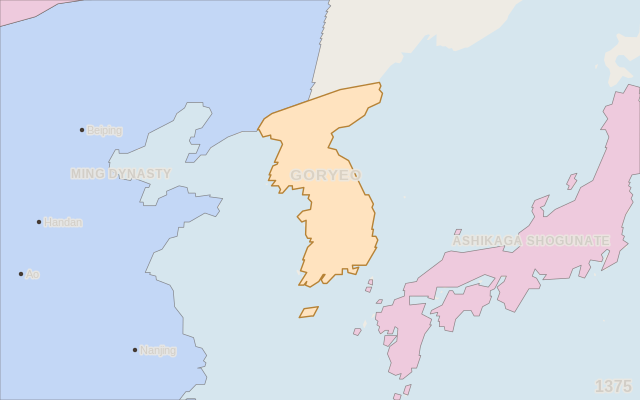
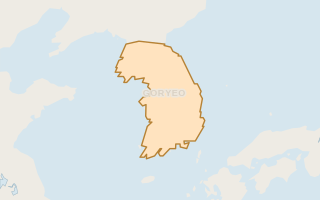
At its largest, in 1375, it held 208,100 km².↓ Its highest office was held by 3 rulers, covering 1274 – 1389, the median reign 23 years; 1 of 2 handovers was irregular.↓ The best known of them are Gongmin of Goryeo, U of Goryeo and Chungnyeol of Goryeo.↓ Most of the 12 rows the atlas files under it are people.↓

It was replaced by Joseon in 1392, 474 years after it began.↓

From Wikipedia’s article, retold · CC BY-SA 4.0

474 years

Longer than the Parthian Empire, shorter than the Roman Republic

208,000 km²

At its height in 1375 · about the size of Belarus

3 rulers

the monarch

4 wars and battles

More per century than 90% of states · 12 entries in all

Map: Goryeo in 1375, its borders in gold among its neighbours
Goryeo–Khitan War, 993 – 1022Mongol invasions of Korea, 1231 – 1270Sambyeolcho Rebellion, 1270 – 12731000110012001300
Beside it on the map in 1375: Ming dynasty, Ashikaga shogunate and Northern Yuan.How far it reached, year by year: its ground inside the borders Cliopatria draws (CC BY 4.0), measured on an equal-area grid; the map shows it at its largest, with the cities of the year.

The story

Five acts, 918 – 1392

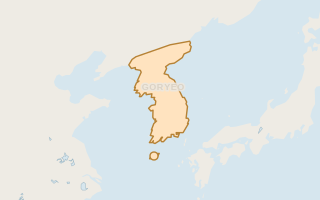
Goryeo in 992, at the end of act I
I918 – 993

Wang Kŏn unites the peninsula

Unlike Kung Ye, Taejo, Wang Kŏn, treats weakened Later Silla generously. In 927 CE Kyŏn Hwŏn of Later Baekje sacks its capital and routs Taejo near Daegu, but the balance swings to Goryeo, aided by Jurchen cavalry. The regional hojok lords stay strong until Gwangjong, king from 949 CE, frees the people they had enslaved, in 956 CE.

Watch this act on the live map, from 918
Goryeo in 1125, at the end of act II
II993 – 1126143,000 → 143,000 km²

Khitan wars and a golden age

The Khitans invade in 993 CE, and the Goryeo–Khitan War lasts until 1022. Victory over Liao brings a balance of power with Liao and Song, and a golden age: Buddhism reaches its height, and in the 11th century the capital alone has 70 temples. On the Yalu frontier Goryeo and Liao compete for the Jurchens' allegiance.

Watch this act on the live map, from 993
Goryeo in 1230, at the end of act III
III1126 – 1231143,000 → 143,000 km²

Clans, rebels and generals

The Inju Yi clan grows stronger than the throne; Yi Chagyŏm's coup of 1126 fails but weakens the monarch, and the nobles fall into civil war. In 1135 Myoch'ŏng, opposed by Kim Pusik, urges a move to Pyongyang and rebels. Generals shut out of command under King Uijong grow bitter. Khitans fleeing the Mongols invade in 1216.

Watch this act on the live map, from 1126
IV1231 – 1351

Under the Mongols and Yuan

Mongols under Ögedei Khan invade in 1231, and after nearly 30 years of war Goryeo swears allegiance but keeps its own royal line. From 1270 it is a semi-autonomous client of the Yuan dynasty, its kings married to Mongol princesses, and the Sambyeolcho Rebellion rages from 1270 to 1273. Goryeo sends women to Yuan as tribute.

Watch this act on the live map, from 1231
Goryeo in 1391, at the end of act V
V1351 – 1392

Gongmin's reforms and the fall

Gongmin purges pro-Mongol aristocrats and officers as Yuan crumbles, to be replaced by Ming in 1368. Goryeo repels the Red Turban Rebels and Japanese pirates. In 1388 King U and Ch'oe Yŏng send Yi Sŏnggye to invade Liaoning; he halts at the border and rebels, kills the last three kings and founds Joseon in 1392.

Watch this act on the live map, from 1351
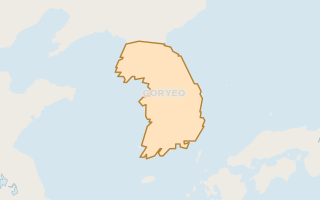
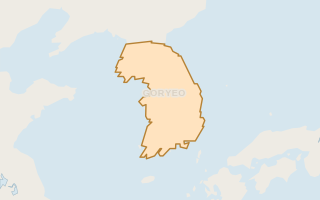
Goryeo in 1375, at its largestGoryeo in 922, first mapped
The rise and the fall in one frame: drag across it from 922, first mapped at 81,700 km², to 1375, at its largest at 208,100 km². Open the live map in 922 or 1375.

Before and after

Before it

After it

  • Joseon · replaced by · 1392 – 1897

Where it sits in time

3000 BCE2000 BCE1000 BCE110002000Balhae: 698 – 926Later Baekje: 892 – 936Taebong: 901 – 918Joseon: 1392 – 1897Goryeo: 918 – 1392

Five thousand years, 3000 BCE to 2026; the state in gold, what it replaced or followed and what replaced or followed it in grey.

Its people

Lives across Goryeo

1000110012001300
Statesmen and generalsAll its people on the timeline →

How it was governed

3 monarchs

3 monarchs on record, 1274 to 1389; a reign lasted 23 years at the median. Each bar is a reign, as long as it lasted.

Chungnyeol of Goryeo · 1274 – 1308 · died in office of natural causesGongmin of Goryeo · 1351 – 1374 · killedU of Goryeo · 1374 – 1389 · executed1000110012001300
How their terms ended, where it is known (3 of 3):Killed 2Died in office 1
Every term, with how it ended and its source

Rulers

How 3 reigns ended - choose one to show only those

How they died, where the record says: died of natural causes 1 · killed 1 · executed 1.

RulerReignLengthHow it ended · sourceTo the ruler before
13th century · 1 reign
Chungnyeol of Goryeo · aged 381274 – 130834 yearsdied in officeWikidata's manner of deathdied of natural causes
14th century · 2 reigns · 2 killed or removed
Gongmin of Goryeo · aged 211351 – 137423 yearskilled in officeWikidata's manner of death
U of Goryeo · aged 101374 – 138915 yearsexecutedWikidata's manner of deathchild

3 rulers, 3 with terms dated as terms, covering 1274 – 1389. Median reign 23 years. 1 of 2 handovers irregular - a killing, a deposition, a rival claimant, a rising or a coup beside it. A blank in the last column means no kin on record, which is coverage, never “unrelated”.

Flag or arms

  • Royal flag of Goryeo (Bong-gi)
    flag, undatedRoyal flag of Goryeo (Bong-gi) · Public domain

Its world

Rivals, and who else stood

Who it fought most

Wars and battles both took part in, on whichever side: the record names who took part, not who fought whom.

Meanwhile, elsewhere

The best-known states of other regions that stood while it did; the band is Goryeo’s own years.

100012001400

How it compares

Among 3,073 states

Stood longer than 84% of 3,073 states
Goryeo · 474 yearsParthian EmpireRoman RepublicHow long it stood, among the states with a recorded end or still standing.
Held more ground at its peak than 59% of 1,464 states
Goryeo · 208,100 km²BelarusUgandaThe most ground it held, among the states with a border in Cliopatria.
Had more wars on record per century than 90% of 3,073 states
Goryeo · 0.8Wars recorded per century, among the states, counting the wars the atlas hosts under each.

Why it fell

Why did Goryeo fall?

Historians still argue. Here is what the atlas records about its last century:

1389

U of Goryeo, killed in office

What led to it, and what came of it

Balhae · Linked · 698 – 926 · “Goryeo proceeded to incorporate a major portion of the Balhae people whose links to Goguryeo were shared with Goryeo, accepting most of their royalty and nobi…”BalhaeUnified Silla · Linked · 668 – 892Unified SillaLater Baekje · Linked · 892 – 936Later BaekjeTaebong · Linked · 901 – 918TaebongTaejo of Goryeo · Coincidence · 877 – 943Taejo of GoryeoGoryeo · 918 – 1392GoryeoJoseon · Linked · 1392 – 1897Joseon10001500
linkedcoincidence

Open the investigation: every row with its evidence, the conditions at the time, the theories condition by condition, and the succession analysed.

Its centuries in the record

900 – 999: 4 recorded — 2 wars and battles, 0 risings, regime changes and massacres, 2 other9001000 – 1099: 2 recorded — 1 wars and battles, 0 risings, regime changes and massacres, 1 other10001100 – 1199: 0 recorded — 0 wars and battles, 0 risings, regime changes and massacres, 0 other11001200 – 1299: 4 recorded — 1 wars and battles, 1 risings, regime changes and massacres, 2 other12001300 – 1399: 2 recorded — 0 wars and battles, 0 risings, regime changes and massacres, 2 other1300

Wars and battles in red, risings, coups and massacres beside them, everything else in grey, by the century each began in. A tall bar is partly a fact about Wikipedia: better-documented centuries hold more.

Each century’s own page:900 – 9991000 – 10991100 – 11991200 – 12991300 – 1399

Keep exploring

Share this page
Copy link
Embed the map
Cite this page

How this page is made

Drawn from Wikidata (Q28208, CC0), the opening and history of its English Wikipedia article retold by the atlas (CC BY-SA 4.0), borders from Cliopatria (CC BY 4.0), coast and rivers from Natural Earth, cities from Reba, Reitsma & Seto 2016 (CC BY 4.0), symbols from Wikimedia Commons, each under its own licence. Data built 2026-11-26 · Pastlas v2.47.1, by Oleh Voronko; the published atlas and its data are for non-commercial use.

How to read it

Areas are measured on an equal-area grid from borders simplified to about five kilometres. “c.” marks an approximate date, and a date known to the century is never printed to the year. Counts are what the atlas holds, and they follow Wikipedia’s coverage: a busy century is partly a fact about the record.

Something wrong?

Tell us and name the entry. We fix the data, not just this page.

Report a problem