People · Europe

Ostrogoths

455 – 499 · 44 years

One of two branches of the Goths: Hunnic vassals in Pannonia who followed Theodoric the Great into Italy and ruled from Ravenna.

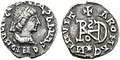
The Ostrogoths were a Germanic people, one of the two chief branches of the Goths beside the Visigoths. After Attila's Hunnic empire collapsed, the Amal dynasty rose to power among them in Pannonia. Backed by the emperor Zeno, Theodoric the Great led them into Italy, defeated Odoacer and in 493 CE founded a kingdom ruled from Ravenna, with separate systems for Goths and Romans.

What the record holds

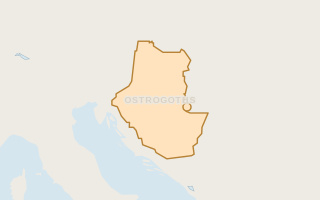
The record dates its beginning to 455.↑ Its borders are first mapped in 455, around 137,900 km².↓

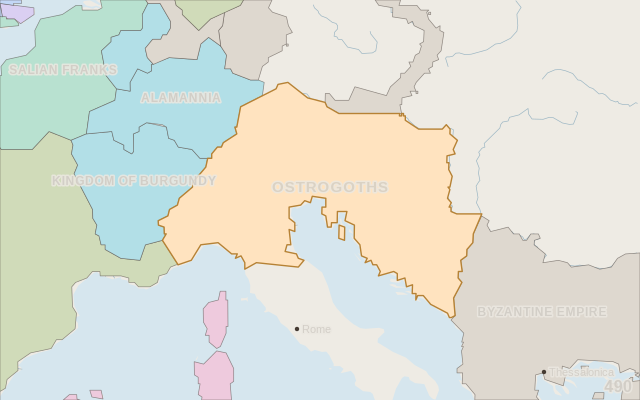
It reached its greatest extent in 490: 416,600 km².↓ Its line names a single ruler, covering 471 – 526.↓ It ended in 499, 44 years after it began.↑

From Wikipedia’s article, retold · CC BY-SA 4.0

44 years

Longer than East Germany, shorter than the German Empire

417,000 km²

At its height in 490 · about the size of Norway

1 ruler

the King of the Ostrogoths

1 war or battle

2 entries in all

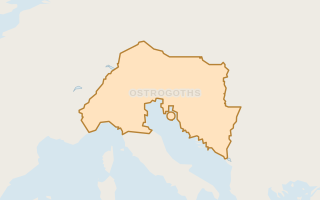
Map: Ostrogoths in 490, its borders in gold among its neighbours
460470480490
Beside it on the map in 490: Byzantine Empire, Visigothic Kingdom, Salian Franks, Kingdom of Burgundy, Alamannia and Thuringi.How far it reached, year by year: its ground inside the borders Cliopatria draws (CC BY 4.0), measured on an equal-area grid; the map shows it at its largest, with the cities of the year.

The story

Three acts, 455 – 499

Ostrogoths in 475, at the end of act I
I455 – 476138,000 → 138,000 km²

Out from under the Huns

With Attila's empire gone, the Pannonian Ostrogoths come under the Amal dynasty, while the Thracian Goths serve Aspar, the East Roman master of soldiers, until his killing in 471 CE. Theodoric, son of Theodemir, passes his childhood as a hostage in Constantinople.

Watch this act on the live map, from 455
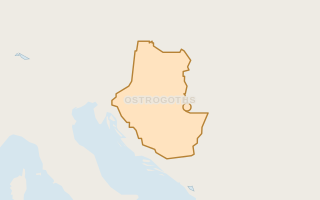
Ostrogoths in 489, at the end of act II
II476 – 490138,000 → 138,000 km²

Zeno and the rival Goths

In c. 476 CE the emperor Zeno drops Theoderic Strabo of the Thracian Goths and honours Theodoric the Amal instead, naming him patricius and recognising his federate kingdom on the Lower Danube. Zeno sets the two Gothic groups against each other in 478 CE, and years of intrigue and war follow.

Watch this act on the live map, from 476
Ostrogoths in 498, at the end of act III
III490 – 499417,000 → 417,000 km²

A kingdom in Italy

Backed by Zeno, Theodoric invades Italy. The Siege of Ravenna lasts three years; in 493 CE he defeats Odoacer and founds the Ostrogothic Kingdom, ruling from Ravenna and keeping Roman administration, law and culture in place.

Watch this act on the live map, from 490

Where it sits in time

3000 BCE2000 BCE1000 BCE110002000Ostrogoths: 455 – 499

Five thousand years, 3000 BCE to 2026; the state in gold.

How it was governed

Its rulers

1 king on record, 471 to 526; a reign lasted 55 years at the median. Each bar is a reign, as long as it lasted.

Theodoric the Great · 471 – 526 · no death date to read the end against460470480490
How their terms ended, where it is known (0 of 1):Not on record 1
Every term, with how it ended and its source

Rulers

RulerReignLengthHow it ended · sourceTo the ruler before
5th century · 1 reign
Theodoric the Great471 – 52655 yearsending not on recorddied of natural causes

1 ruler, 1 with terms dated as terms, covering 471 – 526. Median reign 55 years. A blank in the last column means no kin on record, which is coverage, never “unrelated”.

Its world

Rivals, and who else stood

Who it fought most

Wars and battles both took part in, on whichever side: the record names who took part, not who fought whom.

Meanwhile, elsewhere

The best-known states of other regions that stood while it did; the band is Ostrogoths’s own years.

460480500

How it compares

Among 3,073 states

Stood longer than 31% of 3,073 states
Ostrogoths · 44 yearsEast GermanyGerman EmpireHow long it stood, among the states with a recorded end or still standing.
Held more ground at its peak than 71% of 1,464 states
Ostrogoths · 416,600 km²UzbekistanNorwayThe most ground it held, among the states with a border in Cliopatria.

Why it fell

Why did Ostrogoths fall?

Historians still argue. Here is what the atlas records about its last century:

What led to it, and what came of it

Battle of the Catalaunian Plains · Linked · 451Battle of the Catalaunian PlainsAfrica · In the article · 146 BCE · “In 535, he commissioned Belisarius to attack the Ostrogoths following the success he had in North Africa against the Vandals.”AfricaOstrogoths · 455 – 499OstrogothsBattle of Barcelona · Linked · 512Battle of Barcelona1200400
in the articlelinked

Open the investigation: every row with its evidence, the conditions at the time, the theories condition by condition, and the succession analysed.

In the record

2 entries the atlas files under it, all in 400 – 499.

Keep exploring

Share this page
Copy link
Embed the map
Cite this page

How this page is made

Drawn from Wikidata (Q103122, CC0), the opening and history of its English Wikipedia article retold by the atlas (CC BY-SA 4.0), borders from Cliopatria (CC BY 4.0), coast and rivers from Natural Earth, cities from Reba, Reitsma & Seto 2016 (CC BY 4.0). Data built 2026-11-26 · Pastlas v2.47.1, by Oleh Voronko; the published atlas and its data are for non-commercial use.

How to read it

Areas are measured on an equal-area grid from borders simplified to about five kilometres. “c.” marks an approximate date, and a date known to the century is never printed to the year. Counts are what the atlas holds, and they follow Wikipedia’s coverage: a busy century is partly a fact about the record.

  • Wikidata records no founding for it; the borders dataset maps it from 455 to 499, and those are the years drawn here.

Something wrong?

Tell us and name the entry. We fix the data, not just this page.

Report a problem