Day of Thirst
battle · 724
State · South Asia
704 – 766 · 62 years
The record dates its beginning to 704.↑ Its borders are first mapped in 692, around 2.68 million km².↓
Its ground peaked in 724 at 4.03 million km².↓ Its highest office was held by 2 rulers, covering 699 – 766, the median reign 11.5 years; its one handover was regular.↓ Among them, Üç Elig Khagan and Ata Boyla Qaghan are the best known.↓ The atlas files 6 rows under it, wars and battles the largest group of them.↓ It ended in 766, 62 years after it began.↑
62 years
Longer than Hamburg, shorter than the Austrian Empire
4.03 million km²
At its height in 724 · a little larger than India
2 rulers
the Türgesh Kagans
3 wars and battles
6 entries in all
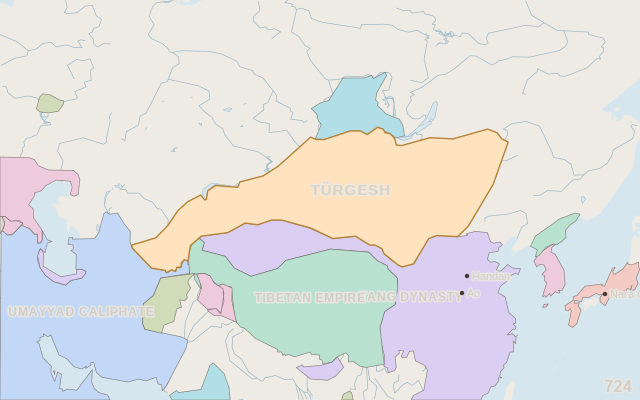
 Tang dynasty,
 Tibetan Empire, Yenisei Kyrgyz, Khazaria and Kabul Shahi.How far it reached, year by year: its ground inside the borders Cliopatria draws (CC BY 4.0), measured on an equal-area grid; the map shows it at its largest, with the cities of the year.
The story
The best-known wars, battles, risings and changes of regime the record files under it; a war within a war is folded into it.
battle · 724
battle · 729
battle · 731
Five thousand years, 3000 BCE to 2026; the state in gold.
Its people
One axis for everyone, so you can see who knew whom: the best-known, ordered by birth.
The best-known people the record files under it, by how many Wikipedias write about them.
How it was governed
2 kaganses on record, 699 to 766; a reign lasted 11.5 years at the median. Each bar is a reign, as long as it lasted.
Read from the state’s own English article and its rulers’ articles, where Wikidata names no ruler.
| Ruler | Reign | Length | How it ended · source | To the ruler before |
|---|---|---|---|---|
| 7th century · 1 reign | ||||
| Üç Elig Khagan | 699 – 706 | 7 years | ending not on record | |
| 8th century · 1 reign | ||||
| Ata Boyla Qaghan | 750 – 766 | 16 years | ending not on record | |
2 rulers, 2 with terms dated as terms, covering 699 – 766. Median reign 11.5 years. 0 of 1 handovers irregular - a killing, a deposition, a rival claimant, a rising or a coup beside it. A blank in the last column means no kin on record, which is coverage, never “unrelated”.
Its world
Wars and battles both took part in, on whichever side: the record names who took part, not who fought whom.
The best-known states of other regions that stood while it did; the band is Türgesh’s own years.
 RhodesMiddle East and North Africa
 United Provinces of New GranadaAmericas and Oceania
 San MarinoEuropeTang dynastyEast and Southeast Asia
How it compares
Each column is a share of the states; gold is Türgesh.
Why it fell
Historians still argue. Here is what the atlas records about its last century:
6 entries the atlas files under it, all in 700 – 799.
“Türgesh”, Pastlas, a historical atlas, 2026-11-26. https://app.pastlas.com/state/turgesh/
Drawn from Wikidata (Q1277895, CC0), borders from Cliopatria (CC BY 4.0), coast and rivers from Natural Earth, cities from Reba, Reitsma & Seto 2016 (CC BY 4.0). Data built 2026-11-26 · Pastlas v2.47.1, by Oleh Voronko; the published atlas and its data are for non-commercial use.
Areas are measured on an equal-area grid from borders simplified to about five kilometres. “c.” marks an approximate date, and a date known to the century is never printed to the year. Counts are what the atlas holds, and they follow Wikipedia’s coverage: a busy century is partly a fact about the record.