1969 race riots of Singapore
unrest · 31 May 1969
City-state · East and Southeast Asia
1965 – present · 61 years · still standing
Came after Singapore in Federation of Malaysia
An island republic expelled from Malaysia that grew, without natural resources, into one of the Four Asian Tigers.
Singapore is an island republic at the southern end of the Malay Peninsula, north of the equator. A British trading post from 1819 and a Crown colony after Japan's occupation, it won self-government in 1959 and joined Malaysia in 1963, only to be expelled two years later. Independent from 9 August 1965 under Prime Minister Lee Kuan Yew, it overcame turbulent early years and a lack of natural resources and grew into one of the Four Asian Tigers.
Its record opens in 1965, replacing the Singapore in Federation of Malaysia.↓ Its borders are first mapped in 1967, around 500 km².↓
The record names 11 rulers in its line, covering 1965 – 2023, the median reign 5.5 years; 1 of 12 handovers was irregular.↓ The best known of them are  Halimah Yacob,
 Tony Tan and
 Tharman Shanmugaratnam.↓ Most of the 20 rows the atlas files under it are people.↓
From Wikipedia’s article, retold · CC BY-SA 4.0
Best known for
61 years
Longer than Hamburg, shorter than the Austrian Empire
500 km²
At its height in 1967 · about the size of Malta
11 rulers
the President of Singapore
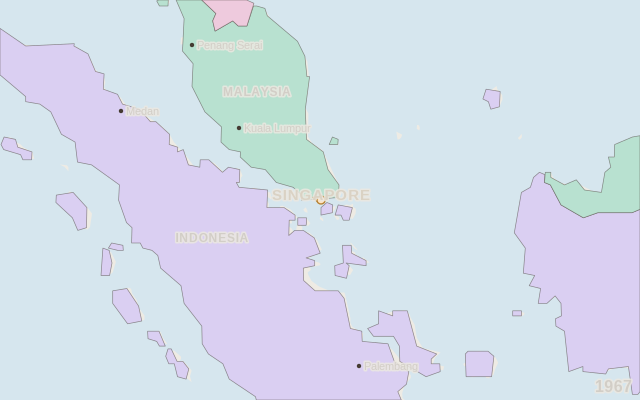
 Indonesia,
 Malaysia and
 Thailand.How far it reached, year by year: its ground inside the borders Cliopatria draws (CC BY 4.0), measured on an equal-area grid; the map shows it at its largest, with the cities of the year.
The story
The best-known wars, battles, risings and changes of regime the record files under it; a war within a war is folded into it.
unrest · 31 May 1969
treaty · 28 March 2006
treaty · 20 November 2007
unrest · 8 December 2013
The states the record files it as replacing or following, and those that replaced or followed it - Wikidata's own statements, each read from this state's side.
Five thousand years, 3000 BCE to 2026; the state in gold.
Its people
One axis for everyone, so you can see who knew whom: the best-known, ordered by birth.
 Benjamin Shearespresident · physician1907 – 1981
 Yusof Ishakpresident1910 – 1970
 Wee Kim Weepresident · diplomat1915 – 2005
 Lee Kuan Yewstatesperson · philosopher1923 – 2015
 Devan Nairpresident1923 – 2005
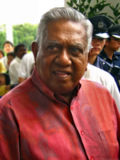 S. R. Nathanpresident · diplomat1924 – 2016
 Ong Teng Cheongpresident · architect1936 – 2002
 Tony Tanpresident · mathematician1940 – present
 Goh Chok Tongpolitician1941 – present
 Lee Hsien Loongpolitician · military officer1952 – present
 Halimah Yacobpresident1954 – present
 Tharman Shanmugaratnampresident1957 – present
 Lawrence Wongpolitician1972 – present
How it was governed
11 presidents on record, 1965 to 2023; a reign lasted 5.5 years at the median. Each bar is a reign, as long as it lasted.
The line of President of Singapore - the office this state names as its head of state.
| Ruler | Reign | Length | How it ended · source | To the ruler before |
|---|---|---|---|---|
| 20th century · 10 reigns | ||||
| Yusof Ishak · aged 55 | 1965 – 1970 | 5 years | died in officeWikidata's manner of deathdied of natural causes | |
| Punch Coomaraswamy · aged 43 | 1968 – 1968 | under a year | left office aliveread off the dates alone | |
| Yeoh Ghim Seng · aged 52 | 1970 – 1971 | 1 year | left office aliveread off the dates alonedied of natural causes | |
| Benjamin Sheares · aged 64 | 1971 – 1981 | 10 years | died in officeWikidata's manner of deathdied of natural causes | |
| Yeoh Ghim Seng · aged 63 | 1981 – 1981 | under a year | left office aliveread off the dates alonedied of natural causes | |
| Devan Nair · aged 58 | 1981 – 1985 | 4 years | resignedread from the ruler's own article | |
| Yeoh Ghim Seng · aged 67 | 1985 – 1985 | under a year | left office aliveread off the dates alonedied of natural causes | |
| Wee Kim Wee · aged 70 | 1985 – 1993 | 8 years | left office aliveread off the dates alonedied of natural causes | |
| Ong Teng Cheong · aged 57 | 1993 – 1999 | 6 years | resignedread from the ruler's own articledied of natural causes | |
| S. R. Nathan · aged 75 | 1999 – 2011 | 12 years | resignedread from the ruler's own articledied of natural causes | |
| 21st century · 3 reigns | ||||
| Tony Tan · aged 71 | 2011 – 2017 | 6 years | resignedread from the ruler's own article | |
| Halimah Yacob · aged 63 | 2017 – 2023 | 6 years | resignedread from the ruler's own article | |
| Tharman Shanmugaratnam · aged 66 | 2023 – in office | in office since 2023 | still in office | |
11 rulers, 11 with terms dated as terms, covering 1965 – 2023. Median reign 5.5 years. 1 of 12 handovers irregular - a killing, a deposition, a rival claimant, a rising or a coup beside it. The violent-handover count is withheld: power changed hands so often that any rising falls beside one (exposure 0.90, limit 0.6). A blank in the last column means no kin on record, which is coverage, never “unrelated”.
The line of Prime Minister of Singapore, drawn and never measured: a cabinet is not a reign.
 Lee Kuan Yew | 1959 – 1990 |
 Goh Chok Tong | 1990 – 2004 |
 Lee Hsien Loong | 2004 – 2024 |
 Lawrence Wong | 2024 – … |
Each symbol with the years its own statement gives; the timeline flies the one of the year on screen.

 S. R. Nathan12 yrsBenjamin Sheares10 yrsWee Kim Wee8 yrsHalimah Yacob6 yrsOng Teng Cheong6 yrs
Its world
Wars and battles both took part in, on whichever side: the record names who took part, not who fought whom.
 United KingdomOperation Prosperity Guardian2
 CanadaOperation Prosperity Guardian2
 United StatesOperation Prosperity Guardian2
The best-known states of other regions that stood while it did; the band is Singapore’s own years.
United StatesAmericas and Oceania MexicoAmericas and Oceania
 TurkeyMiddle East and North Africa
 ItalyEurope
 IndiaSouth Asia
 EgyptMiddle East and North Africa
 South AfricaSub-Saharan Africa
 RussiaEurope
How it compares
Each column is a share of the states; gold is Singapore.
How it began
Expelled from Malaysia, it became independent on 9 August 1965 as the Republic of Singapore, led by Prime Minister Lee Kuan Yew and President Yusof Ishak.
The investigation's own picture: 6 causes the record names and 0 results, the strongest six of each at their own years, joined to the state by the kind of claim - a recorded statement solid, the article's sentence dashed, a theory dash-dot.
Open the investigation: every row with its evidence, the conditions at the time, the theories condition by condition, and the succession analysed.
Wars and battles in red, risings, coups and massacres beside them, everything else in grey, by the century each began in. A tall bar is partly a fact about Wikipedia: better-documented centuries hold more.
Each century’s own page:1900 – 19992000 – 2099
“Singapore”, Pastlas, a historical atlas, 2026-11-26. https://app.pastlas.com/state/singapore/
Drawn from Wikidata (Q334, CC0), the opening and history of its English Wikipedia article retold by the atlas (CC BY-SA 4.0), borders from Cliopatria (CC BY 4.0), coast and rivers from Natural Earth, cities from Reba, Reitsma & Seto 2016 (CC BY 4.0), symbols from Wikimedia Commons, each under its own licence. Data built 2026-11-26 · Pastlas v2.47.1, by Oleh Voronko; the published atlas and its data are for non-commercial use.
Areas are measured on an equal-area grid from borders simplified to about five kilometres. “c.” marks an approximate date, and a date known to the century is never printed to the year. Counts are what the atlas holds, and they follow Wikipedia’s coverage: a busy century is partly a fact about the record.