State · Sub-Saharan Africa

Rhodesia

1965 – 1979 · 14 years

Became Zimbabwe Rhodesia

A white-ruled breakaway from the United Kingdom that fought to delay black majority rule, unrecognised and worn down by the Bush War.

Rhodesia came into being in 1965, when the white cabinet of the self-governing colony of Southern Rhodesia declared independence from the United Kingdom to put off black majority rule. It was never recognised, and the United Nations imposed a wide trade embargo. A republic from 1970, it fought the ZAPU and ZANU insurgents in the Rhodesian Bush War until Ian Smith conceded majority rule in 1978.

What the record holds

Its record opens in 1965.↑ In 1967, the first year its borders are mapped, it covered 393,600 km².↓

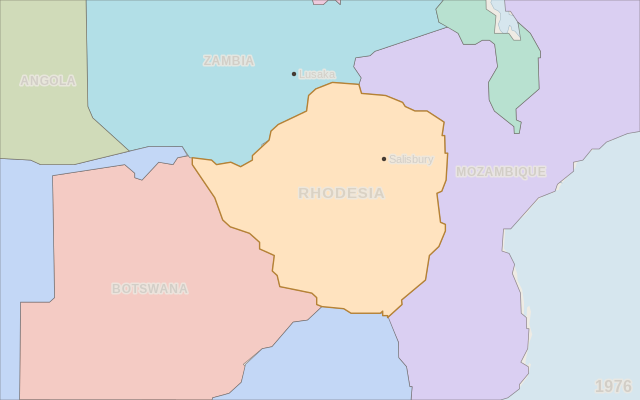
It reached its greatest extent in 1976: 394,000 km².↓ The record names 4 rulers in its line, covering 1970 – 1978; its one handover was regular.↓ The best known of them are Clifford Dupont and John Wrathall.↓ Most of the 6 rows the atlas files under it are people.↓

Zimbabwe Rhodesia replaced it in 1979, after 14 years.↓ Its end fits “Elite conflict” and “The five conditions of revolution”, every condition present.↓

From Wikipedia’s article, retold · CC BY-SA 4.0

14 years

Longer than Nazi Germany, shorter than the Weimar Republic

394,000 km²

At its height in 1976 · about the size of Zimbabwe

4 rulers

the President of Rhodesia

Map: Rhodesia in 1976, its borders in gold among its neighbours
197019711972197319741975
Beside it on the map in 1976: Mozambique, Botswana, Zambia, South Africa, Angola and Malawi.How far it reached, year by year: its ground inside the borders Cliopatria draws (CC BY 4.0), measured on an equal-area grid; the map shows it at its largest, with the cities of the year.

The story

Its key moments

Before and after

After it

Where it sits in time

3000 BCE2000 BCE1000 BCE110002000Zimbabwe Rhodesia: 1979 – 1979Rhodesia: 1965 – 1979

Five thousand years, 3000 BCE to 2026; the state in gold, what it replaced or followed and what replaced or followed it in grey.
Its people

Lives across Rhodesia

190019201940196019802000
Statesmen and generalsLived on after it endedAll its people on the timeline →

How it was governed

4 presidents

4 presidents on record, 1970 to 1978. Each bar is a reign, as long as it lasted.

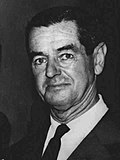
Clifford Dupont · 1970 – 1975 · left office aliveJohn Wrathall · 1976 – 1978 · died in office, manner not recorded196519701975
How their terms ended, where it is known (2 of 2):Died in office 1Left office alive 1
Every term, with how it ended and its source

Rulers

How 2 reigns ended - choose one to show only those
RulerReignLengthHow it ended · sourceTo the ruler before
20th century · 2 reigns
Clifford Dupont · aged 651970 – 19755 yearsleft office aliveread off the dates alone
John Wrathall · aged 631976 – 19782 yearsdied in officeread off the dates alone

4 rulers, 2 with terms dated as terms, covering 1970 – 1978. Only 8 years of the line are dated - too short for a median. 0 of 1 handovers irregular - a killing, a deposition, a rival claimant, a rising or a coup beside it. The violent-handover count is withheld: power changed hands so often that any rising falls beside one (exposure 0.78, limit 0.6). A blank in the last column means no kin on record, which is coverage, never “unrelated”.

Heads of government

The line of Prime Minister of Rhodesia, drawn and never measured: a cabinet is not a reign.

Winston Fieldlived 1904 – 1969
Edgar Whitehead1958 – 1962
Ian Smith1964 – 1979

Flags and arms, in order

  • Coat of arms of Southern Rhodesia (1924–1981)
    coat of arms, undatedCoat of arms of Southern Rhodesia (1924–1981) · Public domain
  • Flag of Rhodesia (1964–1968)
    flag, 1965 – 1968Flag of Rhodesia (1964–1968) · Public domain
  • Flag of Rhodesia (1968–1979)
    flag, 1968 – 1979Flag of Rhodesia (1968–1979) · Public domain

Its world

Who else stood

Meanwhile, elsewhere

The best-known states of other regions that stood while it did; the band is Rhodesia’s own years.

196019701980

How it compares

Among 3,073 states

Stood longer than 19% of 3,073 states
Rhodesia · 14 yearsNazi GermanyWeimar RepublicHow long it stood, among the states with a recorded end or still standing.
Held more ground at its peak than 70% of 1,464 states
Rhodesia · 394,000 km²GermanyParaguayThe most ground it held, among the states with a border in Cliopatria.

Why it fell

Why did Rhodesia fall?

Historians still argue. Here is what the atlas records about its last century:

What led to it, and what came of it

United Nations Security Council · In the article · 1945 · “Following the UDI, the United Nations Security Council passed resolution 216 which called upon all states to deny recognition and assistance to Rhodesia.”United Nations Security CouncilUnited States Secretary of State · In the article · 1789 · “In response to the initiative of United States Secretary of State Henry Kissinger, in 1976 Ian Smith accepted the principle of black majority rule within two …”United States Secretary of StateLancaster · In the article · 1730 · “Following the Lancaster House Agreement in 1979 and general elections held under a universal suffrage in 1980, the territory finally gained de jure independen…”LancasterHerbert Chitepo · Coincidence · 1923 – 1975Herbert ChitepoRhodesia · 1965 – 1979RhodesiaZimbabwe Rhodesia · Linked · 1979Zimbabwe Rhodesia17501800185019001950
in the articlelinkedcoincidence

Open the investigation: every row with its evidence, the conditions at the time, the theories condition by condition, and the succession analysed.

Theories that apply to its ending

  • Elite conflict

    Lachmann 2000 · Lachmann 2010

    Applies by its own logic: 2 of its 2 conditions held here (it needs all of them), and this is the kind of outcome it predicts — adverse regime change, unrest or the state's ending.

    • 2 or more elite groups in the regime's support, or a parliament met within 100 y — agrarian elites, the military (1979)
    • an elite group among the regime's opposition within 5 y, or an elite group left the regime's support over 10 y, or a monarch deposed or killed by others within 20 y, or overlapping reigns — rival claimants — within 20 y — business elites (1979)
  • The five conditions of revolution

    Goldstone 2014 · Goldstone 2001

    Applies by its own logic: 4 of its 5 conditions held here (it needs 4), and this is the kind of outcome it predicts — unrest, adverse regime change or the state's ending.

    • an elite group among the regime's opposition within 5 y, or an elite group left the regime's support over 10 y, or a monarch deposed or killed within 10 y, or overlapping reigns — rival claimants — within 10 y, or 2 or more reigns of two years or less within 10 y — business elites (1979)
    • mass mobilisation at 3 or more of 4 within 5 y, or a popular class among the regime's opposition within 5 y, or unrest within 5 y in the state — several large-scale and small-scale events (1974); urban working classes, urban middle classes, rural working classes (1974)
    • anti-system movements at 3 or more of 4 within 5 y — a very high level, a real and present threat (1974)
    • a foreign patron left the regime's support, or its foreign policy became its own, within 5 y — a foreign patron left the regime's support (1979)

In the record

6 entries the atlas files under it, all in 1900 – 1999.

Keep exploring

Share this page
Copy link
Embed the map
Cite this page

How this page is made

Drawn from Wikidata (Q217169, CC0), the opening and history of its English Wikipedia article retold by the atlas (CC BY-SA 4.0), borders from Cliopatria (CC BY 4.0), coast and rivers from Natural Earth, cities from Reba, Reitsma & Seto 2016 (CC BY 4.0), symbols from Wikimedia Commons, each under its own licence. Data built 2026-11-26 · Pastlas v2.47.1, by Oleh Voronko; the published atlas and its data are for non-commercial use.

How to read it

Areas are measured on an equal-area grid from borders simplified to about five kilometres. “c.” marks an approximate date, and a date known to the century is never printed to the year. Counts are what the atlas holds, and they follow Wikipedia’s coverage: a busy century is partly a fact about the record.

Something wrong?

Tell us and name the entry. We fix the data, not just this page.

Report a problem