State · East and Southeast Asia

Laos

1949 – present · 77 years · still standing

Southeast Asia's only landlocked country, a kingdom freed from French rule that civil war turned into a communist people's republic.

Laos, Southeast Asia's only landlocked country, has its capital at Vientiane. Unified under French rule in 1893, it won autonomy in 1949 and full independence in 1953 as a kingdom under Sisavang Vong. From 1959 the communist Pathet Lao, backed by North Vietnam, China and the Soviet Union, fought the royal army, which the United States supported, until in 1975 the Lao People's Revolutionary Party proclaimed a people's democratic republic.

What the record holds

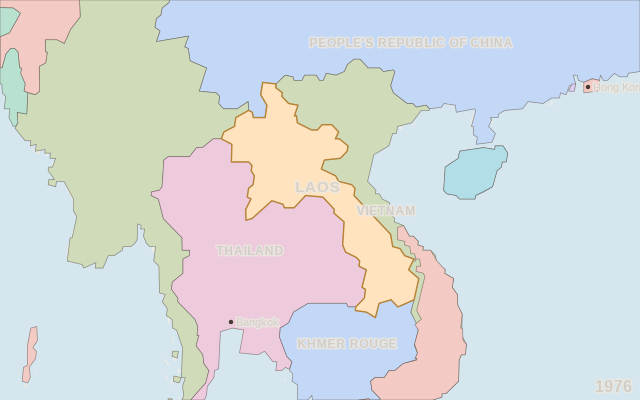
Its record opens in 1949.↑ Its borders are first mapped in 1976, around 230,000 km².↓

The record names 4 rulers in its line, covering 1992 – 2021; none of its 3 handovers was irregular.↓ The best known of them are Bounnhang Vorachit, Choummaly Sayasone and Thongloun Sisoulith.↓ Most of the 21 rows the atlas files under it are people.↓

From Wikipedia’s article, retold · CC BY-SA 4.0

77 years

Longer than Yugoslavia, shorter than the Empire of Japan

230,000 km²

At its height in 1976 · about the size of Romania

4 rulers

the General Secretary of the Lao People's Revolutionary Party

2 wars and battles

21 entries in all

Map: Laos in 1976, its borders in gold among its neighbours
2007 Laotian coup d'état conspiracy allegation, 20071980199020002010
Beside it on the map in 1976: People's Republic of China, Socialist Republic of the Union of Burma, Thailand, Vietnam, India and Taiwan.How far it reached, year by year: its ground inside the borders Cliopatria draws (CC BY 4.0), measured on an equal-area grid; the map shows it at its largest, with the cities of the year.

The story

Two acts, 1949 – present

I1949 – 1975

A kingdom at war

Autonomous from 1949 and independent from 1953, the kingdom survives France's defeat at Dien Bien Phu and the Geneva settlement of 1954. A National Union government formed by Prince Souvanna Phouma with the Pathet Lao fails, and by 1959 the country is in civil war, which ends only with the communist victory of 1975.

Watch this act on the live map, from 1949
II1975 – present

Rule of the Revolutionary Party

The Lao People's Revolutionary Party rules the new republic alone, its general secretaries following one another: Khamtai Siphandone from 1992, Choummaly Sayasone from 2006, Bounnhang Vorachit from 2016 and Thongloun Sisoulith from 2021. Laos takes its place in ASEAN and the World Trade Organization.

Watch this act on the live map, from 1975

Where it sits in time

3000 BCE2000 BCE1000 BCE110002000Laos: 1949 – 2026

Five thousand years, 3000 BCE to 2026; the state in gold.

Its people

Lives across Laos

19251950197520002025
Statesmen and generalsAll its people on the timeline →

How it was governed

4 secretaries

4 secretaries on record, 1992 to 2021. Each bar is a reign, as long as it lasted.

Khamtai Siphandone · 1992 – 2006 · resigned or stood down, the article saysChoummaly Sayasone · 2006 – 2016 · no death date to read the end againstBounnhang Vorachit · 2016 – 2021 · resigned or stood down, the article saysThongloun Sisoulith · 2021 – … · still in office1960198020002020
How their terms ended, where it is known (3 of 4):Left office alive 2In office 1Not on record 1
Every term, with how it ended and its source

Rulers

How 4 reigns ended - choose one to show only those
RulerReignLengthHow it ended · sourceTo the ruler before
20th century · 1 reign
Khamtai Siphandone · aged 681992 – 200614 yearsresignedread from the ruler's own article
21st century · 3 reigns
Choummaly Sayasone · aged 702006 – 201610 yearsending not on record
Bounnhang Vorachit · aged 792016 – 20215 yearsresignedread from the ruler's own article
Thongloun Sisoulith · aged 762021 – in officein office since 2021still in office

4 rulers, 4 with terms dated as terms, covering 1992 – 2021. Only 29 years of the line are dated - too short for a median. 0 of 3 handovers irregular - a killing, a deposition, a rival claimant, a rising or a coup beside it. The violent-handover count is withheld: power changed hands so often that any rising falls beside one (exposure 0.63, limit 0.6). A blank in the last column means no kin on record, which is coverage, never “unrelated”.

Formal heads of state and heads of government

The line of Prime Minister of Laos, drawn and never measured: a cabinet is not a reign.

Souvanna Phouma1951 – 1954
Souvanna Phouma1956 – 1958
Boun Oum1960 – 1962
Souvanna Phouma1960 – 1960
Souvanna Phouma1962 – 1975
Kaysone Phomvihane1975 – 1991
Souphanouvong1975 – 1991
Phoumi Vongvichit1986 – 1991
Khamtai Siphandone1991 – 1998
Kaysone Phomvihane1991 – 1992
Nouhak Phoumsavanh1992 – 1998
Sisavath Keobounphanh1998 – 2001
Khamtai Siphandone1998 – 2006
Bounnhang Vorachit2001 – 2006
Bouasone Bouphavanh2006 – 2010
Choummaly Sayasone2006 – 2016
Thongsing Thammavong2010 – 2016
Thongloun Sisoulith2016 – 2021
Bounnhang Vorachit2016 – 2021
Phankham Viphavanh2021 – 2022
Thongloun Sisoulith2021 – …
Sonexay Siphandone2022 – …

Flags and arms, in order

  • Flag of Laos
    flag, from 1945Flag of Laos · Public domain
  • Emblem of Laos (1991-2025)
    coat of arms, from 1991Emblem of Laos (1991-2025) · Public domain

Its world

Rivals, and who else stood

Who it fought most

Wars and battles both took part in, on whichever side: the record names who took part, not who fought whom.

Meanwhile, elsewhere

The best-known states of other regions that stood while it did; the band is Laos’s own years.

19401960198020002020

How it compares

Among 3,073 states

Stood longer than 41% of 3,073 states
Laos · 77 yearsYugoslaviaEmpire of JapanHow long it stood, among the states with a recorded end or still standing.
Held more ground at its peak than 61% of 1,464 states
Laos · 230,000 km²UgandaRomaniaThe most ground it held, among the states with a border in Cliopatria.

How it began

How did Laos begin?

What led to it, and what came of it

Indochina wars · Linked · 1946 – 1989Indochina warsUnited States · In the article · 1776 · “In response, the United States initiated an aerial bombing campaign against the PAVN positions, supported regular and irregular anti-communist forces in Laos,…”United StatesSisavang Vong · Coincidence · 1885 – 1959Sisavang VongPhetsarath Ratanavongsa · Coincidence · 1890 – 1959Phetsarath RatanavongsaSouvanna Phouma · Coincidence · 1901 – 1984Souvanna PhoumaSisavang Vatthana · Coincidence · 1907 – 1978Sisavang VatthanaLaos · 1949 – 2026Laos18001850190019502000
in the articlelinkedcoincidence

Open the investigation: every row with its evidence, the conditions at the time, the theories condition by condition, and the succession analysed.

Its centuries in the record

1900 – 1999: 19 recorded — 2 wars and battles, 2 risings, regime changes and massacres, 15 other19002000 – 2099: 2 recorded — 0 wars and battles, 1 risings, regime changes and massacres, 1 other2000

Wars and battles in red, risings, coups and massacres beside them, everything else in grey, by the century each began in. A tall bar is partly a fact about Wikipedia: better-documented centuries hold more.

Each century’s own page:1900 – 19992000 – 2099

Keep exploring

Share this page
Copy link
Embed the map
Cite this page

How this page is made

Drawn from Wikidata (Q819, CC0), the opening and history of its English Wikipedia article retold by the atlas (CC BY-SA 4.0), borders from Cliopatria (CC BY 4.0), coast and rivers from Natural Earth, cities from Reba, Reitsma & Seto 2016 (CC BY 4.0), symbols from Wikimedia Commons, each under its own licence. Data built 2026-11-26 · Pastlas v2.47.1, by Oleh Voronko; the published atlas and its data are for non-commercial use.

How to read it

Areas are measured on an equal-area grid from borders simplified to about five kilometres. “c.” marks an approximate date, and a date known to the century is never printed to the year. Counts are what the atlas holds, and they follow Wikipedia’s coverage: a busy century is partly a fact about the record.

  • Still standing: the span runs to the year of the build, 2026.

Something wrong?

Tell us and name the entry. We fix the data, not just this page.

Report a problem