State · Europe

Khanate of Kazan

1438 – 1552 · 114 years

Came after Great Horde · became Kazan Kingdom

A Tatar successor of the Golden Horde on the lands of Volga Bulgaria, which raided Muscovy and fell to Ivan the Terrible.

From 1438 to 1552 the Khanate of Kazan, a Tatar state ruled from the city of Kazan, held the old lands of Volga Bulgaria. These took in today's Tatarstan, Mari El, Chuvashia and Mordovia, with parts of Udmurtia and Bashkortostan. One of the Golden Horde's successor states, it raided Muscovy, fell under Moscow's protection, and in 1552 the Tsardom of Russia conquered it.

What the record holds

Its record opens in 1438, after the Great Horde.↓ Its borders are first mapped in 1440, around 170,000 km².↓

Its ground peaked in 1502 at 171,700 km².↓ Its line counts 13 rulers, covering 1438 – 1552, the median reign 3 years; 1 of 19 handovers was irregular.↓ The best known of them are Sahib I Giray, Ulugh Muhammad and Yadegar Mokhammad of Kazan.↓ Most of the 15 rows the atlas files under it are people.↓

Its own article says it was dissolved, in 1552.↓ In 1552, after 114 years, it was replaced by the Kazan Kingdom.↓ Its end fits “Dynastic cycle and the decay of group feeling”, every condition present.↓

From Wikipedia’s article, retold · CC BY-SA 4.0

Best known for

114 years

Longer than Nizhny Novgorod, shorter than the Maurya Empire

172,000 km²

At its height in 1502 · about the size of Uruguay

13 rulers

the Khan of the Tatar Kazan Khanate

1 war or battle

More per century than 90% of states · 15 entries in all

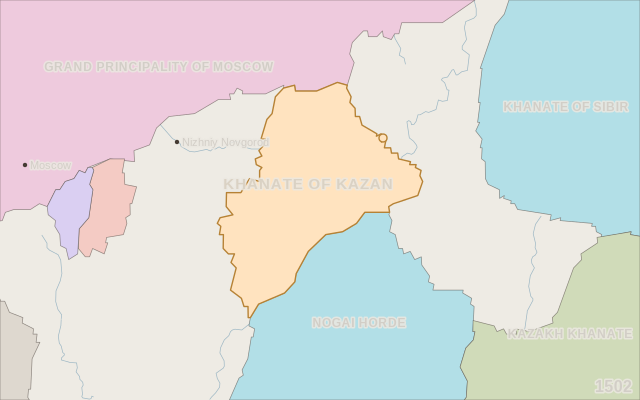
Map: Khanate of Kazan in 1502, its borders in gold among its neighbours
14601480150015201540
Beside it on the map in 1502: Grand Principality of Moscow, Khanate of Sibir, Nogai Horde, Kazakh Khanate, Qasim Khanate and Polish–Lithuanian union.How far it reached, year by year: its ground inside the borders Cliopatria draws (CC BY 4.0), measured on an equal-area grid; the map shows it at its largest, with the cities of the year.

The story

Three acts, 1438 – 1552

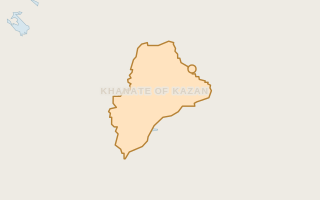
Khanate of Kazan in 1520, at the end of act II
II1487 – 1521170,000 → 172,000 km²

A protectorate of Moscow

In July 1487 Ivan III of Moscow takes Kazan and seats Möxämmädämin on its throne as his puppet. The khanate becomes Moscow's protectorate, and Russian merchants trade freely across it. Partisans of a Crimean and Ottoman union feed on popular grievances to stir revolts, the first in 1496. Its mapped lands reach their widest in 1502.

Watch this act on the live map, from 1487
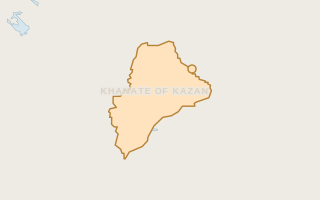
Khanate of Kazan in 1551, at the end of act III
III1521 – 1552172,000 → 172,000 km²

Revolts, regency and the siege

From 1521 Sahib I Giray and then Safa Giray hold the throne. Pro-Moscow nobles depose Safa Giray in a revolt of 1545, but with the Nogais' help he returns and executes 75 of them. He dies in 1549 and his three-year-old son becomes khan. In August 1552 Ivan the Terrible's forces besiege Kazan, and in October they storm it.

Watch this act on the live map, from 1521

Before and after

Before it

After it

  • Kazan Kingdom · replaced by

Where it sits in time

3000 BCE2000 BCE1000 BCE110002000Great Horde: 1433 – 1502Khanate of Kazan: 1438 – 1552

Five thousand years, 3000 BCE to 2026; the state in gold, what it replaced or followed and what replaced or followed it in grey.

Its people

Lives across the Khanate of Kazan

145015001550
Statesmen and generalsLived on after it endedAll its people on the timeline →

How it was governed

13 khans

13 khans on record, 1438 to 1552; a reign lasted 3 years at the median. Each bar is a reign, as long as it lasted.

Ulugh Muhammad · 1438 – 1445 · no death date to read the end againstMäxmüd of Kazan · 1445 – 1466 · no death date to read the end againstXälil of Kazan · 1466 – 1467 · no death date to read the end againstIbrahim of Kazan · 1467 – 1479 · no death date to read the end againstIlham Ghali of Kazan · 1479 – 1484 · no death date to read the end againstMöxämmät-Ämin · 1484 – 1485 · no death date to read the end againstIlham Ghali of Kazan · 1485 – 1487 · no death date to read the end againstMöxämmät-Ämin · 1487 – 1495 · no death date to read the end againstGhabdellatif of Kazan · 1496 – 1502 · no death date to read the end againstMöxämmät-Ämin · 1502 – 1518 · no death date to read the end againstShah-Ali · 1518 – 1521 · no death date to read the end againstSahib I Giray · 1521 – 1524 · no death date to read the end againstSafa Giray of Kazan · 1524 – 1531 · no death date to read the end againstDzhan-Ali of Kazan · 1532 – 1535 · deposed, the article saysSafa Giray of Kazan · 1535 – 1546 · no death date to read the end againstShah-Ali · 1546 – 1546 · no death date to read the end againstSafa Giray of Kazan · 1546 – 1549 · no death date to read the end againstUtameshgaray of Kazan · 1549 – 1551 · no death date to read the end againstShah-Ali · 1551 – 1552 · no death date to read the end againstYadegar Mokhammad of Kazan · 1552 – 1552 · no death date to read the end against144014601480150015201540
How their terms ended, where it is known (1 of 20):Deposed or removed 1Not on record 19
Every term, with how it ended and its source

Rulers

How 20 reigns ended - choose one to show only those
RulerReignLengthHow it ended · sourceTo the ruler before
15th century · 9 reigns
Ulugh Muhammad1438 – 14457 yearsending not on record
Mäxmüd of Kazan1445 – 146621 yearsending not on record
Xälil of Kazan1466 – 14671 yearending not on record
Ibrahim of Kazan1467 – 147912 yearsending not on record
Ilham Ghali of Kazan1479 – 14845 yearsending not on recordchild
Möxämmät-Ämin1484 – 14851 yearending not on recordsibling
Ilham Ghali of Kazan1485 – 14872 yearsending not on record
Möxämmät-Ämin1487 – 14958 yearsending not on recordsibling
Ghabdellatif of Kazan1496 – 15026 yearsending not on record
16th century · 11 reigns · 1 killed or removed
Möxämmät-Ämin1502 – 151816 yearsending not on record
Shah-Ali1518 – 15213 yearsending not on record
Sahib I Giray1521 – 15243 yearsending not on record
Safa Giray of Kazan1524 – 15317 yearsending not on record
Dzhan-Ali of Kazan1532 – 15353 yearsdeposedread from the ruler's own article
Safa Giray of Kazan1535 – 154611 yearsending not on record
Shah-Ali1546 – 1546under a yearending not on record
Safa Giray of Kazan1546 – 15493 yearsending not on record
Utameshgaray of Kazan1549 – 15512 yearsending not on record
Shah-Ali1551 – 15521 yearending not on record
Yadegar Mokhammad of Kazan1552 – 1552under a yearending not on record

13 rulers, 13 with terms dated as terms, covering 1438 – 1552. Median reign 3 years. 1 of 19 handovers irregular - a killing, a deposition, a rival claimant, a rising or a coup beside it. The violent-handover count is withheld: power changed hands so often that any rising falls beside one (exposure 0.69, limit 0.6). A blank in the last column means no kin on record, which is coverage, never “unrelated”.

Flag or arms

  • Banner of Kazan
    flag, undatedBanner of Kazan · CC BY 4.0 · HetmanTheResearcher

Its world

Who else stood

Meanwhile, elsewhere

The best-known states of other regions that stood while it did; the band is the Khanate of Kazan’s own years.

142514501475150015251550

How it compares

Among 3,073 states

Stood longer than 49% of 3,073 states
Khanate of Kazan · 114 yearsNizhny NovgorodMaurya EmpireHow long it stood, among the states with a recorded end or still standing.
Held more ground at its peak than 55% of 1,464 states
Khanate of Kazan · 171,700 km²TunisiaUruguayThe most ground it held, among the states with a border in Cliopatria.
Had more wars on record per century than 90% of 3,073 states
Khanate of Kazan · 0.9Wars recorded per century, among the states, counting the wars the atlas hosts under each.

Why it fell

Why did the Khanate of Kazan fall?

Historians still argue. Here is what the atlas records about its last century:

1535

Dzhan-Ali of Kazan, deposed or removed in office

How it ended, as its article says

Dissolved. Read from the article's section “lead” by its grammar; the claim is only that the article says so.

It was one of the successor states of the Golden Horde (Mongol state), and it came to an end when it was conquered by the Tsardom of Russia.

One sentence of the English Wikipedia article, CC BY-SA 4.0.

What led to it, and what came of it

Great Horde · Linked · 1433 – 1502Great HordeKhanate of Kazan · 1438 – 1552Khanate of KazanKazan Kingdom · Linked · 1552 – 1708Kazan Kingdom145015001550160016501700
linked

Open the investigation: every row with its evidence, the conditions at the time, the theories condition by condition, and the succession analysed.

Theories that apply to its ending

  • Dynastic cycle and the decay of group feeling

    Ibn Khaldun 1377 · Turchin & Nefedov 2009

    Applies by its own logic: the condition it names held here, and this is the kind of outcome it predicts — adverse regime change or the state's ending.

    • the state 90 to 160 years old — ageBand 114

Its centuries in the record

1400 – 1499: 8 recorded — 1 wars and battles, 0 risings, regime changes and massacres, 7 other14001500 – 1599: 7 recorded — 0 wars and battles, 0 risings, regime changes and massacres, 7 other1500

Wars and battles in red, risings, coups and massacres beside them, everything else in grey, by the century each began in. A tall bar is partly a fact about Wikipedia: better-documented centuries hold more.

Each century’s own page:1400 – 14991500 – 1599

Keep exploring

Share this page
Copy link
Embed the map
Cite this page

How this page is made

Drawn from Wikidata (Q186537, CC0), the opening and history of its English Wikipedia article retold by the atlas (CC BY-SA 4.0), borders from Cliopatria (CC BY 4.0), coast and rivers from Natural Earth, cities from Reba, Reitsma & Seto 2016 (CC BY 4.0), symbols from Wikimedia Commons, each under its own licence, and one sentence of the article, quoted. Data built 2026-11-26 · Pastlas v2.47.1, by Oleh Voronko; the published atlas and its data are for non-commercial use.

How to read it

Areas are measured on an equal-area grid from borders simplified to about five kilometres. “c.” marks an approximate date, and a date known to the century is never printed to the year. Counts are what the atlas holds, and they follow Wikipedia’s coverage: a busy century is partly a fact about the record.

  • Wikidata's English label: Khanate of Qazan.

Something wrong?

Tell us and name the entry. We fix the data, not just this page.

Report a problem