State · Europe

Grand Principality of Moscow

1263 – 1547 · 284 years

Came after Vladimir-Suzdal and Duchy of Moscow · became Tsardom of Russia

The appanage of Alexander Nevsky's youngest son, which grew by gathering tribute and Russian lands into a centralized Russian state.

The Grand Principality of Moscow, or Muscovy, began as the appanage given to Daniel, youngest son of Alexander Nevsky. Its princes rose as tribute collectors for the khan of the Golden Horde, won the seat of the Russian Orthodox Church for Moscow and outdid their rivals in Tver. Ivan III absorbed nearly every other Russian state and defeated the Tatars in 1480, laying the ground for Tsarist Russia.

What the record holds

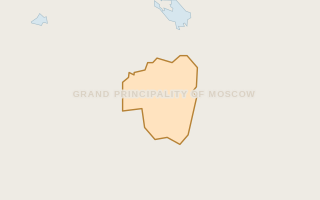
It was founded in 1263, replacing the Duchy of Moscow and the Period of Appanages.↓ When the borders dataset first draws it, in 1294, it held 10,200 km².↓ The Russo-Swedish War, 1495 – 1497, began with it holding 2.09 million km² and ended with 2.13 million km².↓

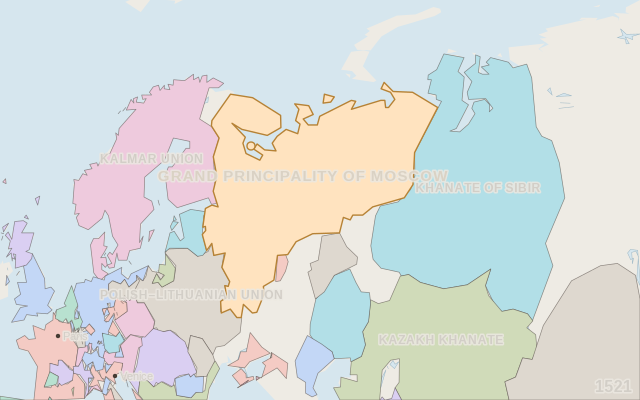
Its ground peaked in 1521 at 2.42 million km².↓ Its line counts 14 rulers, covering 1263 – 1505, the median reign 9.5 years; 7 of 15 handovers were irregular.↓ The best known of them are Ivan III of Russia, Dmitry Donskoy and Vasili III of Russia.↓ Most of the 26 rows the atlas files under it are people.↓

The Tsardom of Russia replaced it in 1547, after 284 years.↓

From Wikipedia’s article, retold · CC BY-SA 4.0

284 years

Longer than the Ming dynasty, shorter than the Tang dynasty

2.42 million km²

At its height in 1521 · about the size of Algeria

14 rulers

the Prince of Moscow

10 wars and battles

More per century than 95% of states · 26 entries in all

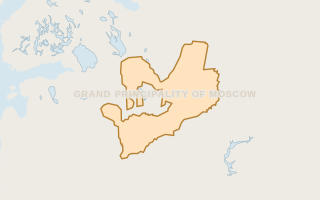
Map: Grand Principality of Moscow in 1521, its borders in gold among its neighbours
Battle of Kulikovo, 1380Siege of Moscow, 1382Great Stand on the Ugra River, 1480Russo-Swedish War (1495–1497), 1495 – 1497: 2.09 million km² → 2.13 million km²Russo-Crimean Wars, 1507 – 15721350140014501500
Beside it on the map in 1521: Khanate of Sibir, Kazakh Khanate, Kalmar Union, Polish–Lithuanian union, Nogai Horde and Kingdom of France.How far it reached, year by year: its ground inside the borders Cliopatria draws (CC BY 4.0), measured on an equal-area grid; the map shows it at its largest, with the cities of the year.

The story

Four acts, 1263 – 1547

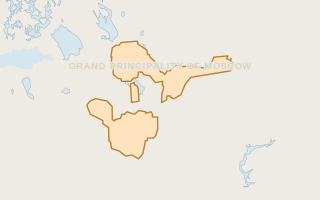
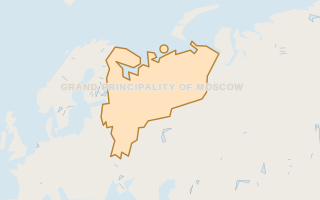
Grand Principality of Moscow in 1388, at the end of act II
II1325 – 138946,600 → 164,000 km²

Tribute, the Church and Kulikovo

Ivan I wins back the title, gathers the khan's tribute from other princes and grows rich; the seat of the Russian Orthodox Church moves to Moscow, and Tver is beaten. His sons Simeon and Ivan II keep the title. Dmitry joins the thrones of Vladimir and Moscow for good and defeats the Tatars in 1380.

Watch this act on the live map, from 1325
Grand Principality of Moscow in 1461, at the end of act III
III1389 – 1462164,000 → 316,000 km²

Tatar raids and civil war

Vasily I exploits strife in the Golden Horde to enlarge his domain, taking Nizhny Novgorod, but Tatar raids force him to pay tribute again. Vasily II, ten when he succeeds, survives a civil war begun by his uncle, Yury of Galich. In 1448 the Russian Church declares autocephaly, a freedom the fall of Constantinople confirms in 1453.

Watch this act on the live map, from 1389
Grand Principality of Moscow in 1546, at the end of act IV
IV1462 – 1547316,000 → 2.42 million km²

Gathering the Russian lands

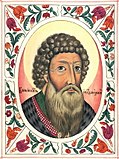
Ivan III gathers the Russian lands: his army beats Novgorod's in 1471, the city is annexed in 1478, and he styles himself sovereign of all Russia. His reign ends the appanage period. Vasily III adds Pskov in 1510, Smolensk in 1514 and Ryazan in 1521, and in 1547 the realm becomes the Tsardom of Russia.

Watch this act on the live map, from 1462
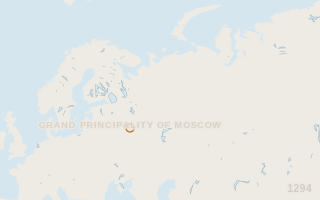
Grand Principality of Moscow in 1521, at its largestGrand Principality of Moscow in 1294, first mapped
The rise and the fall in one frame: drag across it from 1294, first mapped at 10,200 km², to 1521, at its largest at 2.42 million km². Open the live map in 1294 or 1521.

Before and after

Before it

  • Duchy of Moscow · replaces
  • Period of Appanages · replaces
  • Vladimir-Suzdal · follows · 1125 – 1389

After it

Where it sits in time

3000 BCE2000 BCE1000 BCE110002000Vladimir-Suzdal: 1125 – 1389Tsardom of Russia: 1547 – 1721Grand Principality of Moscow: 1263 – 1547

Five thousand years, 3000 BCE to 2026; the state in gold, what it replaced or followed and what replaced or followed it in grey.

Its people

Lives across the Grand Principality of Moscow

130014001500
Statesmen and generalsWriters, artists and thinkersLived on after it endedAll its people on the timeline →

How it was governed

14 princes

14 princes on record, 1263 to 1505; a reign lasted 9.5 years at the median. Each bar is a reign, as long as it lasted.

Daniel of Moscow · 1263 – 1303 · died in office, manner not recordedYury of Moscow · 1303 – 1325 · killedIvan I of Moscow · 1325 – 1340 · died in office, manner not recordedSimeon of Moscow · 1340 – 1353 · died in office of natural causesIvan II of Moscow · 1353 – 1359 · died in office, manner not recordedDmitry Donskoy · 1359 – 1389 · died a natural deathVasily I of Moscow · 1389 – 1425 · died a natural deathVasily II of Moscow · 1425 – 1433 · deposed or killedYury of Zvenigorod · 1433 – 1433 · deposed or killedVasily Kosoy · 1434 – 1434 · ended otherwise, as coded — neither deposed nor a natural deathVasily II of Moscow · 1434 – 1445 · deposed or killedDmitry Shemyaka · 1445 – 1445 · deposed or killedVasily II of Moscow · 1445 – 1446 · deposed or killedIvan III of Russia · 1452 – 1505 · died a natural deathDmitry Ivanovich · 1498 – 1502 · left office aliveVasili III of Russia · 1502 – 1505 · died a natural death13001350140014501500
a second row: a reign that began before the last had ended — rival claimants, or a shared throne
How their terms ended, where it is known (16 of 16):Killed 1Deposed or removed 5Died in office 8Left office alive 2
Every term, with how it ended and its source

Rulers

How 16 reigns ended - choose one to show only those

How they died, where the record says: died by accident 3 · killed 2 · died of natural causes 1.

RulerReignLengthHow it ended · sourceTo the ruler before
13th century · 1 reign
Daniel of Moscow · aged 21263 – 130340 yearsdied in officeread off the dates alone
14th century · 6 reigns · 1 killed or removed
Yury of Moscow · aged 221303 – 132522 yearskilled in officeWikidata's manner of deathchild
Ivan I of Moscow · aged 371325 – 134015 yearsdied in officeread off the dates alonesibling
Simeon of Moscow · aged 241340 – 135313 yearsdied in officeWikidata's manner of deathdied of natural causeschild
Ivan II of Moscow · aged 271353 – 13596 yearsdied in officeread off the dates alonesibling
Dmitry Donskoy · aged 91359 – 138930 yearsnatural deathcoded by Kokkonen & Sundellchild
Vasily I of Moscow · aged 171389 – 142536 yearsnatural deathcoded by Kokkonen & Sundellchild
15th century · 8 reigns · 5 killed or removed
Vasily II of Moscow · aged 101425 – 14338 yearsdeposed or killedcoded by Kokkonen & Sundelldied by accidentchild
Yury of Zvenigorod · aged 591433 – 1433under a yeardeposed or killedcoded by Kokkonen & Sundell
Vasily Kosoy · aged 131434 – 1434under a yearended otherwisecoded by Kokkonen & Sundellchild
Vasily II of Moscow · aged 191434 – 144511 yearsdeposed or killedcoded by Kokkonen & Sundelldied by accident
Dmitry Shemyaka1445 – 1445under a yeardeposed or killedcoded by Kokkonen & Sundellkilled
Vasily II of Moscow · aged 301445 – 14461 yeardeposed or killedcoded by Kokkonen & Sundelldied by accident
Ivan III of Russia · aged 121452 – 150553 yearsnatural deathcoded by Kokkonen & Sundellchild
Dmitry Ivanovich · aged 151498 – 15024 yearsleft office aliveread off the dates alonegrandchild
16th century · 1 reign
Vasili III of Russia · aged 231502 – 15053 yearsnatural deathcoded by Kokkonen & Sundell

14 rulers, 14 with terms dated as terms, covering 1263 – 1505. Median reign 9.5 years. 7 of 15 handovers irregular - a killing, a deposition, a rival claimant, a rising or a coup beside it. A blank in the last column means no kin on record, which is coverage, never “unrelated”.

Flags and arms, in order

  • Seal of Ivan 3 (obverse)
    coat of arms, undatedSeal of Ivan 3 (obverse) · Public domain
  • Seal of Ivan 3 (reverse)
    coat of arms, undatedSeal of Ivan 3 (reverse) · Public domain

Its world

Rivals, and who else stood

Who it fought most

Wars and battles both took part in, on whichever side: the record names who took part, not who fought whom.

Meanwhile, elsewhere

The best-known states of other regions that stood while it did; the band is the Grand Principality of Moscow’s own years.

130014001500

How it compares

Among 3,073 states

Stood longer than 71% of 3,073 states
Grand Principality of Moscow · 284 yearsMing dynastyTang dynastyHow long it stood, among the states with a recorded end or still standing.
Held more ground at its peak than 93% of 1,464 states
Grand Principality of Moscow · 2,419,200 km²AlgeriaKazakhstanThe most ground it held, among the states with a border in Cliopatria.
Had more wars on record per century than 95% of 3,073 states
Grand Principality of Moscow · 1.8Wars recorded per century, among the states, counting the wars the atlas hosts under each.

Why it fell

Why did the Grand Principality of Moscow fall?

Historians still argue. Here is what the atlas records about its last century:

2

wars and battles in its last century

×7.7

its land, between 1447 and 1546

What led to it, and what came of it

Vladimir-Suzdal · Linked · 1125 – 1389Vladimir-SuzdalPeriod of Appanages · Linked · 1150 – 1550Period of AppanagesDuchy of Moscow · Linked · 1213 – 1263Duchy of MoscowGrand Principality of Moscow · 1263 – 1547Grand Principality of MoscowTsardom of Russia · Linked · 1547 – 1721Tsardom of Russia120014001600
linked

Open the investigation: every row with its evidence, the conditions at the time, the theories condition by condition, and the succession analysed.

Its centuries in the record

1200 – 1299: 3 recorded — 0 wars and battles, 0 risings, regime changes and massacres, 3 other12001300 – 1399: 8 recorded — 3 wars and battles, 0 risings, regime changes and massacres, 5 other13001400 – 1499: 11 recorded — 5 wars and battles, 0 risings, regime changes and massacres, 6 other14001500 – 1599: 4 recorded — 2 wars and battles, 0 risings, regime changes and massacres, 2 other1500

Wars and battles in red, risings, coups and massacres beside them, everything else in grey, by the century each began in. A tall bar is partly a fact about Wikipedia: better-documented centuries hold more.

Each century’s own page:1200 – 12991300 – 13991400 – 14991500 – 1599

Keep exploring

Share this page
Copy link
Embed the map
Cite this page

How this page is made

Drawn from Wikidata (Q170770, CC0), the opening and history of its English Wikipedia article retold by the atlas (CC BY-SA 4.0), borders from Cliopatria (CC BY 4.0), coast and rivers from Natural Earth, cities from Reba, Reitsma & Seto 2016 (CC BY 4.0), symbols from Wikimedia Commons, each under its own licence. Data built 2026-11-26 · Pastlas v2.47.1, by Oleh Voronko; the published atlas and its data are for non-commercial use.

How to read it

Areas are measured on an equal-area grid from borders simplified to about five kilometres. “c.” marks an approximate date, and a date known to the century is never printed to the year. Counts are what the atlas holds, and they follow Wikipedia’s coverage: a busy century is partly a fact about the record.

  • ends in 1478 and 1547; the atlas draws the article's infobox.

Something wrong?

Tell us and name the entry. We fix the data, not just this page.

Report a problem