State · South Asia

Kazakh Khanate

1465 – 1847 · 382 years

Became Senior jüz

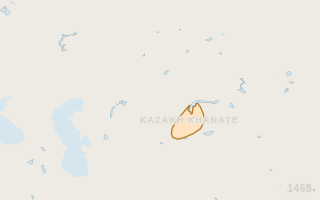
The record dates its beginning to 1465.↑ When the borders dataset first draws it, in 1468, it held 160,700 km².↓

Continue reading

Its ground peaked in 1595 at 2.65 million km².↓ Its line counts 19 rulers, covering 1465 – 1847, the median reign 10 years; 1 of 17 handovers was irregular.↓ The best known of them are Ablai Khan, Janibek Khan and Kerei Khan.↓ Most of the 20 rows the atlas files under it are people.↓

Senior jüz replaced it in 1847, after 382 years.↓

Best known for

382 years

Longer than Kyivan Rus', shorter than the Spanish Empire

2.65 million km²

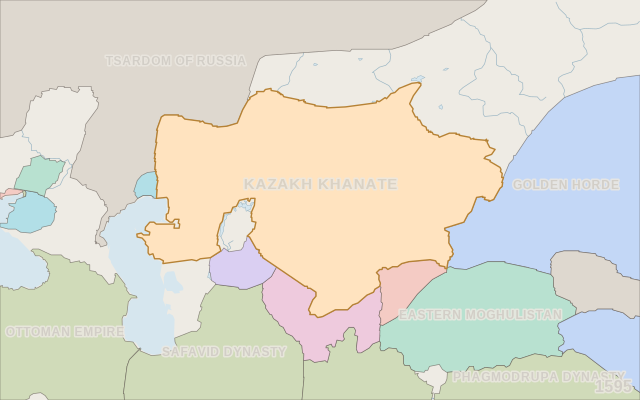
At its height in 1595 · about the size of Kazakhstan

19 rulers

the Kazakh khan

1 war or battle

20 entries in all

Map: Kazakh Khanate in 1595, its borders in gold among its neighbours
1500160017001800
Beside it on the map in 1595: Tsardom of Russia, Golden Horde, Ottoman Empire, Moghulistan, Safavid Iran and Phagmodrupa dynasty.How far it reached, year by year: its ground inside the borders Cliopatria draws (CC BY 4.0), measured on an equal-area grid; the map shows it at its largest, with the cities of the year.

The story

Its key moments

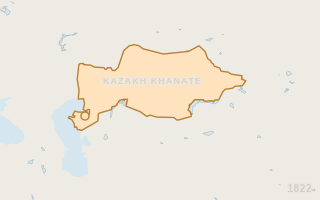
Kazakh Khanate in 1822, last mappedKazakh Khanate in 1468, first mapped
The rise and the fall in one frame: drag across it from 1468, first mapped at 160,700 km², to 1822, last mapped at 1.70 million km². Open the live map in 1468 or 1822.

Before and after

After it

  • Senior jüz · replaced by

Where it sits in time

3000 BCE2000 BCE1000 BCE110002000Kazakh Khanate: 1465 – 1847

Five thousand years, 3000 BCE to 2026; the state in gold.

Its people

Lives across the Kazakh Khanate

1500160017001800
Statesmen and generalsAll its people on the timeline →

How it was governed

19 khans

19 khans on record, 1465 to 1847; a reign lasted 10 years at the median. Each bar is a reign, as long as it lasted.

Kerei Khan · 1465 – 1473 · died in office, manner not recordedJanibek Khan · 1473 – 1480 · died in office, manner not recordedBurunduk Khan · 1480 – 1511 · died in office, manner not recordedKasym Khan · 1511 – 1521 · died in office, manner not recordedMamash Khan · 1521 – 1523 · the term ends after the recorded deathTaiyr Khan · 1523 – 1533 · died in office, manner not recordedHaqnazar Khan · 1538 – 1580 · died in office, manner not recordedShigay Khan · 1580 – 1582 · died in office, manner not recordedTevkel Khan · 1582 – 1598 · died in office, manner not recordedEsim Khan · 1598 – 1628 · died in office, manner not recordedZhanibek II · 1628 – 1643 · died in office, manner not recordedSalqam Jangir Khan · 1643 – 1652 · died in office, manner not recordedBatyr Khan · 1652 – 1680 · died in office, manner not recordedTauke Khan · 1680 – 1715 · deposed, the article saysKaip Khan · 1715 – 1718 · left office aliveBolat Khan · 1718 – 1729 · died in office, manner not recordedAblai Khan · 1771 – 1781 · died in office, manner not recordedKenesary Qasymuly · 1841 – 1847 · killed, the article says1500160017001800
How their terms ended, where it is known (17 of 18):Killed 1Deposed or removed 1Died in office 14Left office alive 1Not on record 1
Every term, with how it ended and its source

Rulers

How 18 reigns ended - choose one to show only those
RulerReignLengthHow it ended · sourceTo the ruler before
15th century · 3 reigns
Kerei Khan · aged 401465 – 14738 yearsdied in officeread off the dates alone
Janibek Khan · aged 451473 – 14807 yearsdied in officeread off the dates alone
Burunduk Khan1480 – 151131 yearsdied in officeread off the dates alone
16th century · 7 reigns
Kasym Khan · aged 661511 – 152110 yearsdied in officeread off the dates alone
Mamash Khan1521 – 15232 yearsdates disagreeread off the dates alonechild
Taiyr Khan1523 – 153310 yearsdied in officeread off the dates alone
Haqnazar Khan · aged 291538 – 158042 yearsdied in officeread off the dates alone
Shigay Khan · aged 801580 – 15822 yearsdied in officeread off the dates alone
Tevkel Khan · aged 201582 – 159816 yearsdied in officeread off the dates alonechild
Esim Khan · aged 331598 – 162830 yearsdied in officeread off the dates alonesibling
17th century · 4 reigns · 1 killed or removed
Zhanibek II · aged 361628 – 164315 yearsdied in officeread off the dates alonechild
Salqam Jangir Khan · aged 331643 – 16529 yearsdied in officeread off the dates alonesibling
Batyr Khan1652 – 168028 yearsdied in officeread off the dates alone
Tauke Khan · aged 451680 – 171535 yearsdeposedread from the ruler's own article
18th century · 3 reigns
Kaip Khan · aged 501715 – 17183 yearsleft office aliveread off the dates alone
Bolat Khan1718 – 172911 yearsdied in officeread off the dates alone
Ablai Khan · aged 601771 – 178110 yearsdied in officeread off the dates alone
19th century · 1 reign · 1 killed or removed
Kenesary Qasymuly · aged 401841 – 18476 yearskilledread from the ruler's own article

19 rulers, 18 with terms dated as terms, covering 1465 – 1847. Median reign 10 years. 1 of 17 handovers irregular - a killing, a deposition, a rival claimant, a rising or a coup beside it. A blank in the last column means no kin on record, which is coverage, never “unrelated”.

The line also names one holder with a page of their own whose term the record gives no first year, so the table cannot place it: Abilmambet Khan.

Flag or arms

  • Tamga of the Töre dynasty
    tamga, undatedTamga of the Töre dynasty · CC0

Its world

Who else stood

Meanwhile, elsewhere

The best-known states of other regions that stood while it did; the band is the Kazakh Khanate’s own years.

15001600170018001900

How it compares

Among 3,073 states

Stood longer than 79% of 3,073 states
Kazakh Khanate · 382 yearsKyivan Rus'Spanish EmpireHow long it stood, among the states with a recorded end or still standing.
Held more ground at its peak than 94% of 1,464 states
Kazakh Khanate · 2,645,400 km²KazakhstanArgentinaThe most ground it held, among the states with a border in Cliopatria.

Why it fell

Why did the Kazakh Khanate fall?

Historians still argue. Here is what the atlas records about its last century:

1847

Kenesary Qasymuly, killed in office

What led to it, and what came of it

Jani Beg · In the article · 1350 · “The khan's domain consisted of the appanages of five sons of Jochi—Orda, Udur, Tuqa-Timur, Shingkum, and Singkum. Following the death of Jani Beg in 1357, the…”Jani BegJochi · In the article · 1182 · “Following the annexation of Khwarazm, the Ulus of Jochi expanded westward as far as the Ural River. After Jochi's death in 1227, his ulus passed, in accordanc…”JochiGolden Horde · In the article · 1243 · “The Kazakh Khanate was formed as a result of the disintegration of the Golden Horde, or Ulus of Jochi, which had originally been a ulus of the Mongol Empire.”Golden HordeKazakh Khanate · 1465 – 1847Kazakh Khanate1200140016001800
in the article

Open the investigation: every row with its evidence, the conditions at the time, the theories condition by condition, and the succession analysed.

Its centuries in the record

1400 – 1499: 5 recorded — 1 wars and battles, 0 risings, regime changes and massacres, 4 other14001500 – 1599: 7 recorded — 0 wars and battles, 0 risings, regime changes and massacres, 7 other15001600 – 1699: 5 recorded — 0 wars and battles, 0 risings, regime changes and massacres, 5 other16001700 – 1799: 2 recorded — 0 wars and battles, 0 risings, regime changes and massacres, 2 other17001800 – 1899: 1 recorded — 0 wars and battles, 0 risings, regime changes and massacres, 1 other1800

Wars and battles in red, risings, coups and massacres beside them, everything else in grey, by the century each began in. A tall bar is partly a fact about Wikipedia: better-documented centuries hold more.

Each century’s own page:1400 – 14991500 – 15991600 – 16991700 – 17991800 – 1899

Keep exploring

Share this page
Copy link
Embed the map
Cite this page

How this page is made

Drawn from Wikidata (Q1433867, CC0), borders from Cliopatria (CC BY 4.0), coast and rivers from Natural Earth, cities from Reba, Reitsma & Seto 2016 (CC BY 4.0), symbols from Wikimedia Commons, each under its own licence. Data built 2026-11-26 · Pastlas v2.47.1, by Oleh Voronko; the published atlas and its data are for non-commercial use.

How to read it

Areas are measured on an equal-area grid from borders simplified to about five kilometres. “c.” marks an approximate date, and a date known to the century is never printed to the year. Counts are what the atlas holds, and they follow Wikipedia’s coverage: a busy century is partly a fact about the record.

  • Wikidata records foundings in 1445 and 1456 and 1458 and 1465; the atlas draws the article's infobox.

Something wrong?

Tell us and name the entry. We fix the data, not just this page.

Report a problem