Polish–Cossack–Tatar War
war · 1666 – 1671
Ground held: 120,700 km² → 120,300 km²
State · Europe
Its record opens in the 1550s, replacing  Cossack Hetmanate.↓ Its borders are first mapped in 1662, around 120,700 km².↓ Over the years of the Russo-Turkish War, 1676 – 1681, its ground went from 119,400 km² to 120,000 km².↓
Its line counts 91 rulers, covering 1579 – 1764, the median reign 2.5 years; 7 of 20 handovers were irregular.↓ The best known of them are  Bohdan Khmelnytsky,
 Ivan Mazepa and
 Ivan Vyhovsky.↓ Most of the 22 rows the atlas files under it are people.↓
Its own article says it was dissolved by Catherine, in 1775.↓
Best known for
223 years
Longer than the Achaemenid Empire, shorter than the Polish–Lithuanian Commonwealth
121,000 km²
At its height in 1662 · about the size of Greece
91 rulers
the Hetman of Zaporizhian Host
4 wars and battles
More per century than 90% of states · 22 entries in all
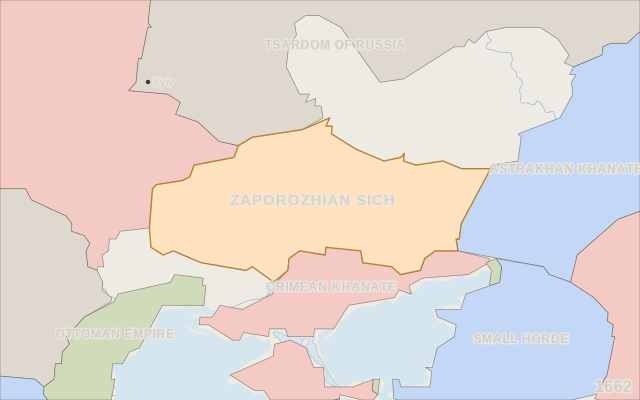
 Polish–Lithuanian Commonwealth,
 Tsardom of Russia, Astrakhan Khanate, Nogai Horde,
 Crimean Khanate and
 Principality of Moldavia.How far it reached, year by year: its ground inside the borders Cliopatria draws (CC BY 4.0), measured on an equal-area grid; the map shows it at its largest, with the cities of the year.
The story
The best-known wars, battles, risings and changes of regime the record files under it; a war within a war is folded into it.
war · 1666 – 1671
Ground held: 120,700 km² → 120,300 km²
war · 1676 – 1681
Ground held: 119,400 km² → 120,000 km²
battle · 20 September 1708
battle · 8 July 1709
treaty · 12 July 1709
The states the record files it as replacing or following, and those that replaced or followed it - Wikidata's own statements, each read from this state's side.
Cossack Hetmanate · replaces · 1648 – 1764Five thousand years, 3000 BCE to 2026; the state in gold, what it replaced or followed and what replaced or followed it in grey.
Its people
One axis for everyone, so you can see who knew whom: the best-known, ordered by birth.
 Mykhailo Doroshenkopolitician1505 – 1628
 Samuel Zborowskimilitary personnel1520 – 1584
 Hryhoriy Lobodamilitary leader · diplomat1557 – 1596
 Severyn Nalyvaikoruler1560 – 1597
 Petro Konashevych-Sahaidachnymilitary leader · politician1582 – 1622
 Paisius Velichkovskyreligious leader
How it was governed
91 hetmen on record, 1579 to 1764; a reign lasted 2.5 years at the median. Each bar is a reign, as long as it lasted.
The line of Hetman of Zaporizhian Host.
| Ruler | Reign | Length | How it ended · source | To the ruler before |
|---|---|---|---|---|
| 16th century · 3 reigns | ||||
| Ostafi Ruzhynsky | 1579 – 1586 | 7 years | left office aliveread off the dates alone | |
| Michał Iwanowicz Rożyński | 1579 – 1586 | 7 years | left office aliveread off the dates alone | sibling |
| Wojciech Czanowiecki | 1590 – 1590 | under a year | ending not on record | |
| 17th century · 15 reigns · 2 killed or removed | ||||
| Ivan Kutskovych | 1602 – 1603 | 1 year | ending not on record | |
| Marko Zhmaylo | 1625 – 1625 | under a year | deposedread from the ruler's own article | |
 Bohdan Khmelnytsky · aged 53 | 1648 – 1657 | 9 years | died in officeWikidata's manner of deathdied of natural causes | |
 Yurii Khmelnytsky · aged 16 | 1657 – 1657 | under a year | left office aliveread off the dates aloneexecuted | child |
 Ivan Vyhovsky · aged 49 | 1657 – 1659 | 2 years | left office aliveread off the dates alone | |
| Yurii Khmelnytsky · aged 18 | 1659 – 1660 | 1 year | left office aliveread off the dates aloneexecuted | |
 Pavlo Teteria · aged 43 | 1663 – 1665 | 2 years | left office aliveread off the dates alone | |
 Ivan Briukhovetsky · aged 40 | 1663 – 1668 | 5 years | died in officeread off the dates alone | |
| Levko Shkura | 1665 – 1665 | under a year | ending not on record | |
 Petro Doroshenko · aged 41 | 1668 – 1669 | 1 year | left office aliveread off the dates alone | |
 Demian Mnohohrishny · aged 48 | 1669 – 1672 | 3 years | left office aliveread off the dates alone | |
 Ivan Samoylovych · aged 42 | 1672 – 1687 | 15 years | left office aliveread off the dates alone | |
 George Ducas · aged 61 | 1681 – 1683 | 2 years | left office aliveread off the dates alone | |
 Ivan Mazepa · aged 48 | 1687 – 1708 | 21 years | exiledread from the ruler's own article | |
| Hryhorii Sahaidachnyi | 1687 – — | no end recorded | ending not on record | |
| 18th century · 3 reigns | ||||
 Pylyp Orlyk · aged 38 | 1710 – 1742 | 32 years | died in officeread off the dates alone | |
 Danylo Apostol · aged 73 | 1727 – 1734 | 7 years | died in officeWikidata's manner of deathdied of natural causes | |
 Kirill Razumovsky · aged 22 | 1750 – 1764 | 14 years | left office aliveread off the dates alone | |
91 rulers, 20 with terms dated as terms, covering 1579 – 1764. Median reign 2.5 years. 7 of 20 handovers irregular - a killing, a deposition, a rival claimant, a rising or a coup beside it. A blank in the last column means no kin on record, which is coverage, never “unrelated”.
The line also names 4 holders with a page of their own whose term the record gives no first year, so the table cannot place them: Yakym Somko, Ivan Skoropadsky, Pavlo Polubotok, Ivan Pidkova.
Pylyp Orlyk32 yrsIvan Mazepa21 yrsIvan Samoylovych15 yrsKirill Razumovsky14 yrsBohdan Khmelnytsky9 yrsIts world
The best-known states of other regions that stood while it did; the band is Zaporozhian Sich’s own years.
 KathmanduSouth Asia
 Ottoman EmpireMiddle East and North Africa
 BruneiEast and Southeast Asia
 JoseonEast and Southeast Asia
 HaudenosauneeAmericas and Oceania
 Mughal EmpireSouth Asia
 MoroccoMiddle East and North Africa
 DahomeySub-Saharan Africa
How it compares
Each column is a share of the states; gold is Zaporozhian Sich.
Why it fell
Historians still argue. Here is what the atlas records about its last century:
2
wars and battles in its last century
1708
Ivan Mazepa, deposed or removed in office
Dissolved by Catherine, 1775-08-03. Read from the article's section “History - Destruction and aftermath” by its grammar; the claim is only that the article says so.
The Sich was officially disbanded by the 3 August 1775 manifesto of Catherine, "On the Liquidation of Zaporozhian Sich and Annexation thereof to Novorossiya Governorate", and the Sich was razed to the ground.
One sentence of the English Wikipedia article, CC BY-SA 4.0.
Wars and battles in red, risings, coups and massacres beside them, everything else in grey, by the century each began in. A tall bar is partly a fact about Wikipedia: better-documented centuries hold more.
Each century’s own page:1500 – 15991600 – 16991700 – 1799
“Zaporozhian Sich”, Pastlas, a historical atlas, 2026-11-26. https://app.pastlas.com/state/zaporozhian-sich/
Drawn from Wikidata (Q2418795, CC0), borders from Cliopatria (CC BY 4.0), coast and rivers from Natural Earth, cities from Reba, Reitsma & Seto 2016 (CC BY 4.0), and one sentence of the article, quoted. Data built 2026-11-26 · Pastlas v2.47.1, by Oleh Voronko; the published atlas and its data are for non-commercial use.
Areas are measured on an equal-area grid from borders simplified to about five kilometres. “c.” marks an approximate date, and a date known to the century is never printed to the year. Counts are what the atlas holds, and they follow Wikipedia’s coverage: a busy century is partly a fact about the record.