State · Sub-Saharan Africa

Togo

1960 – present · 66 years · still standing

Came after French Togoland

A narrow West African republic on the Gulf of Guinea, ruled for 38 years by Gnassingbé Eyadéma and then by his son.

Togo is a small tropical country of West Africa, less than 115 km wide, stretching north from Lomé on the Gulf of Guinea. Germany made it the protectorate of Togoland in 1884; after World War I it passed to France, from which it gained independence in 1960. Gnassingbé Eyadéma seized power in 1967, built an anti-communist single-party state, and held the presidency for 38 years, winning irregular multiparty elections from 1993. His son Faure Gnassingbé was elected in 2005.

What the record holds

Togo began in 1960, after French Togoland.↓ When the borders dataset first draws it, in 1960, it held 56,700 km².↓

Its highest office was held by 8 rulers, covering 1963 – 2025, the median reign under a year; 5 of 5 handovers were irregular.↓ The best known of them are Faure Gnassingbé, Gnassingbé Eyadéma and Nicolas Grunitzky.↓ Most of the 24 rows the atlas files under it are people.↓

From Wikipedia’s article, retold · CC BY-SA 4.0

66 years

Longer than Bremen, shorter than the Soviet Union

56,700 km²

At its height in 1960 · about the size of Costa Rica

8 rulers

the President of Togo

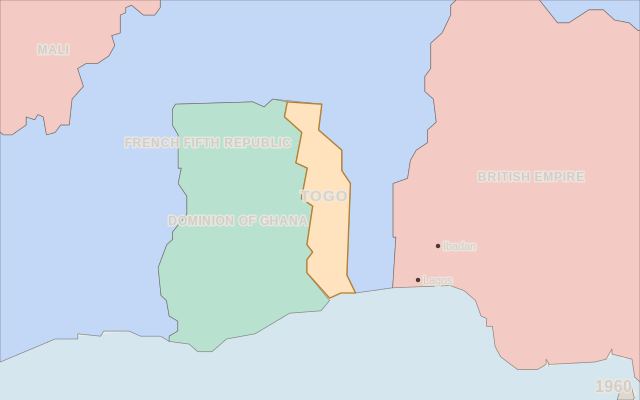
Map: Togo in 1960, its borders in gold among its neighbours
1963 Togolese coup d'état, 19631967 Togolese coup d'état, 19672005 Togolese coup d'état, 20051960197019801990200020102020
Beside it on the map in 1960: French Fifth Republic, British Empire, Dominion of Ghana, Mali and Francoist Spain.How far it reached, year by year: its ground inside the borders Cliopatria draws (CC BY 4.0), measured on an equal-area grid; the map shows it at its largest, with the cities of the year.

The story

Three acts, 1960 – present

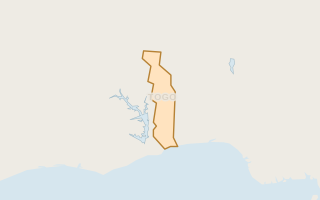
Togo in 1966, at the end of act I
I1960 – 196756,700 → 56,700 km²

Olympio and the first coups

The republic is proclaimed on 27 April 1960. Sylvanus Olympio becomes the first president in 1961 in a vote the opposition boycotts; opposition leaders are arrested and their parties dissolved. Olympio seeks partners beyond France. A coup comes in 1963, the year of his death; Nicolas Grunitzky is president until another coup in 1967.

Watch this act on the live map, from 1960
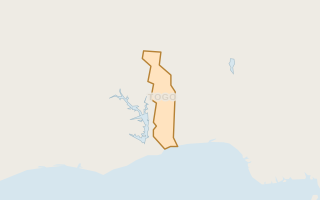
Togo in 2004, at the end of act II
II1967 – 200556,700 → 56,700 km²

Eyadéma's long presidency

Gnassingbé Eyadéma takes power in the 1967 coup and runs an anti-communist, one-party state. In 1993 he faces multiparty elections tainted by irregularities and goes on to win the presidency three times. When he dies in 2005, he has ruled for 38 years, the longest of any leader in modern African history.

Watch this act on the live map, from 1967
III2005 – present

Faure Gnassingbé's Togo

The year 2005 brings a coup, the short presidency of Bonfoh Abass, and the election of Eyadéma's son Faure Gnassingbé. Togo faces COVID-19 in 2020 and joins the Commonwealth in June 2022, hoping for new export markets, development funding and a chance to learn English. Jean-Lucien Savi de Tové becomes president in 2025.

Watch this act on the live map, from 2005

Before and after

Before it

Where it sits in time

3000 BCE2000 BCE1000 BCE110002000French Togoland: 1916 – 1960Togo: 1960 – 2026

Five thousand years, 3000 BCE to 2026; the state in gold, what it replaced or followed and what replaced or followed it in grey.

Its people

Lives across Togo

19251950197520002025
Statesmen and generalsAll its people on the timeline →

How it was governed

8 presidents

8 presidents on record, 1963 to 2025; a reign lasted 0 years at the median. Each bar is a reign, as long as it lasted.

Nicolas Grunitzky · 1963 – 1967 · left office aliveKléber Dadjo · 1967 – 1967 · left office aliveGnassingbé Eyadéma · 1967 – 2005 · died in office of natural causesBonfoh Abass · 2005 – 2005 · left office aliveFaure Gnassingbé · 2005 – 2005 · resigned or stood down, the article saysJean-Lucien Savi de Tové · 2025 – … · still in office1960198020002020
How their terms ended, where it is known (6 of 6):Died in office 1Left office alive 4In office 1
Every term, with how it ended and its source

Rulers

How 6 reigns ended - choose one to show only those

How they died, where the record says: died by accident 1 · died of natural causes 1.

RulerReignLengthHow it ended · sourceTo the ruler before
20th century · 3 reigns
Nicolas Grunitzky · aged 501963 – 19674 yearsleft office aliveread off the dates alonedied by accident
Kléber Dadjo · aged 531967 – 1967under a yearleft office aliveread off the dates alone
Gnassingbé Eyadéma · aged 321967 – 200538 yearsdied in officeWikidata's manner of deathdied of natural causes
21st century · 3 reigns
Bonfoh Abass · aged 572005 – 2005under a yearleft office aliveread off the dates alone
Faure Gnassingbé · aged 392005 – 2005under a yearresignedread from the ruler's own article
Jean-Lucien Savi de Tové · aged 862025 – in officein office since 2025still in office

8 rulers, 6 with terms dated as terms, covering 1963 – 2025. Median reign 0 years. 5 of 5 handovers irregular - a killing, a deposition, a rival claimant, a rising or a coup beside it. A blank in the last column means no kin on record, which is coverage, never “unrelated”.

Heads of government

The line of President of the Council of Ministers of Togo, drawn and never measured: a cabinet is not a reign.

Nicolas Grunitzkylived 1913 – 1969
Sylvanus Olympio1960 – 1961
Joseph Kokou Koffigoh1991 – 1994
Edem Kodjo1994 – 1996
Kwassi Klutse1996 – 1999
Eugène Koffi Adoboli1999 – 2000
Agbéyomé Kodjo2000 – 2002
Koffi Sama2002 – 2005
Edem Kodjo2005 – 2006
Yawovi Agboyibo2006 – 2007
Komlan Mally2007 – 2008
Gilbert Houngbo2008 – 2012
Kwesi Ahoomey-Zunu2012 – 2015
Komi Sélom Klassou2015 – 2020
Victoire Tomegah Dogbé2020 – 2025
Faure Gnassingbé2025 – …

Flags and arms, in order

  • Flag of Togo (1957–1958)
    flag, 1957 – 1958Flag of Togo (1957–1958) · CC BY-SA 3.0 · Mysid
  • Flag of Togo (1958–1960)
    flag, 1958 – 1960Flag of Togo (1958–1960) · CC BY-SA 3.0 · Mysid
  • Flag of Togo (3-2)
    flag, from 1960Flag of Togo (3-2) · Public domain
  • Armoiries du Togo
    coat of arms, from 1962Armoiries du Togo · CC BY-SA 4.0 · Edem Fiadjoe

Its world

Who else stood

Meanwhile, elsewhere

The best-known states of other regions that stood while it did; the band is Togo’s own years.

1960198020002020

How it compares

Among 3,073 states

Stood longer than 38% of 3,073 states
Togo · 66 yearsBremenSoviet UnionHow long it stood, among the states with a recorded end or still standing.
Held more ground at its peak than 36% of 1,464 states
Togo · 56,700 km²Costa RicaLithuaniaThe most ground it held, among the states with a border in Cliopatria.

How it began

How did Togo begin?

What led to it, and what came of it

French Togoland · Linked · 1916 – 1960French TogolandTogo · 1960 – 2026Togo19502000
linked

Open the investigation: every row with its evidence, the conditions at the time, the theories condition by condition, and the succession analysed.

Its centuries in the record

1900 – 1999: 22 recorded — 0 wars and battles, 2 risings, regime changes and massacres, 20 other19002000 – 2099: 2 recorded — 0 wars and battles, 1 risings, regime changes and massacres, 1 other2000

Wars and battles in red, risings, coups and massacres beside them, everything else in grey, by the century each began in. A tall bar is partly a fact about Wikipedia: better-documented centuries hold more.

Each century’s own page:1900 – 19992000 – 2099

Keep exploring

Share this page
Copy link
Embed the map
Cite this page

How this page is made

Drawn from Wikidata (Q945, CC0), the opening and history of its English Wikipedia article retold by the atlas (CC BY-SA 4.0), borders from Cliopatria (CC BY 4.0), coast and rivers from Natural Earth, cities from Reba, Reitsma & Seto 2016 (CC BY 4.0), symbols from Wikimedia Commons, each under its own licence. Data built 2026-11-26 · Pastlas v2.47.1, by Oleh Voronko; the published atlas and its data are for non-commercial use.

How to read it

Areas are measured on an equal-area grid from borders simplified to about five kilometres. “c.” marks an approximate date, and a date known to the century is never printed to the year. Counts are what the atlas holds, and they follow Wikipedia’s coverage: a busy century is partly a fact about the record.

  • Still standing: the span runs to the year of the build, 2026.

Something wrong?

Tell us and name the entry. We fix the data, not just this page.

Report a problem