Battle of Sarmin
battle · 1115
State · Middle East and North Africa
The Principality of Antioch began in 1098, replacing the Fatimid Caliphate.↓ When the borders dataset first draws it, in 1099, it held 7,600 km².↓
At its largest, in 1139, it held 15,600 km².↓ The record names 12 rulers in its line, covering 1098 – 1275, the median reign 14 years; 8 of 11 handovers were irregular.↓ Among them,  Bohemond I of Antioch,
 Tancred of Galilee and
 Raynald of Châtillon are the best known.↓ The atlas files 17 rows under it, most of them people.↓ It ended in 1268, 170 years after it began.↑
Best known for
170 years
Longer than the Mongol Empire, shorter than the Russian Empire
15,600 km²
At its height in 1139 · almost the size of Kuwait
12 rulers
the regent of the Principality of Antioch
8 wars and battles
17 entries in all
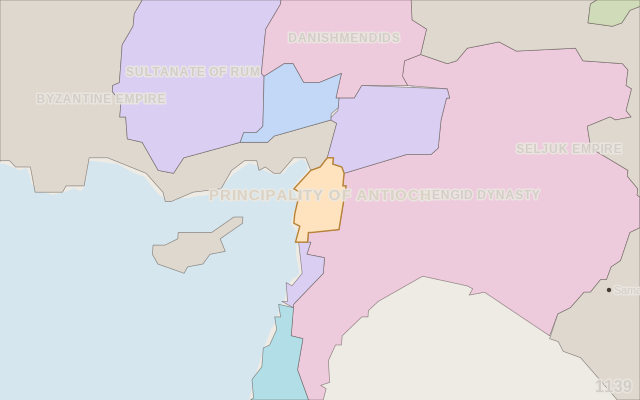
 Zengid dynasty, Byzantine Empire,
 Seljuk Empire,
 Sultanate of Rum, Danishmendids and
 County of Edessa.How far it reached, year by year: its ground inside the borders Cliopatria draws (CC BY 4.0), measured on an equal-area grid; the map shows it at its largest, with the cities of the year.
The story
The best-known wars, battles, risings and changes of regime the record files under it; a war within a war is folded into it.
battle · 1115
battle · 1119
battle · 1125 · a victory
battle · 1149
battle · 1164
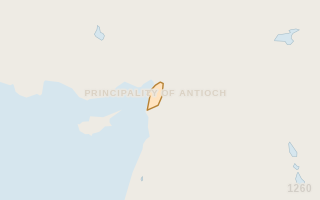
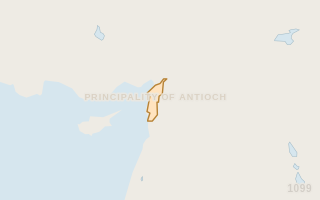
The states the record files it as replacing or following, and those that replaced or followed it - Wikidata's own statements, each read from this state's side.
Five thousand years, 3000 BCE to 2026; the state in gold, what it replaced or followed and what replaced or followed it in grey.
Its people
One axis for everyone, so you can see who knew whom: the best-known, ordered by birth.
 Tancred of Galileeregent1072 – 1112
 Raymond of Poitiersregent · military personnel1115 – 1149
 Raynald of Châtillonregent1120 – 1187
 Bohemond III of Antiochregent1144 – 1201
 Bohemond V of Antiochregent1199 – 1252
How it was governed
12 regents on record, 1098 to 1275; a reign lasted 14 years at the median. Each bar is a reign, as long as it lasted.
The line of regent of the Principality of Antioch.
| Ruler | Reign | Length | How it ended · source | To the ruler before |
|---|---|---|---|---|
| 11th century · 2 reigns | ||||
 Bohemond I of Antioch | 1098 – 1111 | 13 years | ending not on record | |
| Tancred of Galilee · aged 28 | 1100 – 1112 | 12 years | died in officeWikidata's manner of deathdied of natural causes | nephew or niece |
| 12th century · 6 reigns · 2 killed or removed | ||||
| Bohemond II of Antioch | 1111 – 1130 | 19 years | ending not on recorddied in battle | |
 Roger of Salerno · aged 32 | 1112 – 1119 | 7 years | died in battleWikidata's manner of death | |
| Constance of Antioch | 1130 – 1163 | 33 years | ending not on record | |
| Raymond of Poitiers | 1136 – 1149 | 13 years | killedread from the ruler's own article | spouse |
| Raynald of Châtillon | 1153 – 1160 | 7 years | ending not on recordexecuted | |
| Bohemond III of Antioch | 1163 – 1201 | 38 years | ending not on record | |
| 13th century · 4 reigns · 1 killed or removed | ||||
| Bohemond IV of Antioch | 1201 – 1216 | 15 years | ending not on record | child |
| Raymond-Roupen | 1216 – 1219 | 3 years | deposedread from the ruler's own articledied in battle | nephew or niece |
| Bohemond V of Antioch | 1233 – 1252 | 19 years | ending not on record | |
| Bohemond VI of Antioch | 1251 – 1275 | 24 years | ending not on record | child |
12 rulers, 12 with terms dated as terms, covering 1098 – 1275. Median reign 14 years. 8 of 11 handovers irregular - a killing, a deposition, a rival claimant, a rising or a coup beside it. A blank in the last column means no kin on record, which is coverage, never “unrelated”.
Each symbol with the years its own statement gives; the timeline flies the one of the year on screen.


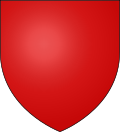
 Bohemond III of Antioch38 yrsBohemond V of Antioch19 yrs
Its world
Wars and battles both took part in, on whichever side: the record names who took part, not who fought whom.
 Kingdom of JerusalemSecond Crusade8
 County of TripoliBattle of Hattin7Zengid dynastySecond Crusade5Seljuk EmpireBattle of Azaz (1125)5County of EdessaBattle of Azaz (1125)4
The best-known states of other regions that stood while it did; the band is the Principality of Antioch’s own years.
 DenmarkEurope
 TibetansSouth Asia
 SwedenEurope
 Kilwa SultanateSub-Saharan Africa
How it compares
Each column is a share of the states; gold is the Principality of Antioch.
Why it fell
Historians still argue. Here is what the atlas records about its last century:
1
wars and battles in its last century
÷2.8
its land, between 1168 and 1267
1219
Raymond-Roupen, deposed or removed in office
The investigation's own picture: 2 causes the record names and 0 results, the strongest six of each at their own years, joined to the state by the kind of claim - a recorded statement solid, the article's sentence dashed, a theory dash-dot.
Open the investigation: every row with its evidence, the conditions at the time, the theories condition by condition, and the succession analysed.
Wars and battles in red, risings, coups and massacres beside them, everything else in grey, by the century each began in. A tall bar is partly a fact about Wikipedia: better-documented centuries hold more.
Each century’s own page:1000 – 10991100 – 11991200 – 1299
“Principality of Antioch”, Pastlas, a historical atlas, 2026-11-26. https://app.pastlas.com/state/principality-of-antioch/
Drawn from Wikidata (Q235030, CC0), borders from Cliopatria (CC BY 4.0), coast and rivers from Natural Earth, cities from Reba, Reitsma & Seto 2016 (CC BY 4.0), symbols from Wikimedia Commons, each under its own licence. Data built 2026-11-26 · Pastlas v2.47.1, by Oleh Voronko; the published atlas and its data are for non-commercial use.
Areas are measured on an equal-area grid from borders simplified to about five kilometres. “c.” marks an approximate date, and a date known to the century is never printed to the year. Counts are what the atlas holds, and they follow Wikipedia’s coverage: a busy century is partly a fact about the record.