State · South Asia

Hyderabad State

1724 – 1948 · 224 years

Became India and Hyderabad State (1948–1956)

The record dates its beginning to 1724.↑ When the borders dataset first draws it, in 1727, it held 262,000 km².↓

Continue reading

Its ground peaked in 1744 at 262,300 km².↓ Its line counts 10 rulers, covering 1724 – 1948, the median reign 25 years; 2 of 9 handovers were irregular.↓ The best known of them are Mir Osman Ali Khan, Nizam-ul-Mulk, Asaf Jah I and Mahboob Ali Khan.↓ Most of the 10 rows the atlas files under it are people.↓

India and Hyderabad State replaced it in 1948, after 224 years.↓

224 years

Longer than the Achaemenid Empire, shorter than the Polish–Lithuanian Commonwealth

262,000 km²

At its height in 1744 · about the size of Ecuador

10 rulers

the 1st Nizam of Hyderabad

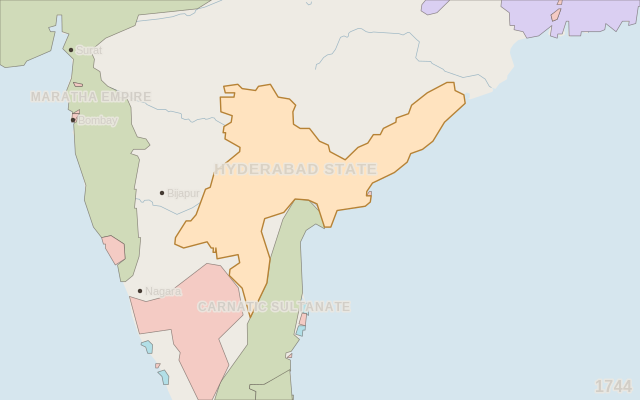
Map: Hyderabad State in 1744, its borders in gold among its neighbours
174017501760177017801790
Beside it on the map in 1744: Maratha Empire, Carnatic Sultanate, Kingdom of Mysore, Nawabs of Bengal, Thanjavur Maratha kingdom and Portuguese Empire.How far it reached, year by year: its ground inside the borders Cliopatria draws (CC BY 4.0), measured on an equal-area grid; the map shows it at its largest, with the cities of the year.

The story

Its key moments

Before and after

After it

Where it sits in time

3000 BCE2000 BCE1000 BCE110002000Hyderabad State (1948–1956): 1948 – 1956India: 1950 – 2026Hyderabad State: 1724 – 1948

Five thousand years, 3000 BCE to 2026; the state in gold, what it replaced or followed and what replaced or followed it in grey.

Its people

Lives across Hyderabad State

170017501800185019001950
Statesmen and generalsLived on after it endedAll its people on the timeline →

How it was governed

10 nizams

10 nizams on record, 1724 to 1948; a reign lasted 25 years at the median. Each bar is a reign, as long as it lasted.

Nizam-ul-Mulk, Asaf Jah I · 1724 – 1748 · no death date to read the end againstNasir Jung · 1748 – 1750 · killed, the article saysMuzaffar Jang Hidayat · 1750 – 1751 · no death date to read the end againstSalabat Jung · 1751 – 1762 · killed, the article saysNizam Ali Khan, Asaf Jah II · 1762 – 1803 · no death date to read the end againstSikander Jah, Asaf Jah III · 1803 – 1829 · no death date to read the end againstNasir-ud-Daulah · 1829 – 1857 · no death date to read the end againstAfzal-ud-Daulah · 1857 – 1869 · no death date to read the end againstMahboob Ali Khan · 1869 – 1911 · no death date to read the end againstMir Osman Ali Khan · 1911 – 1948 · no death date to read the end against1750180018501900
How their terms ended, where it is known (2 of 10):Killed 2Not on record 8
Every term, with how it ended and its source

Rulers

How 10 reigns ended - choose one to show only those

How they died, where the record says: killed 1.

RulerReignLengthHow it ended · sourceTo the ruler before
18th century · 5 reigns · 2 killed or removed
Nizam-ul-Mulk, Asaf Jah I1724 – 174824 yearsending not on record
Nasir Jung1748 – 17502 yearskilledread from the ruler's own articlechild
Muzaffar Jang Hidayat1750 – 17511 yearending not on record
Salabat Jung1751 – 176211 yearskilledread from the ruler's own article
Nizam Ali Khan, Asaf Jah II1762 – 180341 yearsending not on recordsibling
19th century · 4 reigns
Sikander Jah, Asaf Jah III1803 – 182926 yearsending not on recordchild
Nasir-ud-Daulah1829 – 185728 yearsending not on recordchild
Afzal-ud-Daulah1857 – 186912 yearsending not on recordchild
Mahboob Ali Khan1869 – 191142 yearsending not on recordchild
20th century · 1 reign
Mir Osman Ali Khan1911 – 194837 yearsending not on recordchild

10 rulers, 10 with terms dated as terms, covering 1724 – 1948. Median reign 25 years. 2 of 9 handovers irregular - a killing, a deposition, a rival claimant, a rising or a coup beside it. A blank in the last column means no kin on record, which is coverage, never “unrelated”.

Flags and arms, in order

  • Asafia flag of Hyderabad State
    flag, undatedAsafia flag of Hyderabad State · CC BY-SA 4.0 · SajidA829
  • The Royal arms of Hyderabad State
    coat of arms, undatedThe Royal arms of Hyderabad State · Public domain

Its world

Rivals, and who else stood

Who it fought most

Wars and battles both took part in, on whichever side: the record names who took part, not who fought whom.

Meanwhile, elsewhere

The best-known states of other regions that stood while it did; the band is Hyderabad State’s own years.

170017501800185019001950

How it compares

Among 3,073 states

Stood longer than 65% of 3,073 states
Hyderabad State · 224 yearsAchaemenid EmpirePolish–Lithuanian CommonwealthHow long it stood, among the states with a recorded end or still standing.
Held more ground at its peak than 64% of 1,464 states
Hyderabad State · 262,300 km²GuineaEcuadorThe most ground it held, among the states with a border in Cliopatria.

Why it fell

Why did Hyderabad State fall?

Historians still argue. Here is what the atlas records about its last century:

What led to it, and what came of it

Maratha Empire · In the article · 1674 · “By 1818 following the overthrow of the Maratha Empire by the Company after the Third Anglo-Maratha War, the Maratha protection of Hyderabad was quickly replac…”Maratha EmpireShahu I · In the article · 1682 · “Following the conquest of Deccan by Shahu I and the imposition of Chauth by him, Nizam remained a tributary of the Marathas for all intent and purposes and he…”Shahu IBattle of Shakar Kheda · In the article · 1724 · “In 1724, following the Battle of Shakar Kheda, he resumed rule from the Mughal provincial capital of Aurangabad, under the title of Asaf Jah (granted by Mugha…”Battle of Shakar KhedaNizam-ul-Mulk, Asaf Jah I · Coincidence · 1671 – 1748Nizam-ul-Mulk, Asaf Jah IHyderabad State · 1724 – 1948Hyderabad StateHyderabad State (1948–1956) · Linked · 1948 – 1956Hyderabad State (1948–1956)India · Linked · 1950 – 2026India1700180019002000
in the articlelinkedcoincidence

Open the investigation: every row with its evidence, the conditions at the time, the theories condition by condition, and the succession analysed.

Its centuries in the record

1700 – 1799: 6 recorded — 0 wars and battles, 0 risings, regime changes and massacres, 6 other17001800 – 1899: 3 recorded — 0 wars and battles, 0 risings, regime changes and massacres, 3 other18001900 – 1999: 0 recorded — 0 wars and battles, 0 risings, regime changes and massacres, 0 other1900

Wars and battles in red, risings, coups and massacres beside them, everything else in grey, by the century each began in. A tall bar is partly a fact about Wikipedia: better-documented centuries hold more.

Each century’s own page:1700 – 17991800 – 18991900 – 1999

Keep exploring

Share this page
Copy link
Embed the map
Cite this page

How this page is made

Drawn from Wikidata (Q1240096, CC0), borders from Cliopatria (CC BY 4.0), coast and rivers from Natural Earth, cities from Reba, Reitsma & Seto 2016 (CC BY 4.0), symbols from Wikimedia Commons, each under its own licence. Data built 2026-11-26 · Pastlas v2.47.1, by Oleh Voronko; the published atlas and its data are for non-commercial use.

How to read it

Areas are measured on an equal-area grid from borders simplified to about five kilometres. “c.” marks an approximate date, and a date known to the century is never printed to the year. Counts are what the atlas holds, and they follow Wikipedia’s coverage: a busy century is partly a fact about the record.

Something wrong?

Tell us and name the entry. We fix the data, not just this page.

Report a problem