State · South Asia

Magadha

1201 – 345 BCE · 856 years

Became Nanda Empire

The kingdom of the eastern Ganges Plain where Jainism and Buddhism arose, ruled by Bimbisara and Ajatashatru in the Buddha's lifetime.

Magadha was a kingdom of ancient India in the eastern Ganges Plain, and one of the sixteen Mahajanapadas of the Second Urbanisation. Its dynasties overshadowed and absorbed the other Mahajanapadas, and Jainism and Buddhism took shape on its soil. Under the Haryanka kings Bimbisara and Ajatashatru it was the realm of the Buddha's and Mahavira's time. Magadha later formed the core of the Nanda, Mauryan, Shunga and Gupta empires.

What the record holds

Its record opens in the 13th century BCE.↑ In 600 BCE, the first year its borders are mapped, it covered 5,100 km².↓

The record names 8 rulers in its line, covering 544 BCE – 345 BCE, the median reign 23 years; 3 of 7 handovers were irregular.↓ The best known of them are Bimbisara, Ajatashatru and Udayin.↓ Most of the 8 rows the atlas files under it are people.↓

In 345 BCE, after 856 years, it was replaced by the Nanda Empire.↓

From Wikipedia’s article, retold · CC BY-SA 4.0

856 years

Longer than the Holy Roman Empire, shorter than the Byzantine Empire

5,100 km²

At its height in 600 BCE

8 rulers

the king

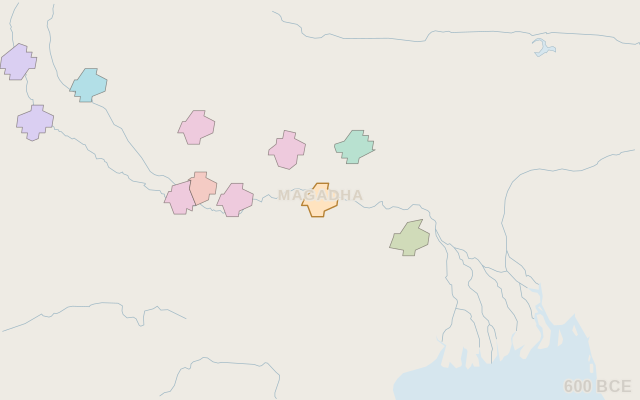
Map: Magadha in 600 BCE, its borders in gold among its neighbours
560 BCE540 BCE520 BCE
Beside it on the map in 600 BCE: Anga Kingdom, Kuru kingdom, Malla, Surasena, Vajjika League and Panchala.How far it reached, year by year: its ground inside the borders Cliopatria draws (CC BY 4.0), measured on an equal-area grid; the map shows it at its largest, with the cities of the year.

The story

Three acts, 1201 – 345 BCE

Magadha in 545 BCE, at the end of act I
I1201 – 544 BCE

A tribe beyond the Vedic world

The Atharvaveda, of c. 1200–900 BCE, lists the Magadhas with the Angas and others as tribes outside the Vedic world of the Kuru-Panchala. The Puranas name the legendary Brihadratha dynasty as Magadha's first rulers. Some scholars take the Rigveda's hostile Kikata tribe for their forebears, but Witzel places the Kikatas elsewhere.

Watch this act on the live map, from 1201 BCE
II544 – 413 BCE

The Haryanka kings

Jain and Buddhist sources give the Haryanka dynasty about a hundred and thirty years on the throne, though the dates are uncertain. Its best-known kings, Bimbisara and his son Ajatashatru, live in the time of the Buddha and Mahavira. From c. 500 BCE Greater Magadha is the heart of the Second Urbanisation, and Jainism and Buddhism arise there.

Watch this act on the live map, from 544 BCE

Before and after

After it

Where it sits in time

3000 BCE2000 BCE1000 BCE110002000Nanda Empire: 345 BCE – 321 BCEMagadha: 1201 BCE – 345 BCE

Five thousand years, 3000 BCE to 2026; the state in gold, what it replaced or followed and what replaced or followed it in grey.

Its people

Lives across Magadha

550 BCE500 BCE450 BCE400 BCE350 BCE
Statesmen and generalsAll its people on the timeline →

How it was governed

8 kings

8 kings on record, 544 BCE to 345 BCE; a reign lasted 23 years at the median. Each bar is a reign, as long as it lasted.

Bimbisara · 544 BCE – 492 BCE · left office aliveAjatashatru · 492 BCE – 460 BCE · killedUdayin · 460 BCE – 444 BCE · killedAnuruddha · 444 BCE – 441 BCE · killedNāgadāsaka · 437 BCE – 413 BCE · ended by a named eventShishunaga · 413 BCE – 395 BCE · no death date to read the end againstKakavarna Kalashoka · 395 BCE – 367 BCE · no death date to read the end againstMahanandin · 367 BCE – 345 BCE · killed1200 BCE1000 BCE800 BCE600 BCE400 BCE
How their terms ended, where it is known (6 of 8):Killed 4Left office alive 2Not on record 2
Every term, with how it ended and its source

Rulers

How 8 reigns ended - choose one to show only those

How they died, where the record says: killed 4.

RulerReignLengthHow it ended · sourceTo the ruler before
6th century BCE · 1 reign
Bimbisara · aged 14544 BCE – 492 BCE52 yearsleft office aliveread off the dates alone
5th century BCE · 5 reigns · 3 killed or removed
Ajatashatru · aged 9492 BCE – 460 BCE32 yearskilled in officeWikidata's manner of deathchild
Udayin460 BCE – 444 BCE16 yearskilled in officeWikidata's manner of deathchild
Anuruddha · aged 107444 BCE – 441 BCE3 yearskilled in officeWikidata's manner of deathchild
Nāgadāsaka437 BCE – 413 BCE24 yearsended by an eventWikidata's end cause on the termgrandchild
Shishunaga · aged 37413 BCE – 395 BCE18 yearsending not on record
4th century BCE · 2 reigns · 1 killed or removed
Kakavarna Kalashoka395 BCE – 367 BCE28 yearsending not on recordchild
Mahanandin367 BCE – 345 BCE22 yearskilled in officeWikidata's manner of death

8 rulers, 8 with terms dated as terms, covering 544 BCE – 345 BCE. Median reign 23 years. 3 of 7 handovers irregular - a killing, a deposition, a rival claimant, a rising or a coup beside it. A blank in the last column means no kin on record, which is coverage, never “unrelated”.

Its world

Who else stood

Meanwhile, elsewhere

The best-known states of other regions that stood while it did; the band is Magadha’s own years.

1200 BCE1000 BCE800 BCE600 BCE400 BCE

How it compares

Among 3,073 states

Stood longer than 96% of 3,073 states
Magadha · 856 yearsHoly Roman EmpireByzantine EmpireHow long it stood, among the states with a recorded end or still standing.
Held more ground at its peak than 10% of 1,464 states
Magadha · 5,100 km²LuxembourgCyprusThe most ground it held, among the states with a border in Cliopatria.

Why it fell

Why did Magadha fall?

Historians still argue. Here is what the atlas records about its last century:

345 BCE

Mahanandin, killed in office

What led to it, and what came of it

Magadha · 1201 BCE – 345 BCEMagadhaNanda Empire · Linked · 345 BCE – 321 BCENanda Empire1200 BCE1000 BCE800 BCE600 BCE400 BCE
linked

Open the investigation: every row with its evidence, the conditions at the time, the theories condition by condition, and the succession analysed.

Its centuries in the record

1300 BCE – 1201 BCE: 0 recorded — 0 wars and battles, 0 risings, regime changes and massacres, 0 other1300 BCE1200 BCE – 1101 BCE: 0 recorded — 0 wars and battles, 0 risings, regime changes and massacres, 0 other1200 BCE1100 BCE – 1001 BCE: 0 recorded — 0 wars and battles, 0 risings, regime changes and massacres, 0 other1100 BCE1000 BCE – 901 BCE: 0 recorded — 0 wars and battles, 0 risings, regime changes and massacres, 0 other1000 BCE900 BCE – 801 BCE: 0 recorded — 0 wars and battles, 0 risings, regime changes and massacres, 0 other900 BCE800 BCE – 701 BCE: 0 recorded — 0 wars and battles, 0 risings, regime changes and massacres, 0 other800 BCE700 BCE – 601 BCE: 0 recorded — 0 wars and battles, 0 risings, regime changes and massacres, 0 other700 BCE600 BCE – 501 BCE: 3 recorded — 0 wars and battles, 0 risings, regime changes and massacres, 3 other600 BCE500 BCE – 401 BCE: 3 recorded — 0 wars and battles, 0 risings, regime changes and massacres, 3 other500 BCE400 BCE – 301 BCE: 2 recorded — 0 wars and battles, 0 risings, regime changes and massacres, 2 other400 BCE

Wars and battles in red, risings, coups and massacres beside them, everything else in grey, by the century each began in. A tall bar is partly a fact about Wikipedia: better-documented centuries hold more.

Each century’s own page:1300 BCE – 1201 BCE1200 BCE – 1101 BCE1100 BCE – 1001 BCE1000 BCE – 901 BCE900 BCE – 801 BCE800 BCE – 701 BCE700 BCE – 601 BCE600 BCE – 501 BCE500 BCE – 401 BCE400 BCE – 301 BCE

Keep exploring

Share this page
Copy link
Embed the map
Cite this page

How this page is made

Drawn from Wikidata (Q234009, CC0), the opening and history of its English Wikipedia article retold by the atlas (CC BY-SA 4.0), borders from Cliopatria (CC BY 4.0), coast and rivers from Natural Earth, cities from Reba, Reitsma & Seto 2016 (CC BY 4.0). Data built 2026-11-26 · Pastlas v2.47.1, by Oleh Voronko; the published atlas and its data are for non-commercial use.

How to read it

Areas are measured on an equal-area grid from borders simplified to about five kilometres. “c.” marks an approximate date, and a date known to the century is never printed to the year. Counts are what the atlas holds, and they follow Wikipedia’s coverage: a busy century is partly a fact about the record.

Something wrong?

Tell us and name the entry. We fix the data, not just this page.

Report a problem