State · South Asia

Thanjavur Maratha kingdom

1674 – 1855 · 181 years

Came after Thanjavur Nayak kingdom · became India

The Thanjavur Maratha kingdom began in 1674, replacing the Thanjavur Nayak kingdom.↓ In 1677, the first year its borders are mapped, it covered 14,800 km².↓

Continue reading

The record names 12 rulers in its line, covering 1674 – 1855, the median reign 9 years; 2 of 11 handovers were irregular.↓ The best known of them are Serfoji II, Sujana Bai and Vyankoji Bhosale.↓ Most of the 14 rows the atlas files under it are people.↓

It was replaced by India in 1855, 181 years after it began.↓

181 years

Longer than the Mongol Empire, shorter than the Russian Empire

14,800 km²

At its height in 1677 · about the size of Montenegro

12 rulers

the Raja of Thanjavur

2 wars and battles

14 entries in all

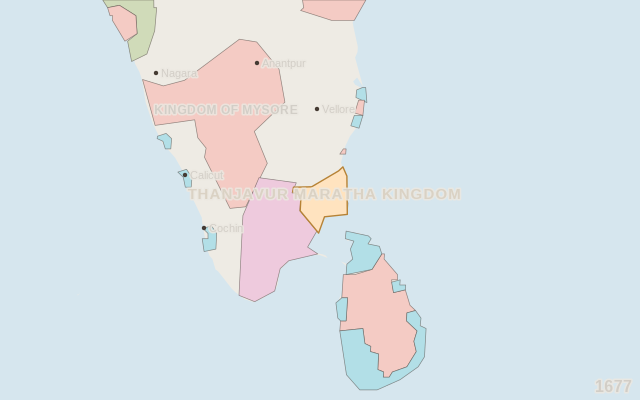
Map: Thanjavur Maratha kingdom in 1677, its borders in gold among its neighbours
17001720174017601780
Beside it on the map in 1677: Kingdom of Mysore, Madurai Nayak dynasty, Portuguese Ceylon, Dutch Republic, Maratha Empire and Sultanate of Golconda.How far it reached, year by year: its ground inside the borders Cliopatria draws (CC BY 4.0), measured on an equal-area grid; the map shows it at its largest, with the cities of the year.

The story

Its key moments

Before and after

Before it

After it

  • India · replaced by · 1950 – present

Where it sits in time

3000 BCE2000 BCE1000 BCE110002000Thanjavur Nayak kingdom: 1532 – 1673India: 1950 – 2026Thanjavur Maratha kingdom: 1674 – 1855

Five thousand years, 3000 BCE to 2026; the state in gold, what it replaced or followed and what replaced or followed it in grey.

Its people

Lives across the Thanjavur Maratha kingdom

16501700175018001850
Statesmen and generalsAll its people on the timeline →

How it was governed

12 rajas

12 rajas on record, 1674 to 1855; a reign lasted 9 years at the median. Each bar is a reign, as long as it lasted.

Vyankoji Bhosale · 1674 – 1684 · no death date to read the end againstShahuji I · 1684 – 1712 · abdicated, the article saysSerfoji I · 1712 – 1728 · no death date to read the end againstTukkoji · 1728 – 1736 · no death date to read the end againstEkoji II · 1736 – 1737 · no death date to read the end againstSujana Bai · 1737 – 1738 · deposed, the article saysShahuji II · 1738 – 1739 · no death date to read the end againstPratap Singh of Thanjavur · 1739 – 1763 · no death date to read the end againstThuljaji · 1763 – 1773 · no death date to read the end againstSerfoji II · 1787 – 1793 · no death date to read the end againstAmar Singh of Thanjavur · 1793 – 1798 · no death date to read the end againstShivaji of Thanjavur · 1832 – 1855 · no death date to read the end against1700175018001850
How their terms ended, where it is known (2 of 12):Deposed or removed 2Not on record 10
Every term, with how it ended and its source

Rulers

How 12 reigns ended - choose one to show only those
RulerReignLengthHow it ended · sourceTo the ruler before
17th century · 2 reigns · 1 killed or removed
Vyankoji Bhosale1674 – 168410 yearsending not on record
Shahuji I1684 – 171228 yearsabdicatedread from the ruler's own articlechild
18th century · 9 reigns · 1 killed or removed
Serfoji I1712 – 172816 yearsending not on recordsibling
Tukkoji1728 – 17368 yearsending not on recordsibling
Ekoji II1736 – 17371 yearending not on recordchild
Sujana Bai1737 – 17381 yeardeposedread from the ruler's own articlespouse
Shahuji II1738 – 17391 yearending not on record
Pratap Singh of Thanjavur1739 – 176324 yearsending not on record
Thuljaji1763 – 177310 yearsending not on recordchild
Serfoji II1787 – 17936 yearsending not on record
Amar Singh of Thanjavur1793 – 17985 yearsending not on record
19th century · 1 reign
Shivaji of Thanjavur1832 – 185523 yearsending not on record

12 rulers, 12 with terms dated as terms, covering 1674 – 1855. Median reign 9 years. 2 of 11 handovers irregular - a killing, a deposition, a rival claimant, a rising or a coup beside it. A blank in the last column means no kin on record, which is coverage, never “unrelated”.

Its world

Who else stood

Meanwhile, elsewhere

The best-known states of other regions that stood while it did; the band is the Thanjavur Maratha kingdom’s own years.

16501700175018001850

How it compares

Among 3,073 states

Stood longer than 59% of 3,073 states
Thanjavur Maratha kingdom · 181 yearsMongol EmpireRussian EmpireHow long it stood, among the states with a recorded end or still standing.
Held more ground at its peak than 18% of 1,464 states
Thanjavur Maratha kingdom · 14,800 km²MontenegroKuwaitThe most ground it held, among the states with a border in Cliopatria.

Why it fell

Why did the Thanjavur Maratha kingdom fall?

Historians still argue. Here is what the atlas records about its last century:

What led to it, and what came of it

Thanjavur Nayak kingdom · Linked · 1532 – 1673Thanjavur Nayak kingdomThanjavur Maratha kingdom · 1674 – 1855Thanjavur Maratha kingdomIndia · Linked · 1950 – 2026India16001700180019002000
linked

Open the investigation: every row with its evidence, the conditions at the time, the theories condition by condition, and the succession analysed.

Its centuries in the record

1600 – 1699: 7 recorded — 1 wars and battles, 0 risings, regime changes and massacres, 6 other16001700 – 1799: 6 recorded — 1 wars and battles, 0 risings, regime changes and massacres, 5 other17001800 – 1899: 1 recorded — 0 wars and battles, 0 risings, regime changes and massacres, 1 other1800

Wars and battles in red, risings, coups and massacres beside them, everything else in grey, by the century each began in. A tall bar is partly a fact about Wikipedia: better-documented centuries hold more.

Each century’s own page:1600 – 16991700 – 17991800 – 1899

Keep exploring

Share this page
Copy link
Embed the map
Cite this page

How this page is made

Drawn from Wikidata (Q3530610, CC0), borders from Cliopatria (CC BY 4.0), coast and rivers from Natural Earth, cities from Reba, Reitsma & Seto 2016 (CC BY 4.0). Data built 2026-11-26 · Pastlas v2.47.1, by Oleh Voronko; the published atlas and its data are for non-commercial use.

How to read it

Areas are measured on an equal-area grid from borders simplified to about five kilometres. “c.” marks an approximate date, and a date known to the century is never printed to the year. Counts are what the atlas holds, and they follow Wikipedia’s coverage: a busy century is partly a fact about the record.

Something wrong?

Tell us and name the entry. We fix the data, not just this page.

Report a problem