Period · East and Southeast Asia

Heian period

794 – 1185 · 391 years

Came after Nara period · became Kamakura period

Japan's classical age, when the imperial court at Heian-kyō produced its own scripts and literature while the Fujiwara held the real power.

The Heian period ran from 794 CE, when Emperor Kammu moved the capital from Nara to Heian-kyō, modern Kyoto, until 1185. Chinese influence waned and a native court culture flowered: the katakana and hiragana syllabaries appeared, and court ladies wrote much of the new vernacular literature. Emperors reigned, but the Fujiwara clan, married into the imperial house, ruled. Aristocratic estates slipped from imperial control, banditry spread, and at last a warrior class rose to power.

What the record holds

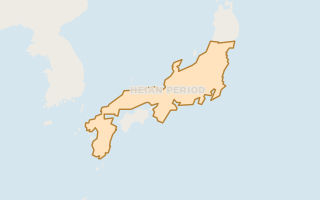
It was founded in 794, after Nara period.↓ Its borders are first mapped in 793, around 230,100 km².↓

Its ground peaked in 1094 at 243,600 km².↓ Most of the 36 rows the atlas files under it are wars and battles.↓

It was followed by Kamakura period in 1185, 391 years after it began.↓

From Wikipedia’s article, retold · CC BY-SA 4.0

391 years

Longer than Kyivan Rus', shorter than the Spanish Empire

244,000 km²

At its height in 1094 · about the size of Ghana

21 wars and battles

More per century than 89% of states · 36 entries in all

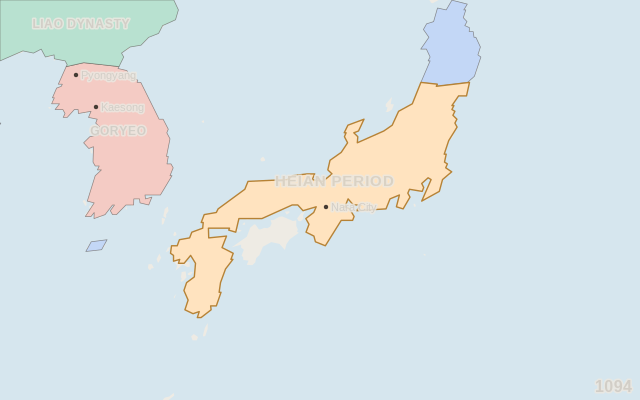
Map: Heian period in 1094, its borders in gold among its neighbours
Hōgen rebellion, 1156Heiji rebellion, 1160Battle of Uji (1180), 1180Genpei War, 1180 – 1185Battle of Dan-no-ura, 118580090010001100
Beside it on the map in 1094: Goryeo, Liao dynasty, Northern Fujiwara, Tamna and Song dynasty.How far it reached, year by year: its ground inside the borders Cliopatria draws (CC BY 4.0), measured on an equal-area grid; the map shows it at its largest, with the cities of the year.

The story

Three acts, 794 – 1185

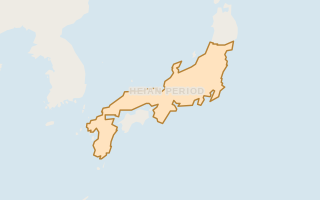
Heian period in 1085, at the end of act I
I794 – 1086230,000 → 244,000 km²

Capital and court at Heian-kyō

Kammu moves the court from Nara, partly to escape its Buddhist institutions, to a larger capital modelled on Tang Chang'an. The Fujiwara, who furnish most emperors' mothers, govern as regents, and a vernacular literature flowers. Warfare is rare, the Toi invasion of 1019 aside, yet estates slip from imperial control and banditry spreads.

Watch this act on the live map, from 794
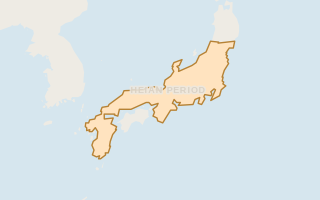
Heian period in 1155, at the end of act II
II1086 – 1156244,000 → 244,000 km²

The In-no-chō and the warriors

The Fujiwara split into northern and southern factions; kept in their old posts but bypassed, many are replaced by men of the rising Minamoto clan. The In-no-chō fills the gap, and the insei system lets the imperial family's paternal line steer the throne. Across the country a military class gains strength.

Watch this act on the live map, from 1086
Heian period in 1184, at the end of act III
III1156 – 1185244,000 → 244,000 km²

Rebellion and the Genpei War

Military might now outweighs civil authority. The Hōgen rebellion of 1156, the Heiji rebellion of 1160 and the Shishigatani incident of 1177 follow. From 1180 the Genpei War brings battles at Uji, Kurikara Pass and Ichi-no-Tani, and in 1185 the Battle of Dan-no-ura closes the period, which gives way to the Kamakura period.

Watch this act on the live map, from 1156

Before and after

Before it

After it

  • Kamakura period · followed by

Where it sits in time

3000 BCE2000 BCE1000 BCE110002000Nara period: 710 – 794Heian period: 794 – 1185

Five thousand years, 3000 BCE to 2026; the state in gold, what it replaced or followed and what replaced or followed it in grey.

Its people

Lives across Heian period

10001050110011501200
Writers, artists and thinkersStatesmen and generalsLived on after it endedAll its people on the timeline →

Its world

Who else stood

Meanwhile, elsewhere

The best-known states of other regions that stood while it did; the band is Heian period’s own years.

800900100011001200

How it compares

Among 3,073 states

Stood longer than 80% of 3,073 states
Heian period · 391 yearsKyivan Rus'Spanish EmpireHow long it stood, among the states with a recorded end or still standing.
Held more ground at its peak than 63% of 1,464 states
Heian period · 243,600 km²GhanaGuineaThe most ground it held, among the states with a border in Cliopatria.
Had more wars on record per century than 89% of 3,073 states
Heian period · 0.8Wars recorded per century, among the states, counting the wars the atlas hosts under each.

Why it fell

Why did Heian period fall?

Historians still argue. Here is what the atlas records about its last century:

20

wars and battles in its last century, more than in any before it

What led to it, and what came of it

Nara period · Linked · 710 – 794 · “It followed the Nara period, beginning when the 50th emperor, Emperor Kammu, moved the capital of Japan to Heian-kyō (modern Kyoto).”Nara periodHeian period · 794 – 1185Heian periodKamakura period · Linked · 1185 – 1333Kamakura period80010001200
linked

Open the investigation: every row with its evidence, the conditions at the time, the theories condition by condition, and the succession analysed.

Its centuries in the record

700 – 799: 0 recorded — 0 wars and battles, 0 risings, regime changes and massacres, 0 other700800 – 899: 0 recorded — 0 wars and battles, 0 risings, regime changes and massacres, 0 other800900 – 999: 1 recorded — 0 wars and battles, 0 risings, regime changes and massacres, 1 other9001000 – 1099: 1 recorded — 1 wars and battles, 0 risings, regime changes and massacres, 0 other10001100 – 1199: 34 recorded — 20 wars and battles, 2 risings, regime changes and massacres, 12 other1100

Wars and battles in red, risings, coups and massacres beside them, everything else in grey, by the century each began in. A tall bar is partly a fact about Wikipedia: better-documented centuries hold more.

Each century’s own page:700 – 799800 – 899900 – 9991000 – 10991100 – 1199

Keep exploring

Share this page
Copy link
Embed the map
Cite this page

How this page is made

Drawn from Wikidata (Q193292, CC0), the opening and history of its English Wikipedia article retold by the atlas (CC BY-SA 4.0), borders from Cliopatria (CC BY 4.0), coast and rivers from Natural Earth, cities from Reba, Reitsma & Seto 2016 (CC BY 4.0). Data built 2026-11-26 · Pastlas v2.47.1, by Oleh Voronko; the published atlas and its data are for non-commercial use.

How to read it

Areas are measured on an equal-area grid from borders simplified to about five kilometres. “c.” marks an approximate date, and a date known to the century is never printed to the year. Counts are what the atlas holds, and they follow Wikipedia’s coverage: a busy century is partly a fact about the record.

Something wrong?

Tell us and name the entry. We fix the data, not just this page.

Report a problem