 Minamoto no Yoritomo, as its article puts it.
The story
Its key moments
Where it sits in time
Five thousand years, 3000 BCE to 2026; the state in gold.
Royal house · East and Southeast Asia
1094 – 1191 · 97 years
97 years
Longer than the Inca Empire, shorter than Nizhny Novgorod
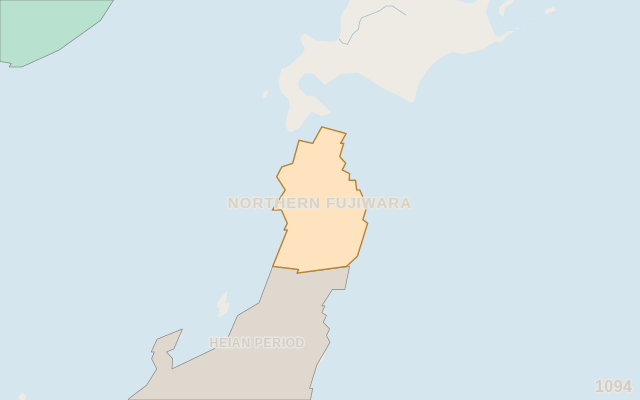
44,900 km²
At its height in 1094 · about the size of Estonia
1 ruler
the Chinjufu shōgun
1 war or battle
2 entries in all
The story
Five thousand years, 3000 BCE to 2026; the state in gold.
How it was governed
1 shōgun on record, 1170 to 1170. Each bar is a reign, as long as it lasted.
The line of Chinjufu shōgun.
| Ruler | Reign | Length | How it ended · source | To the ruler before |
|---|---|---|---|---|
| 12th century · 1 reign | ||||
 Fujiwara no Hidehira · aged 48 | 1170 – — | no end recorded | ending not on record | |
1 ruler, 1 with terms dated as terms, covering 1170 – 1170. A blank in the last column means no kin on record, which is coverage, never “unrelated”.
Its world
The best-known states of other regions that stood while it did; the band is Northern Fujiwara’s own years.
 Abbasid CaliphateMiddle East and North Africa
 DenmarkEurope
 TibetansSouth Asia
 SwedenEurope
 Kilwa SultanateSub-Saharan Africa
How it compares
Each column is a share of the states; gold is Northern Fujiwara.
Why it fell
Historians still argue. Here is what the atlas records about its last century:
1
wars and battles in its last century, more than in any before it
Conquered by Minamoto no Yoritomo, 1189. Read from the article's section “lead” by its grammar; the claim is only that the article says so.
They were able to keep their independence vis-à-vis Kyoto by the strength of their warrior bands until they were ultimately conquered by the Kantō samurai clans led by Minamoto no Yoritomo, in the Battle of Ōshū in 1189.
One sentence of the English Wikipedia article, CC BY-SA 4.0.
The investigation's own picture: 1 cause the record names and 0 results, the strongest six of each at their own years, joined to the state by the kind of claim - a recorded statement solid, the article's sentence dashed, a theory dash-dot.
Open the investigation: every row with its evidence, the conditions at the time, the theories condition by condition, and the succession analysed.
Of 5 theories of why states fall, 1 has every condition present at this ending; each is applied by its own logic, condition by condition, and whether its authors named this case is a footnote.
Ibn Khaldun 1377 · Turchin & Nefedov 2009
Applies by its own logic: the condition it names held here, and this is the kind of outcome it predicts — adverse regime change or the state's ending.
Wars and battles in red, risings, coups and massacres beside them, everything else in grey, by the century each began in. A tall bar is partly a fact about Wikipedia: better-documented centuries hold more.
Each century’s own page:1000 – 10991100 – 1199
“Northern Fujiwara”, Pastlas, a historical atlas, 2026-11-26. https://app.pastlas.com/state/northern-fujiwara/
Drawn from Wikidata (Q1050942, CC0), borders from Cliopatria (CC BY 4.0), coast and rivers from Natural Earth, cities from Reba, Reitsma & Seto 2016 (CC BY 4.0), and one sentence of the article, quoted. Data built 2026-11-26 · Pastlas v2.47.1, by Oleh Voronko; the published atlas and its data are for non-commercial use.
Areas are measured on an equal-area grid from borders simplified to about five kilometres. “c.” marks an approximate date, and a date known to the century is never printed to the year. Counts are what the atlas holds, and they follow Wikipedia’s coverage: a busy century is partly a fact about the record.