State · Middle East and North Africa

Emirate of Kuwait

1752 – 1961 · 209 years

Came after Bani Khalid Emirate · became Kuwait

Its record opens in 1752, replacing the Bani Khalid Emirate.↓ In 1961, the first year its borders are mapped, it covered 14,200 km².↓

Continue reading

Its line counts 11 rulers, covering 1752 – 1961, the median reign 15 years; 1 of 10 handovers was irregular.↓ The best known of them are Abdullah Al-Salim Al-Sabah, Ahmad Al-Jaber Al-Sabah and Mubarak Al-Sabah.↓ Most of the 7 rows the atlas files under it are people.↓

Kuwait followed it in 1961, after 209 years.↓ Its end fits “Elite conflict”, every condition present.↓

209 years

Longer than Greenland, shorter than the Achaemenid Empire

14,200 km²

At its height in 1961 · about the size of Montenegro

11 rulers

the head of state

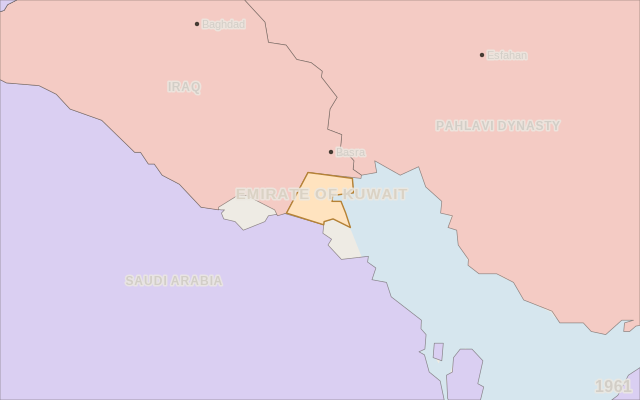
Map: Emirate of Kuwait in 1961, its borders in gold among its neighbours
Beside it on the map in 1961: Saudi Arabia, Pahlavi Iran, Iraq, United Kingdom, United Arab Republic and Syria.How far it reached, year by year: its ground inside the borders Cliopatria draws (CC BY 4.0), measured on an equal-area grid; the map shows it at its largest, with the cities of the year.

The story

Its key moments

Before and after

Before it

After it

  • Kuwait · followed by · 1991 – present

Where it sits in time

3000 BCE2000 BCE1000 BCE110002000Bani Khalid Emirate: 1669 – 1796Kuwait: 1991 – 2026Emirate of Kuwait: 1752 – 1961

Five thousand years, 3000 BCE to 2026; the state in gold, what it replaced or followed and what replaced or followed it in grey.

Its people

Lives across the Emirate of Kuwait

170017501800185019001950
Statesmen and generalsLived on after it endedAll its people on the timeline →

How it was governed

11 heads

11 heads on record, 1752 to 1961; a reign lasted 15 years at the median. Each bar is a reign, as long as it lasted.

Sabah I bin Jaber · 1752 – … · no end recordedAbdullah I Al-Sabah · 1763 – 1814 · died in office, manner not recordedJaber I Al-Sabah · 1814 – 1859 · died in office, manner not recordedSabah II Al-Sabah · 1859 – 1866 · died in office, manner not recordedAbdullah II Al-Sabah · 1866 – 1892 · died in office, manner not recordedMuhammad bin Sabah Al-Sabah · 1892 – 1896 · killedMubarak Al-Sabah · 1896 – 1915 · died in office of natural causesJaber II Al-Sabah · 1915 – 1917 · died in office, manner not recordedSalim Al-Mubarak Al-Sabah · 1917 – 1921 · died in office, manner not recordedAhmad Al-Jaber Al-Sabah · 1921 – 1950 · died in office of natural causesAbdullah Al-Salim Al-Sabah · 1950 – 1961 · left office alive1800185019001950
How their terms ended, where it is known (10 of 11):Killed 1Died in office 8Left office alive 1Not on record 1
Every term, with how it ended and its source

Rulers

5 terms are shared from Kuwait.

How 11 reigns ended - choose one to show only those

How they died, where the record says: died of natural causes 3 · killed 1.

RulerReignLengthHow it ended · sourceTo the ruler before
18th century · 2 reigns
Sabah I bin Jaber · from the line of Kuwait · aged 521752 – —no end recordedending not on record
Abdullah I Al-Sabah · from the line of Kuwait · aged 231763 – 181451 yearsdied in officeread off the dates alone
19th century · 5 reigns · 1 killed or removed
Jaber I Al-Sabah · from the line of Kuwait · aged 441814 – 185945 yearsdied in officeread off the dates alone
Sabah II Al-Sabah · from the line of Kuwait1859 – 18667 yearsdied in officeread off the dates alone
Abdullah II Al-Sabah · from the line of Kuwait · aged 521866 – 189226 yearsdied in officeread off the dates alone
Muhammad bin Sabah Al-Sabah · aged 541892 – 18964 yearskilled in officeWikidata's manner of death
Mubarak Al-Sabah · aged 581896 – 191519 yearsdied in officeWikidata's manner of deathdied of natural causessibling
20th century · 4 reigns
Jaber II Al-Sabah · aged 551915 – 19172 yearsdied in officeread off the dates alonechild
Salim Al-Mubarak Al-Sabah · aged 531917 – 19214 yearsdied in officeread off the dates alonesibling
Ahmad Al-Jaber Al-Sabah · aged 361921 – 195029 yearsdied in officeWikidata's manner of deathdied of natural causesnephew or niece
Abdullah Al-Salim Al-Sabah · aged 551950 – 196111 yearsleft office aliveread off the dates alonedied of natural causescousin

11 rulers, 11 with terms dated as terms, covering 1752 – 1961. Median reign 15 years. 1 of 10 handovers irregular - a killing, a deposition, a rival claimant, a rising or a coup beside it. A blank in the last column means no kin on record, which is coverage, never “unrelated”.

Flags and arms, in order

  • Flag of Kuwait Al-Sulami 1746-1871
    flag, 1746 – 1871Flag of Kuwait Al-Sulami 1746-1871 · CC BY-SA 4.0 · Tcfc2349
  • Flag of the Ottoman Empire (1844–1922)
    flag, 1871 – 1914Flag of the Ottoman Empire (1844–1922) · Public domain
  • Flag of Kuwait (1914-1921)
    flag, 1914 – 1921Flag of Kuwait (1914-1921) · CC BY-SA 4.0 · Tcfc2349
  • Flag of Kuwait (1921-1940)
    flag, 1921 – 1940Flag of Kuwait (1921-1940) · CC BY-SA 4.0 · Tcfc2349
  • Coat of Arms of Kuwait (1940–1956)
    coat of arms, 1940 – 1956Coat of Arms of Kuwait (1940–1956) · CC BY-SA 4.0 · User: Felipe Fidelis Tobias
  • Flag of Kuwait (1940-1961)
    flag, 1940 – 1961Flag of Kuwait (1940-1961) · CC BY-SA 4.0 · Tcfc2349

Longest reigns

All 11 terms, year by year, in the atlas →

Its world

Who else stood

Meanwhile, elsewhere

The best-known states of other regions that stood while it did; the band is the Emirate of Kuwait’s own years.

17501800185019001950

How it compares

Among 3,073 states

Stood longer than 63% of 3,073 states
Emirate of Kuwait · 209 yearsGreenlandAchaemenid EmpireHow long it stood, among the states with a recorded end or still standing.
Held more ground at its peak than 18% of 1,464 states
Emirate of Kuwait · 14,200 km²MontenegroKuwaitThe most ground it held, among the states with a border in Cliopatria.

Why it fell

Why did the Emirate of Kuwait fall?

Historians still argue. Here is what the atlas records about its last century:

1896

Muhammad bin Sabah Al-Sabah, killed in office

What led to it, and what came of it

Bani Khalid Emirate · Linked · 1669 – 1796Bani Khalid EmirateEmirate of Kuwait · 1752 – 1961Emirate of KuwaitKuwait · Linked · 1991 – 2026Kuwait1700180019002000
linked

Open the investigation: every row with its evidence, the conditions at the time, the theories condition by condition, and the succession analysed.

Theories that apply to its ending

  • Elite conflict

    Lachmann 2000 · Lachmann 2010

    Applies by its own logic: 2 of its 2 conditions held here (it needs all of them), and this is the kind of outcome it predicts — adverse regime change, unrest or the state's ending.

    • 2 or more elite groups in the regime's support, or a parliament met within 100 y — the aristocracy, business elites (1900)
    • an elite group among the regime's opposition within 5 y, or an elite group left the regime's support over 10 y, or a monarch deposed or killed by others within 20 y, or overlapping reigns — rival claimants — within 20 y — the aristocracy (1956)

Its centuries in the record

1700 – 1799: 1 recorded — 0 wars and battles, 0 risings, regime changes and massacres, 1 other17001800 – 1899: 6 recorded — 0 wars and battles, 0 risings, regime changes and massacres, 6 other18001900 – 1999: 0 recorded — 0 wars and battles, 0 risings, regime changes and massacres, 0 other1900

Wars and battles in red, risings, coups and massacres beside them, everything else in grey, by the century each began in. A tall bar is partly a fact about Wikipedia: better-documented centuries hold more.

Each century’s own page:1700 – 17991800 – 18991900 – 1999

Keep exploring

Share this page
Copy link
Embed the map
Cite this page

How this page is made

Drawn from Wikidata (Q3480281, CC0), borders from Cliopatria (CC BY 4.0), coast and rivers from Natural Earth, cities from Reba, Reitsma & Seto 2016 (CC BY 4.0), symbols from Wikimedia Commons, each under its own licence. Data built 2026-11-26 · Pastlas v2.47.1, by Oleh Voronko; the published atlas and its data are for non-commercial use.

How to read it

Areas are measured on an equal-area grid from borders simplified to about five kilometres. “c.” marks an approximate date, and a date known to the century is never printed to the year. Counts are what the atlas holds, and they follow Wikipedia’s coverage: a busy century is partly a fact about the record.

  • Wikidata records foundings in 1752 and 1899; the atlas draws the article's infobox.
  • Wikidata's English label: Sheikhdom of Kuwait.

Something wrong?

Tell us and name the entry. We fix the data, not just this page.

Report a problem