State · Middle East and North Africa

Pahlavi Iran

1925 – 1979 · 54 years

Came after Qajar Iran · became Iran and Interim Government of Iran

Iran's last royal dynasty: founded by a soldier after a coup, devoted to a pre-Islamic Iranian nationalism, and swept away by revolution.

The Pahlavi dynasty was founded by Reza Khan, a soldier of Mazanderani origin who rose through the 1921 coup d'état. Once the whole country was in hand by 1923, the Majlis deposed Ahmad Shah Qajar and in 1925 declared Reza Pahlavi Shah; British and clerical opposition ended his plan for a republic. The dynasty ruled Iran as an autocracy, pluralistic only from 1941 to 1953, until the Iranian Revolution overthrew it in 1979.

What the record holds

Pahlavi Iran began in 1925, replacing Qajar Iran.↓ In 1924, the first year its borders are mapped, it covered 1.63 million km².↓ Between the start and the end of the Iran crisis of 1946, 1945 – 1946, it went from 1.16 million km² to 1.45 million km².↓

The record names 2 rulers in its line, covering 1925 – 1979, the median reign 27 years; its one handover was regular.↓ The best known of them are Mohammad Reza Pahlavi and Reza Shah.↓ Most of the 68 rows the atlas files under it are people.↓

It was replaced by Iran and the Interim Government of Iran in 1979, 54 years after it began.↓ Its end fits “Demographic-structural breakdown” and “The five conditions of revolution”, every condition present.↓

From Wikipedia’s article, retold · CC BY-SA 4.0

54 years

Longer than Austria-Hungary, shorter than Hamburg

1.63 million km²

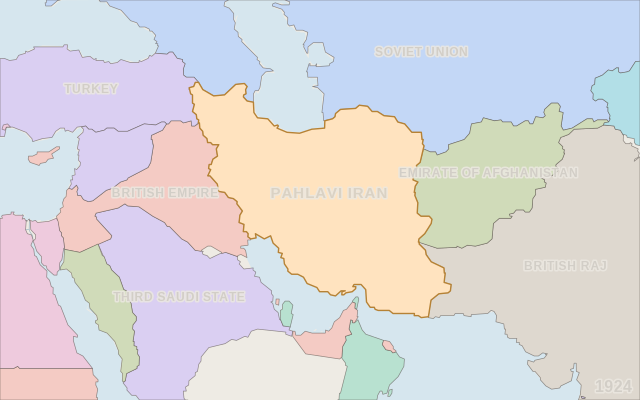
At its height in 1924 · about the size of Iran

2 rulers

on record

4 wars and battles

More per century than 98% of states · 68 entries in all

Map: Pahlavi Iran in 1924, its borders in gold among its neighbours
Anglo-Soviet invasion of Iran, 1941Iran crisis of 1946, 1945 – 1946: 1.16 million km² → 1.45 million km²1953 Iranian coup d'état, 195319301940195019601970
Beside it on the map in 1924: Soviet Union, British Raj, Third Saudi state, British Empire, Turkey and Emirate of Afghanistan.How far it reached, year by year: its ground inside the borders Cliopatria draws (CC BY 4.0), measured on an equal-area grid; the map shows it at its largest, with the cities of the year.

The story

Two acts, 1925 – 1979

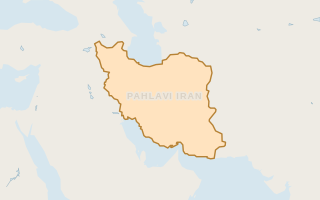
Pahlavi Iran in 1940, at the end of act I
I1925 – 19411.63 million → 1.63 million km²

Reza Shah's new order

Declared Shah by the Majlis in 1925, Reza Shah drops his plan for a republic and rules as an autocrat, espousing an Iranian nationalism drawn from the pre-Islamic past. The Goharshad Mosque rebellion breaks out in 1935, the Treaty of Saadabad is signed in 1937, and in 1941 comes the Anglo-Soviet invasion.

Watch this act on the live map, from 1925
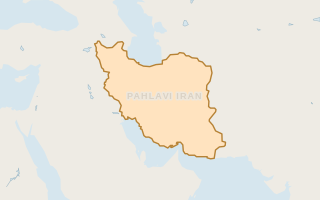
Pahlavi Iran in 1978, at the end of act II
II1941 – 19791.63 million → 1.63 million km²

Mohammad Reza Pahlavi's reign

Mohammad Reza Pahlavi becomes shah in 1941, and a pluralistic period lasts until Mohammed Mossadegh is overthrown in 1953. Authoritarian rule then returns, with a brief spell as a one-party state. The Siahkal incident comes in 1971; in 1978 protest erupts in Qom, and the Iranian Revolution of 1978 to 1979 removes the dynasty.

Watch this act on the live map, from 1941

Before and after

Before it

After it

  • Interim Government of Iran · replaced by
  • Iran · replaced by · 1979 – present

Where it sits in time

3000 BCE2000 BCE1000 BCE110002000Qajar Iran: 1789 – 1925Iran: 1979 – 2026Pahlavi Iran: 1925 – 1979

Five thousand years, 3000 BCE to 2026; the state in gold, what it replaced or followed and what replaced or followed it in grey.

Its people

Lives across Pahlavi Iran

190019251950197520002025
Statesmen and generalsWriters, artists and thinkersScientists and explorersLived on after it endedAll its people on the timeline →

How it was governed

Its rulers

2 rulers on record, 1925 to 1979; a reign lasted 27 years at the median. Each bar is a reign, as long as it lasted.

Reza Shah · 1925 – 1941 · abdicated, the article saysMohammad Reza Pahlavi · 1941 – 1979 · deposed, the article says19301940195019601970
How their terms ended, where it is known (2 of 2):Deposed or removed 2
Every term, with how it ended and its source

Rulers

RulerReignLengthHow it ended · sourceTo the ruler before
20th century · 2 reigns · 2 killed or removed
Reza Shah · aged 471925 – 194116 yearsabdicatedread from the ruler's own articledied of natural causes
Mohammad Reza Pahlavi · aged 221941 – 197938 yearsdeposedread from the ruler's own articledied of natural causeschild

2 rulers, 2 with terms dated as terms, covering 1925 – 1979. Median reign 27 years. 0 of 1 handovers irregular - a killing, a deposition, a rival claimant, a rising or a coup beside it. A blank in the last column means no kin on record, which is coverage, never “unrelated”.

Flags and arms, in order

  • State flag of Iran (1964–1980)
    flag, undatedState flag of Iran (1964–1980) · Public domain
  • The Imperial Coat of Arms of Iran
    coat of arms, 1932 – 1979The Imperial Coat of Arms of Iran · CC0

Its world

Who else stood

Meanwhile, elsewhere

The best-known states of other regions that stood while it did; the band is Pahlavi Iran’s own years.

1920194019601980

How it compares

Among 3,073 states

Stood longer than 35% of 3,073 states
Pahlavi Iran · 54 yearsAustria-HungaryHamburgHow long it stood, among the states with a recorded end or still standing.
Held more ground at its peak than 89% of 1,464 states
Pahlavi Iran · 1,625,300 km²LibyaIranThe most ground it held, among the states with a border in Cliopatria.
Had more wars on record per century than 98% of 3,073 states
Pahlavi Iran · 3.0Wars recorded per century, among the states, counting the wars the atlas hosts under each.

Why it fell

Why did Pahlavi Iran fall?

Historians still argue. Here is what the atlas records about its last century:

1979

Mohammad Reza Pahlavi, deposed or removed in office

What led to it, and what came of it

Qajar Iran · Linked · 1789 – 1925 · “During the late 19th and early 20th centuries, Iran faced financial difficulties under the weakened Qajar dynasty, stemming from limited industrialization and…”Qajar IranPersian Constitutional Revolution · In the article · 1905 · “Iranian dependence on the two empires intensified with the 1907 Anglo-Russian Convention, which formally divided Iran into British and Russian spheres of infl…”Persian Constitutional RevolutionAnglo-Russian Convention · In the article · 1907 · “Iranian dependence on the two empires intensified with the 1907 Anglo-Russian Convention, which formally divided Iran into British and Russian spheres of infl…”Anglo-Russian ConventionKhazʽal Ibn Jabir · Coincidence · 1863 – 1936Khazʽal Ibn JabirMohammad Mosaddegh · Coincidence · 1882 – 1967Mohammad MosaddeghMohammad Farrokhi Yazdi · Coincidence · 1889 – 1939Mohammad Farrokhi YazdiPahlavi Iran · 1925 – 1979Pahlavi IranIran · Linked · 1979 – 2026IranInterim Government of Iran · Linked · 1979Interim Government of IranIranian Revolution · In the article · 1978 · “This led to the successful Iranian Revolution of 1979 and a new, still undemocratic, regime. Khomeini appointed the politically moderate Mehdi Bazargan as pri…”Iranian Revolution18001850190019502000
in the articlelinkedcoincidence

Open the investigation: every row with its evidence, the conditions at the time, the theories condition by condition, and the succession analysed.

Theories that apply to its ending

  • Demographic-structural breakdown

    Goldstone 1991 · Turchin & Nefedov 2009

    Applies by its own logic: 2 of its 3 conditions held here (it needs 2), and this is the kind of outcome it predicts — unrest, adverse regime change or the state's ending.

    • famine, plague or disaster within 30 y in the state, or population up 25% over 50 y — prior
    • a war the state is fighting, still under way, or a war the state fought, ended within 10 y — warEnded
  • The five conditions of revolution

    Goldstone 2014 · Goldstone 2001

    Applies by its own logic: 5 of its 5 conditions held here (it needs 4), and this is the kind of outcome it predicts — unrest, adverse regime change or the state's ending.

    • GDP per capita down 5% over 5 y, or a war the state is fighting, still under way, or a war the state fought, ended within 5 y, or famine within 5 y in the state — warEnded
    • an elite group among the regime's opposition within 5 y, or an elite group left the regime's support over 10 y, or a monarch deposed or killed within 10 y, or overlapping reigns — rival claimants — within 10 y, or 2 or more reigns of two years or less within 10 y — the aristocracy, agrarian elites, civil servants (1979)
    • mass mobilisation at 3 or more of 4 within 5 y, or a popular class among the regime's opposition within 5 y, or unrest within 5 y in the state — many large-scale and small-scale events (1978); urban working classes, urban middle classes, rural working classes (1979); prior
    • anti-system movements at 3 or more of 4 within 5 y — a very high level, a real and present threat (1976)
    • a foreign patron left the regime's support, or its foreign policy became its own, within 5 y — the state regained its foreign-policy autonomy (1979)

In the record

68 entries the atlas files under it, all in 1900 – 1999.

Keep exploring

Share this page
Copy link
Embed the map
Cite this page

How this page is made

Drawn from Wikidata (Q107258515, CC0), the opening and history of its English Wikipedia article retold by the atlas (CC BY-SA 4.0), borders from Cliopatria (CC BY 4.0), coast and rivers from Natural Earth, cities from Reba, Reitsma & Seto 2016 (CC BY 4.0), symbols from Wikimedia Commons, each under its own licence. Data built 2026-11-26 · Pastlas v2.47.1, by Oleh Voronko; the published atlas and its data are for non-commercial use.

How to read it

Areas are measured on an equal-area grid from borders simplified to about five kilometres. “c.” marks an approximate date, and a date known to the century is never printed to the year. Counts are what the atlas holds, and they follow Wikipedia’s coverage: a busy century is partly a fact about the record.

  • Held with the record of Pahlavi dynasty, merged into this one.

Something wrong?

Tell us and name the entry. We fix the data, not just this page.

Report a problem