State · Europe

Carolingian Empire

800 – 887 · 87 years

Came after Francia and Duchy of Brescia · became West Francia and East Francia

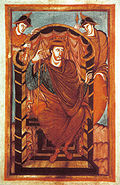
The Frankish empire of Charlemagne, crowned Roman emperor by the Pope, which held most of Western Europe before splitting among his heirs.

In 800 Pope Leo III crowned Charlemagne Roman emperor in return for protection. His empire, centred on Francia between the Loire and the Rhine, with Aachen as his chief residence, spread across Western and Central Europe. After his son Louis the Pious died, a civil war split it into kingdoms under an emperor of little authority. Charles the Fat reunited them in 884, but the Frankish nobles deposed him in 887 and the empire fell apart.

What the record holds

The Carolingian Empire began in 800, replacing Francia and the Duchy of Brescia.↓ Its highest office was held by 6 rulers, covering 800 – 887, the median reign 20.5 years; 3 of 5 handovers were irregular.↓ The best known of them are Charlemagne, Louis the Pious and Charles the Bald.↓ Most of the 3 rows the atlas files under it are people.↓

West Francia and East Francia replaced it in 887, after 87 years.↓

From Wikipedia’s article, retold · CC BY-SA 4.0

87 years

Longer than the Kingdom of Italy, shorter than the British Raj

6 rulers

the Emperor of the Carolingian Empire

Its borders aren’t on record

The borders dataset does not draw the Carolingian Empire. The live map still shows where it stood among the states of its years.

Find it on the live map

The story

Four acts, 800 – 887

I800 – 814

Charlemagne's empire

Crowned Roman emperor in 800, Charlemagne rules most of Western Europe, much as the Romans once did. His reign is near-constant war, with yearly campaigns he often leads himself; he holds the land to the Elbe more lastingly than the Romans. He makes Aachen his chief residence.

Watch this act on the live map, from 800
III843 – 877

The Treaty of Verdun

At Verdun in 843 the three sons of Louis the Pious divide the empire: Lothar takes the imperial title, Italy and the lands between the Rhine and the Rhone; Louis the east, forerunner of Germany; Charles the west. Lothar gives Italy to his son Louis II, co-emperor from 850. Emperors keep their title but little power beyond their own kingdoms.

Watch this act on the live map, from 843
IV877 – 887

Vikings and the last reunion

After Charles the Bald dies in 877, Vikings strike the north and west, strife runs from Italy to the Baltic and the imperial title lapses. Charles the Fat, handed Italy when his brother Carloman of Bavaria suffers a stroke, reunites all the Carolingian kingdoms in 884, but the Frankish nobility depose him in 887.

Watch this act on the live map, from 877

Before and after

Before it

  • Francia · replaces · 481 – 843
  • Duchy of Brescia · replaces

After it

Where it sits in time

3000 BCE2000 BCE1000 BCE110002000Francia: 481 – 843East Francia: 843 – 962West Francia: 843 – 987Middle Francia: 843 – 855Carolingian Empire: 800 – 887

Five thousand years, 3000 BCE to 2026; the state in gold, what it replaced or followed and what replaced or followed it in grey.

Its people

Lives across the Carolingian Empire

Notable figures

How it was governed

6 emperors

6 emperors on record, 800 to 887; a reign lasted 20.5 years at the median. Each bar is a reign, as long as it lasted.

Charlemagne · 800 – 814 · no death date to read the end againstLouis the Pious · 813 – 840 · no death date to read the end againstLothair I · 817 – 855 · no death date to read the end againstLouis II of Italy · 844 – 875 · no death date to read the end againstCharles the Bald · 875 – 877 · no death date to read the end againstCharles the Fat · 881 – 887 · no death date to read the end against800820840860880
a second row: a reign that began before the last had ended — rival claimants, or a shared throne
How their terms ended, where it is known (0 of 6):Not on record 6
Every term, with how it ended and its source

Rulers

RulerReignLengthHow it ended · sourceTo the ruler before
8th century · 1 reign
Charlemagne800 – 81414 yearsending not on recorddied of natural causes
9th century · 5 reigns
Louis the Pious813 – 84027 yearsending not on recordchild
Lothair I817 – 85538 yearsending not on recordchild
Louis II of Italy844 – 87531 yearsending not on recorddied of natural causeschild
Charles the Bald875 – 8772 yearsending not on recorddied of natural causes
Charles the Fat881 – 8876 yearsending not on recorddied of natural causesnephew or niece

6 rulers, 6 with terms dated as terms, covering 800 – 887. Median reign 20.5 years. 3 of 5 handovers irregular - a killing, a deposition, a rival claimant, a rising or a coup beside it. A blank in the last column means no kin on record, which is coverage, never “unrelated”.

Its world

Who else stood

Meanwhile, elsewhere

The best-known states of other regions that stood while it did; the band is the Carolingian Empire’s own years.

800820840860880900

How it compares

Among 3,073 states

Stood longer than 43% of 3,073 states
Carolingian Empire · 87 yearsKingdom of ItalyBritish RajHow long it stood, among the states with a recorded end or still standing.

Why it fell

Why did the Carolingian Empire fall?

Historians still argue. Here is what the atlas records about its last century:

What led to it, and what came of it

Duchy of Brescia · Linked · 568 – 774Duchy of BresciaFrancia · Linked · 481 – 843FranciaCarolingian conquest of the Spanish March · Linked · 759 – 851Carolingian conquest of the Span…Pepin of Italy · Coincidence · 777 – 810Pepin of ItalyLouis the Pious · Coincidence · 778 – 840Louis the PiousRabanus Maurus · Coincidence · 780 – 856Rabanus MaurusCarolingian Empire · 800 – 887Carolingian EmpireWest Francia · Linked · 843 – 987West FranciaEast Francia · Linked · 843 – 962East Francia5006007008009001000
linkedcoincidence

Open the investigation: every row with its evidence, the conditions at the time, the theories condition by condition, and the succession analysed.

In the record

3 entries the atlas files under it, all in 800 – 899.

Keep exploring

Share this page
Copy link
Cite this page

How this page is made

Drawn from Wikidata (Q31929, CC0), the opening and history of its English Wikipedia article retold by the atlas (CC BY-SA 4.0). Data built 2026-11-26 · Pastlas v2.47.1, by Oleh Voronko; the published atlas and its data are for non-commercial use.

How to read it

Areas are measured on an equal-area grid from borders simplified to about five kilometres. “c.” marks an approximate date, and a date known to the century is never printed to the year. Counts are what the atlas holds, and they follow Wikipedia’s coverage: a busy century is partly a fact about the record.

Something wrong?

Tell us and name the entry. We fix the data, not just this page.

Report a problem