Operation Moshtarak
battle · 13 February 2010
State · South Asia
2002 – present · 24 years · still standing
A crossroads of Central and South Asia where an Islamic Republic fought the Taliban until they took Kabul and restored their emirate.
In late 2001 American and British forces, with the Northern Alliance, brought down the Taliban, who had sheltered Osama bin Laden. An interim administration under Hamid Karzai took over, and an international security force was formed. Coalition operations ran for two decades, from Anaconda in 2002 to the Resolute Support Mission. When NATO began withdrawing in 2021, the Taliban advanced fast, took Kabul on 15 August and restored their emirate, now led by Hibatullah Akhundzada.
Its record opens in 2002.↑ When the borders dataset first draws it, in 2003, it held 83,100 km².↓
It reached its greatest extent in 2006: 644,100 km².↓ Its line counts 5 rulers, covering 1996 – 2021; 2 of 4 handovers were irregular.↓ Among them,  Ashraf Ghani, Hibatullah Akhundzada and Mullah Omar are the best known.↓ The atlas files 49 rows under it, most of them wars and battles.↓
From Wikipedia’s article, retold · CC BY-SA 4.0
Best known for
24 years
Longer than South Vietnam, shorter than the Republic of Artsakh
644,000 km²
At its height in 2006 · about the size of Somalia
5 rulers
the Supreme Leader of Afghanistan
25 wars and battles
More per century than 99% of states · 49 entries in all
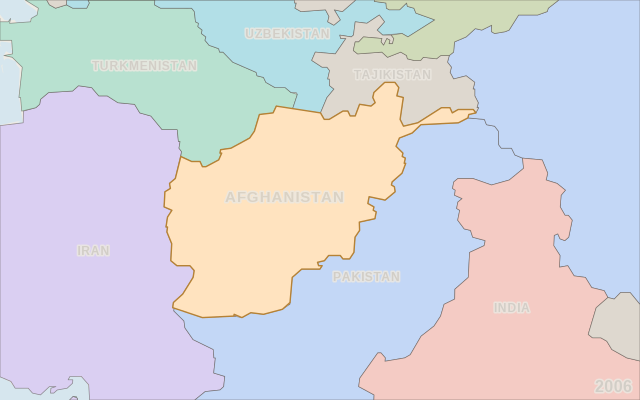
 Iran,
 Pakistan,
 People's Republic of China,
 India,
 Turkmenistan and
 Uzbekistan.How far it reached, year by year: its ground inside the borders Cliopatria draws (CC BY 4.0), measured on an equal-area grid; the map shows it at its largest, with the cities of the year.
The story
The best-known wars, battles, risings and changes of regime the record files under it; a war within a war is folded into it.
battle · 13 February 2010
battle · 2014 – 2021
battle · 15 August 2021
unrest · 2021 – present
war · 21 February 2026
Five thousand years, 3000 BCE to 2026; the state in gold.
Its people
One axis for everyone, so you can see who knew whom: the best-known, ordered by birth.
The best-known people the record files under it, by how many Wikipedias write about them.
 Hasan Akhundruler · born 2000, living
 Gulbuddin Hekmatyarruler · born 1949, living
 Akhtar Mansurruler · 1968 – 2016
 Mohammad Qasim Fahimpolitician · 1957 – 2014
 Abdul Kabirruler · born 1958, living
How it was governed
5 leaders on record, 1996 to 2021. Each bar is a reign, as long as it lasted.
The line of Supreme Leader of Afghanistan - the office this state names as its head of state.
| Ruler | Reign | Length | How it ended · source | To the ruler before |
|---|---|---|---|---|
| 20th century · 1 reign | ||||
| Mullah Omar · aged 36 | 1996 – 2001 | 5 years | left office aliveread off the dates alonedied of natural causes | |
| 21st century · 4 reigns · 1 killed or removed | ||||
 Burhanuddin Rabbani · aged 61 | 2001 – 2001 | under a year | left office aliveread off the dates alonekilled | |
 Ashraf Ghani · aged 65 | 2014 – 2021 | 7 years | ending not on record | |
| Akhtar Mansur · aged 47 | 2015 – 2016 | 1 year | killed in officeWikidata's manner of death | |
| Hibatullah Akhundzada · aged 54 | 2021 – in office | in office since 2021 | still in office | |
5 rulers, 5 with terms dated as terms, covering 1996 – 2021. Only 25 years of the line are dated - too short for a median. 2 of 4 handovers irregular - a killing, a deposition, a rival claimant, a rising or a coup beside it. The violent-handover count is withheld: power changed hands so often that any rising falls beside one (exposure 0.81, limit 0.6). A blank in the last column means no kin on record, which is coverage, never “unrelated”.
The line of Prime Minister of Afghanistan, drawn and never measured: a cabinet is not a reign.
 Gulbuddin Hekmatyar | lived 1949 – … |
| Mullah Omar | 1996 – 2001 |
| Mohammad Rabbani | 1996 – 2001 |
| Abdul Rahim Ghafoorzai | 1997 – 1997 |
 Abdul Kabir | 2001 – 2001 |
 Hasan Akhund | 2021 – 2023 |
| Hasan Akhund | 2023 – … |
| Abdul Kabir | 2023 – 2023 |
Each symbol with the years its own statement gives; the timeline flies the one of the year on screen.





15 more in the atlas.
Ashraf Ghani7 yrsAkhtar Mansur1 yrsBurhanuddin Rabbani0 yrsIts world
Wars and battles both took part in, on whichever side: the record names who took part, not who fought whom.
 United StatesResolute Support Mission13
 United KingdomResolute Support Mission8
 AustraliaResolute Support Mission3Pakistan2026 Afghanistan–Pakistan war2
 GermanyResolute Support Mission2
 Czech RepublicResolute Support Mission2
 RomaniaResolute Support Mission2
The best-known states of other regions that stood while it did; the band is Afghanistan’s own years.
United StatesAmericas and Oceania MexicoAmericas and Oceania
 TurkeyMiddle East and North Africa
 ItalyEurope
 JapanEast and Southeast Asia
 EgyptMiddle East and North Africa
 South AfricaSub-Saharan Africa
 RussiaEurope
How it compares
Each column is a share of the states; gold is Afghanistan.
How it began
This state took shape in December 2001, when the Taliban government had been overthrown and an interim administration under Hamid Karzai was formed.
The investigation's own picture: 17 causes the record names and 0 results, the strongest six of each at their own years, joined to the state by the kind of claim - a recorded statement solid, the article's sentence dashed, a theory dash-dot.
Open the investigation: every row with its evidence, the conditions at the time, the theories condition by condition, and the succession analysed.
49 entries the atlas files under it, all in 2000 – 2099.
“Afghanistan”, Pastlas, a historical atlas, 2026-11-26. https://app.pastlas.com/state/afghanistan/
Drawn from Wikidata (Q889, CC0), the opening and history of its English Wikipedia article retold by the atlas (CC BY-SA 4.0), borders from Cliopatria (CC BY 4.0), coast and rivers from Natural Earth, cities from Reba, Reitsma & Seto 2016 (CC BY 4.0), symbols from Wikimedia Commons, each under its own licence. Data built 2026-11-26 · Pastlas v2.47.1, by Oleh Voronko; the published atlas and its data are for non-commercial use.
Areas are measured on an equal-area grid from borders simplified to about five kilometres. “c.” marks an approximate date, and a date known to the century is never printed to the year. Counts are what the atlas holds, and they follow Wikipedia’s coverage: a busy century is partly a fact about the record.