Period · East and Southeast Asia

Warring States period

476 – 221 BCE · 255 years

Came after Spring and Autumn period · became Qin dynasty

The Zhou dynasty's last centuries, when seven rival states fought and reformed until Qin conquered them all.

The Warring States period was the last stretch of the Zhou dynasty, from c. 475 BCE, when the Zhou king reigned only as a figurehead. Seven major states fought wars of growing scale while reforming their armies and governments: Qin, Chu, Qi, Han, Wei, Zhao and Yan. It ended in 221 BCE, when Qin had annexed every rival and founded the Qin dynasty, the first imperial dynasty in East Asia.

What the record holds

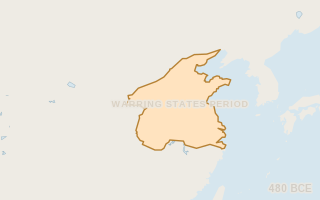
Its record opens in 476 BCE, after Spring and Autumn period.↓ When the borders dataset first draws it, in 480 BCE, it held 1.01 million km².↓

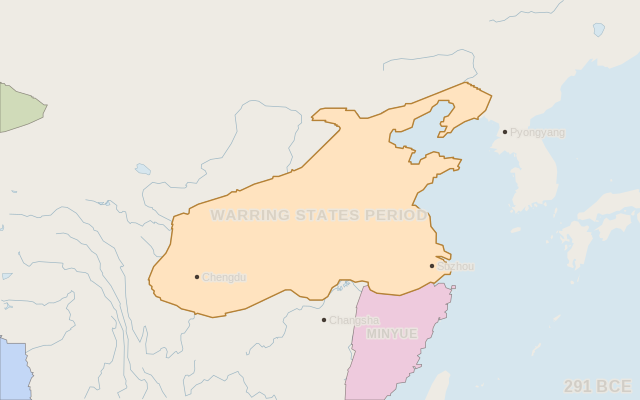
At its largest, in 291 BCE, it held 1.63 million km².↓ The record names 11 rulers in its line, covering 476 BCE – 256 BCE, the median reign 14 years; 1 of 10 handovers was irregular.↓ Among them, King An of Zhou, King Lie of Zhou and King Xian of Zhou are the best known.↓

The Qin dynasty followed it in 221 BCE, after 255 years.↓

From Wikipedia’s article, retold · CC BY-SA 4.0

255 years

Longer than the Gupta Empire, shorter than the Golden Horde

1.63 million km²

At its height in 291 BCE · about the size of Iran

11 rulers

the Chinese king

Map: Warring States period in 291 BCE, its borders in gold among its neighbours
450 BCE400 BCE350 BCE300 BCE250 BCE
Beside it on the map in 291 BCE: State of Qin, State of Chu, Minyue, State of Qi, State of Yan and State of Wei.How far it reached, year by year: its ground inside the borders Cliopatria draws (CC BY 4.0), measured on an equal-area grid; the map shows it at its largest, with the cities of the year.

The story

Four acts, 476 – 221 BCE

Warring States period in 404 BCE, at the end of act I
I476 – 403 BCE1.01 million → 1.0 million km²

The partition of Jin

By 453 BCE Jin is torn by civil war among its four ruling clans. Zhi Yao and two reluctant allies besiege the Zhao at Jinyang, but Zhao persuades the allies to flood Zhi's camp, and his family is wiped out. In 403 BCE the Zhou court makes the heads of Zhao, Wei and Han marquises.

Watch this act on the live map, from 476 BCE
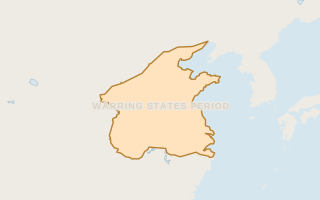
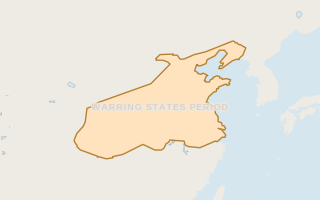
Warring States period in 339 BCE, at the end of act II
II403 – 338 BCE1.0 million → 1.0 million km²

Wei's primacy and Qin's reform

In 376 BCE Han, Wei and Zhao depose Duke Jing of Jin and share out what is left of his state. In Qi the Tian family seizes power and title. Under Marquess Wen, Wei becomes the strongest state in China. Shang Yang then remakes backward Qin with new taxes, state management of the economy and standard weights and measures.

Watch this act on the live map, from 403 BCE
Warring States period in 231 BCE, at the end of act III
III338 – 230 BCE1.0 million → 1.63 million km²

Qin's rise and the alliances

Qin defeats northern nomads and seizes fertile land to the southwest. In 325 BCE Huiwen of Qin proclaims himself king, and the other rulers take the title too. Su Qin leads the Vertical Alliances against Qin's power, Zhang Yi the Horizontal Alliances on its side, and an allied attack fails at the Hangu Pass in 318 BCE.

Watch this act on the live map, from 338 BCE
Warring States period in 222 BCE, at the end of act IV
IV230 – 221 BCE1.63 million → 1.63 million km²

Qin unites China

Qin's young king Zheng unites China in a decade. Han falls first; in Zhao a bribed minister gets the generals Li Mu and Sima Shang removed; Wang Ben floods the Daliang Mountains until Jia of Wei surrenders; Wang Jian invades Chu again; and Qi, its minister bribed, falls easily. In 221 BCE Qin Shi Huang takes the title of emperor.

Watch this act on the live map, from 230 BCE
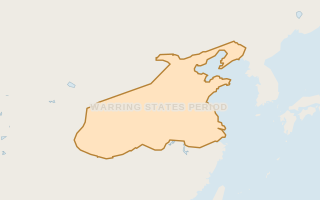
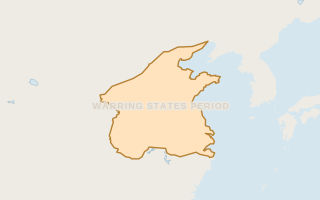
Warring States period in 291 BCE, at its largestWarring States period in 480 BCE, first mapped
The rise and the fall in one frame: drag across it from 480 BCE, first mapped at 1.01 million km², to 291 BCE, at its largest at 1.63 million km². Open the live map in 480 BCE or 291 BCE.

Before and after

Before it

After it

Where it sits in time

3000 BCE2000 BCE1000 BCE110002000Spring and Autumn period: 771 BCE – 476 BCEQin dynasty: 221 BCE – 206 BCEWarring States period: 476 BCE – 221 BCE

Five thousand years, 3000 BCE to 2026; the state in gold, what it replaced or followed and what replaced or followed it in grey.

How it was governed

11 kings

11 kings on record, 476 BCE to 256 BCE; a reign lasted 14 years at the median. Each bar is a reign, as long as it lasted.

King Yuan of Zhou · 476 BCE – 469 BCE · died in office, manner not recordedKing Zhending of Zhou · 468 BCE – 441 BCE · died in office, manner not recordedKing Si of Zhou · 441 BCE – 441 BCE · died in office, manner not recordedKing Ai of Zhou · 441 BCE – 441 BCE · killed, the article saysKing Kao of Zhou · 440 BCE – 426 BCE · died in office, manner not recordedKing Weilie of Zhou · 425 BCE – 402 BCE · died in office, manner not recordedKing An of Zhou · 402 BCE – 376 BCE · died in office, manner not recordedKing Lie of Zhou · 376 BCE – 369 BCE · died in office, manner not recordedKing Xian of Zhou · 368 BCE – 321 BCE · died in office, manner not recordedKing Shenjing of Zhou · 320 BCE – 315 BCE · died in office, manner not recordedKing Nan of Zhou · 315 BCE – 256 BCE · died in office, manner not recorded450 BCE400 BCE350 BCE300 BCE250 BCE
How their terms ended, where it is known (11 of 11):Killed 1Died in office 10
Every term, with how it ended and its source

Rulers

11 terms are shared from Eastern Zhou.

How 11 reigns ended - choose one to show only those
RulerReignLengthHow it ended · sourceTo the ruler before
5th century BCE · 7 reigns · 1 killed or removed
King Yuan of Zhou · from the line of Eastern Zhou476 BCE – 469 BCE7 yearsdied in officeread off the dates alone
King Zhending of Zhou · from the line of Eastern Zhou468 BCE – 441 BCE27 yearsdied in officeread off the dates alonechild
King Si of Zhou · from the line of Eastern Zhou441 BCE – 441 BCEunder a yeardied in officeread off the dates alonechild
King Ai of Zhou · from the line of Eastern Zhou441 BCE – 441 BCEunder a yearkilledread from the ruler's own articlesibling
King Kao of Zhou · from the line of Eastern Zhou440 BCE – 426 BCE14 yearsdied in officeread off the dates alonesibling
King Weilie of Zhou · from the line of Eastern Zhou425 BCE – 402 BCE23 yearsdied in officeread off the dates alonechild
King An of Zhou · from the line of Eastern Zhou · aged 49402 BCE – 376 BCE26 yearsdied in officeread off the dates alonechild
4th century BCE · 4 reigns
King Lie of Zhou · from the line of Eastern Zhou · aged 25376 BCE – 369 BCE7 yearsdied in officeread off the dates alonechild
King Xian of Zhou · from the line of Eastern Zhou · aged 33368 BCE – 321 BCE47 yearsdied in officeread off the dates alonesibling
King Shenjing of Zhou · from the line of Eastern Zhou320 BCE – 315 BCE5 yearsdied in officeread off the dates alonechild
King Nan of Zhou · from the line of Eastern Zhou · aged 86315 BCE – 256 BCE59 yearsdied in officeread off the dates alonechild

11 rulers, 11 with terms dated as terms, covering 476 BCE – 256 BCE. Median reign 14 years. 1 of 10 handovers irregular - a killing, a deposition, a rival claimant, a rising or a coup beside it. A blank in the last column means no kin on record, which is coverage, never “unrelated”.

Its world

Who else stood

Meanwhile, elsewhere

The best-known states of other regions that stood while it did; the band is the Warring States period’s own years.

500 BCE400 BCE300 BCE200 BCE

How it compares

Among 3,073 states

Stood longer than 69% of 3,073 states
Warring States period · 255 yearsGupta EmpireGolden HordeHow long it stood, among the states with a recorded end or still standing.
Held more ground at its peak than 89% of 1,464 states
Warring States period · 1,634,300 km²IranSudanThe most ground it held, among the states with a border in Cliopatria.

Why it fell

Why did the Warring States period fall?

Historians still argue. Here is what the atlas records about its last century:

×1.6

its land, between 321 BCE and 222 BCE

How it ended, as its article says

Replaced by Zhao. Read from the article's section “History - Conquest of Zhao and Yan” by its grammar; the claim is only that the article says so.

They were replaced with Zhao Cong and Ju Xin.

One sentence of the English Wikipedia article, CC BY-SA 4.0.

What led to it, and what came of it

Spring and Autumn period · Linked · 771 BCE – 476 BCE · “It followed the Spring and Autumn period and concluded with the wars of conquest that saw the state of Qin annex each of the other contender states by 221 BC …”Spring and Autumn periodBattle of Lize · Linked · 478 BCEBattle of LizeEastern Zhou · Linked · 771 BCE – 256 BCEEastern ZhouState of Yan · Linked · 750 BCE – 223 BCEState of YanState of Chu · Linked · 722 BCE – 223 BCEState of ChuWarring States period · 476 BCE – 221 BCEWarring States periodQin dynasty · Linked · 221 BCE – 206 BCEQin dynasty600 BCE400 BCE200 BCE
linked

Open the investigation: every row with its evidence, the conditions at the time, the theories condition by condition, and the succession analysed.

Keep exploring

Share this page
Copy link
Embed the map
Cite this page

How this page is made

Drawn from Wikidata (Q185063, CC0), the opening and history of its English Wikipedia article retold by the atlas (CC BY-SA 4.0), borders from Cliopatria (CC BY 4.0), coast and rivers from Natural Earth, cities from Reba, Reitsma & Seto 2016 (CC BY 4.0), and one sentence of the article, quoted. Data built 2026-11-26 · Pastlas v2.47.1, by Oleh Voronko; the published atlas and its data are for non-commercial use.

How to read it

Areas are measured on an equal-area grid from borders simplified to about five kilometres. “c.” marks an approximate date, and a date known to the century is never printed to the year. Counts are what the atlas holds, and they follow Wikipedia’s coverage: a busy century is partly a fact about the record.

Something wrong?

Tell us and name the entry. We fix the data, not just this page.

Report a problem