State · Europe

Volga Bulgaria

601 – 1240 · 639 years

Came after Old Great Bulgaria

A Bulgar state on the middle Volga that adopted Islam and thrived on trade between Europe and Asia.

Volga Bulgaria was a Bulgar state around the meeting of the Volga and the Kama, in today's European Russia, between the 9th and 13th centuries. Bulgars lived there beside Finno-Ugrians, East Slavs and Varangians. It adopted Islam as its state religion in 922 CE and, holding the middle Volga, controlled much of the trade between Europe and Asia, until the Tatar-Mongol army destroyed it in the 13th century.

What the record holds

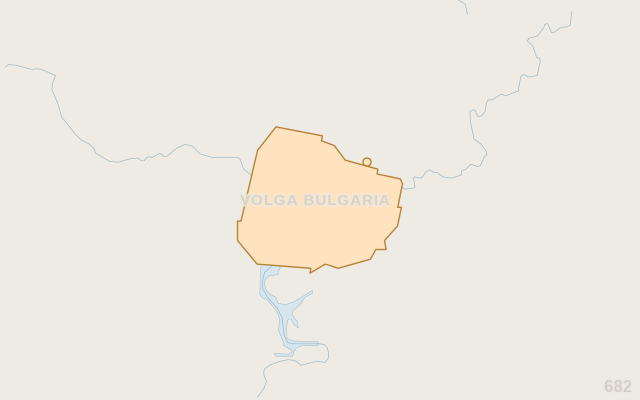
It was founded in the 7th century, after Old Great Bulgaria.↓ Its borders are first mapped in 674, around 4,100 km².↓

Its ground peaked in 682 at 44,000 km².↓ Its line counts 2 rulers, covering 815 – 925, the median reign 40 years; its one handover was regular.↓ The best known of them are Almış and Aidar.↓ Most of the 3 rows the atlas files under it are people.↓

Its own article says it was partitioned, in 1240.↓

From Wikipedia’s article, retold · CC BY-SA 4.0

Best known for

639 years

Longer than the Ottoman Empire, shorter than the House of Habsburg

44,000 km²

At its height in 682 · about the size of Armenia

2 rulers

the Volga Bulgarian elteber

1 war or battle

3 entries in all

Map: Volga Bulgaria in 682, its borders in gold among its neighbours
700800900100011001200
How far it reached, year by year: its ground inside the borders Cliopatria draws (CC BY 4.0), measured on an equal-area grid; the map shows it at its largest, with the cities of the year.

The story

Three acts, 601 – 1240

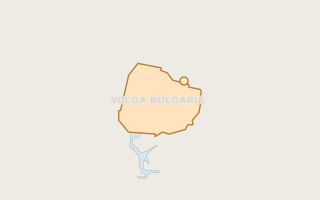
Volga Bulgaria in 921, at the end of act I
I601 – 922

From the steppe to the Volga

Where the Bulgars came from is debated; most scholars look to the steppes between modern Kazakhstan and the North Caucasus, and some tie them to the Huns. Settled where the Kama meets the Volga, they rule a mixed people of Bulgars, East Slavs, Finno-Ugrians and Varangians, under eltebers such as Aidar and Almış.

Watch this act on the live map, from 601
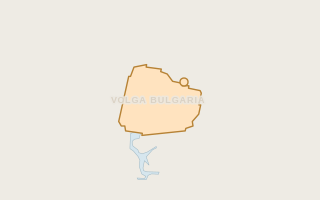
Volga Bulgaria in 1219, at the end of act II
II922 – 122044,000 → 43,100 km²

Islam and the Volga trade

After Almış appeals to the Caliph for instruction, Islam becomes the state religion in 922 CE, when an embassy arrives with Ibn Fadlan as its secretary. The Bulgars fail to win Vladimir I of Kiev, who will not give up wine. Commanding the middle Volga, the state handles much of the trade between Europe and Asia, and Bolghar thrives.

Watch this act on the live map, from 922
III1220 – 1240

Raids and destruction

From the early 13th century East Slavic princes raid the Bulgars over trade routes. In 1220 Grand Duke Yuri II of Vladimir takes Ustiug and besieges Aşlı, cutting into the northern trade and the fur supply. Then the Tatar-Mongol army destroys the state and two thirds of its people; survivors flee across the Volga and the Kama.

Watch this act on the live map, from 1220

Before and after

Before it

Where it sits in time

3000 BCE2000 BCE1000 BCE110002000Old Great Bulgaria: 632 – 668Volga Bulgaria: 601 – 1240

Five thousand years, 3000 BCE to 2026; the state in gold, what it replaced or followed and what replaced or followed it in grey.

How it was governed

2 eltebers

2 eltebers on record, 815 to 925; a reign lasted 40 years at the median. Each bar is a reign, as long as it lasted.

Aidar · 815 – 865 · died in office, manner not recordedAlmış · 895 – 925 · died in office, manner not recorded80010001200
How their terms ended, where it is known (2 of 2):Died in office 2
Every term, with how it ended and its source

Rulers

RulerReignLengthHow it ended · sourceTo the ruler before
9th century · 2 reigns
Aidar · aged 15815 – 86550 yearsdied in officeread off the dates alone
Almış · aged 45895 – 92530 yearsdied in officeread off the dates alone

2 rulers, 2 with terms dated as terms, covering 815 – 925. Median reign 40 years. 0 of 1 handovers irregular - a killing, a deposition, a rival claimant, a rising or a coup beside it. A blank in the last column means no kin on record, which is coverage, never “unrelated”.

Flag or arms

  • Печать Селитренное городище
    seal, undatedПечать Селитренное городище · Public domain

Its world

Who else stood

Meanwhile, elsewhere

The best-known states of other regions that stood while it did; the band is Volga Bulgaria’s own years.

60080010001200

How it compares

Among 3,073 states

Stood longer than 91% of 3,073 states
Volga Bulgaria · 639 yearsOttoman EmpireHouse of HabsburgHow long it stood, among the states with a recorded end or still standing.
Held more ground at its peak than 33% of 1,464 states
Volga Bulgaria · 44,000 km²ArmeniaEstoniaThe most ground it held, among the states with a border in Cliopatria.

Why it fell

Why did Volga Bulgaria fall?

Historians still argue. Here is what the atlas records about its last century:

1

wars and battles in its last century, more than in any before it

How it ended, as its article says

Partitioned by several principalities. Read from the article's section “History - Decline” by its grammar; the claim is only that the article says so.

It was divided into several principalities; each of them became a vassal of the Golden Horde and received some autonomy.

One sentence of the English Wikipedia article, CC BY-SA 4.0.

What led to it, and what came of it

Huns · In the article · 106 · “Interaction with the Hunnic tribes, causing the migration, may have occurred there, and the Pontic–Caspian steppe seems the most likely location. Some scholar…”HunsVolga Bulgaria · 601 – 1240Volga Bulgaria5001000
in the article

Open the investigation: every row with its evidence, the conditions at the time, the theories condition by condition, and the succession analysed.

Its centuries in the record

600 – 699: 0 recorded — 0 wars and battles, 0 risings, regime changes and massacres, 0 other600700 – 799: 0 recorded — 0 wars and battles, 0 risings, regime changes and massacres, 0 other700800 – 899: 2 recorded — 0 wars and battles, 0 risings, regime changes and massacres, 2 other800900 – 999: 0 recorded — 0 wars and battles, 0 risings, regime changes and massacres, 0 other9001000 – 1099: 0 recorded — 0 wars and battles, 0 risings, regime changes and massacres, 0 other10001100 – 1199: 0 recorded — 0 wars and battles, 0 risings, regime changes and massacres, 0 other11001200 – 1299: 1 recorded — 1 wars and battles, 0 risings, regime changes and massacres, 0 other1200

Wars and battles in red, risings, coups and massacres beside them, everything else in grey, by the century each began in. A tall bar is partly a fact about Wikipedia: better-documented centuries hold more.

Each century’s own page:600 – 699700 – 799800 – 899900 – 9991000 – 10991100 – 11991200 – 1299

Keep exploring

Share this page
Copy link
Embed the map
Cite this page

How this page is made

Drawn from Wikidata (Q185488, CC0), the opening and history of its English Wikipedia article retold by the atlas (CC BY-SA 4.0), borders from Cliopatria (CC BY 4.0), coast and rivers from Natural Earth, cities from Reba, Reitsma & Seto 2016 (CC BY 4.0), symbols from Wikimedia Commons, each under its own licence, and one sentence of the article, quoted. Data built 2026-11-26 · Pastlas v2.47.1, by Oleh Voronko; the published atlas and its data are for non-commercial use.

How to read it

Areas are measured on an equal-area grid from borders simplified to about five kilometres. “c.” marks an approximate date, and a date known to the century is never printed to the year. Counts are what the atlas holds, and they follow Wikipedia’s coverage: a busy century is partly a fact about the record.

Something wrong?

Tell us and name the entry. We fix the data, not just this page.

Report a problem