State · South Asia

Pallava dynasty

275 – 897 · 622 years

Came after Satavahana dynasty and Kalabhra dynasty · became Chola dynasty and Eastern Chalukyas

It was founded in 275, replacing the Satavahana dynasty and the Kalabhra dynasty.↓ Its borders are first mapped in 283, around 51,200 km².↓

Continue reading

Its ground peaked in 306 at 306,500 km².↓ Its highest office was held by 14 rulers, covering 275 – 897, the median reign 25 years; 4 of 13 handovers were irregular.↓ Among them, Mahendravarman I, Narasimhavarman I and Simhavishnu are the best known.↓ The atlas files 13 rows under it, most of them people.↓

It was replaced by the Chola dynasty and Eastern Chalukyas in 897, 622 years after it began.↓

622 years

Longer than Huns, shorter than the Ottoman Empire

307,000 km²

At its height in 306 · about the size of Poland

14 rulers

the Pallava emperor

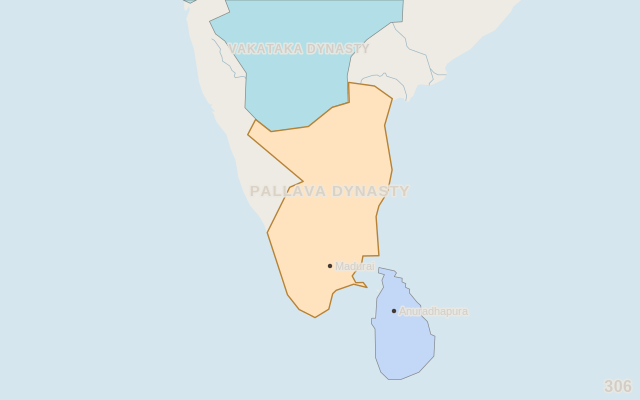
Map: Pallava dynasty in 306, its borders in gold among its neighbours
300400500600700800
Beside it on the map in 306: Vakataka dynasty, Anuradhapura kingdom and Western Satraps.How far it reached, year by year: its ground inside the borders Cliopatria draws (CC BY 4.0), measured on an equal-area grid; the map shows it at its largest, with the cities of the year.

The story

Its key moments

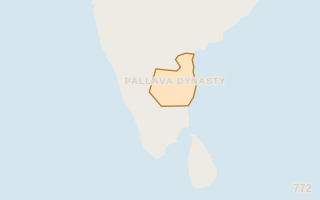
Pallava dynasty in 772, last mappedPallava dynasty in 306, at its largest
The rise and the fall in one frame: drag across it from 306, at its largest at 306,500 km², to 772, last mapped at 105,000 km². Open the live map in 306 or 772.

Before and after

Before it

After it

Where it sits in time

3000 BCE2000 BCE1000 BCE110002000Kalabhra dynasty: 250 – 600Satavahana dynasty: 230 BCE – 220Chola dynasty: 300 BCE – 1279Eastern Chalukyas: 624 – 1189Pallava dynasty: 275 – 897

Five thousand years, 3000 BCE to 2026; the state in gold, what it replaced or followed and what replaced or followed it in grey.

Its people

Lives across the Pallava dynasty

400600800
Statesmen and generalsAll its people on the timeline →

How it was governed

14 emperors

14 emperors on record, 275 to 897; a reign lasted 25 years at the median. Each bar is a reign, as long as it lasted.

Simhavarman I · 275 – 300 · no death date to read the end againstSimhavarman III · 525 – 555 · no death date to read the end againstSimhavishnu · 575 – 600 · no death date to read the end againstMahendravarman I · 590 – 630 · no death date to read the end againstNarasimhavarman I · 630 – 668 · no death date to read the end againstMahendravarman II · 668 – 669 · no death date to read the end againstParameswaravarman I · 670 – 695 · no death date to read the end againstNarasimhavarman II · 695 – 728 · no death date to read the end againstParamesvaravarman II · 725 – 731 · killed, the article saysNandivarman II · 731 – 796 · no death date to read the end againstDantivarman · 795 – 846 · no death date to read the end againstNandivarman III · 846 – 869 · no death date to read the end againstNriputungavarman · 869 – 880 · no death date to read the end againstAparajita Varman · 880 – 897 · no death date to read the end against400600800
a second row: a reign that began before the last had ended — rival claimants, or a shared throne
How their terms ended, where it is known (1 of 14):Killed 1Not on record 13
Every term, with how it ended and its source

Rulers

How 14 reigns ended - choose one to show only those
RulerReignLengthHow it ended · sourceTo the ruler before
3rd century · 1 reign
Simhavarman I275 – 30025 yearsending not on record
6th century · 3 reigns
Simhavarman III525 – 55530 yearsending not on record
Simhavishnu575 – 60025 yearsending not on record
Mahendravarman I590 – 63040 yearsending not on recordchild
7th century · 4 reigns
Narasimhavarman I630 – 66838 yearsending not on recordchild
Mahendravarman II668 – 6691 yearending not on recordchild
Parameswaravarman I670 – 69525 yearsending not on recordchild
Narasimhavarman II695 – 72833 yearsending not on recordchild
8th century · 3 reigns · 1 killed or removed
Paramesvaravarman II725 – 7316 yearskilledread from the ruler's own articlechild
Nandivarman II731 – 79665 yearsending not on record
Dantivarman795 – 84651 yearsending not on recordchild
9th century · 3 reigns
Nandivarman III846 – 86923 yearsending not on recordchild
Nriputungavarman869 – 88011 yearsending not on record
Aparajita Varman880 – 89717 yearsending not on record

14 rulers, 14 with terms dated as terms, covering 275 – 897. Median reign 25 years. 4 of 13 handovers irregular - a killing, a deposition, a rival claimant, a rising or a coup beside it. A blank in the last column means no kin on record, which is coverage, never “unrelated”.

Its world

Who else stood

Meanwhile, elsewhere

The best-known states of other regions that stood while it did; the band is the Pallava dynasty’s own years.

200400600800

How it compares

Among 3,073 states

Stood longer than 91% of 3,073 states
Pallava dynasty · 622 yearsHunsOttoman EmpireHow long it stood, among the states with a recorded end or still standing.
Held more ground at its peak than 66% of 1,464 states
Pallava dynasty · 306,500 km²New ZealandPolandThe most ground it held, among the states with a border in Cliopatria.

Why it fell

Why did the Pallava dynasty fall?

Historians still argue. Here is what the atlas records about its last century:

What led to it, and what came of it

Satavahana dynasty · Linked · 230 BCE – 220Satavahana dynastyKalabhra dynasty · Linked · 250 – 600Kalabhra dynastyPallava dynasty · 275 – 897Pallava dynastyEastern Chalukyas · Linked · 624 – 1189Eastern ChalukyasChola dynasty · Linked · 300 BCE – 1279Chola dynasty15001000
linked

Open the investigation: every row with its evidence, the conditions at the time, the theories condition by condition, and the succession analysed.

Its centuries in the record

200 – 299: 1 recorded — 0 wars and battles, 0 risings, regime changes and massacres, 1 other200300 – 399: 0 recorded — 0 wars and battles, 0 risings, regime changes and massacres, 0 other300400 – 499: 0 recorded — 0 wars and battles, 0 risings, regime changes and massacres, 0 other400500 – 599: 3 recorded — 0 wars and battles, 0 risings, regime changes and massacres, 3 other500600 – 699: 3 recorded — 0 wars and battles, 0 risings, regime changes and massacres, 3 other600700 – 799: 3 recorded — 0 wars and battles, 0 risings, regime changes and massacres, 3 other700800 – 899: 3 recorded — 0 wars and battles, 0 risings, regime changes and massacres, 3 other800

Wars and battles in red, risings, coups and massacres beside them, everything else in grey, by the century each began in. A tall bar is partly a fact about Wikipedia: better-documented centuries hold more.

Each century’s own page:200 – 299300 – 399400 – 499500 – 599600 – 699700 – 799800 – 899

Keep exploring

Share this page
Copy link
Embed the map
Cite this page

How this page is made

Drawn from Wikidata (Q466803, CC0), borders from Cliopatria (CC BY 4.0), coast and rivers from Natural Earth, cities from Reba, Reitsma & Seto 2016 (CC BY 4.0). Data built 2026-11-26 · Pastlas v2.47.1, by Oleh Voronko; the published atlas and its data are for non-commercial use.

How to read it

Areas are measured on an equal-area grid from borders simplified to about five kilometres. “c.” marks an approximate date, and a date known to the century is never printed to the year. Counts are what the atlas holds, and they follow Wikipedia’s coverage: a busy century is partly a fact about the record.

Something wrong?

Tell us and name the entry. We fix the data, not just this page.

Report a problem