State · East and Southeast Asia
Lavo Kingdom
700 – 1388 · 688 years
The Lavo Kingdom began in the 7th century.↑ When the borders dataset first draws it, in 661, it held 126,800 km².↓
Continue readingShow less
Its ground peaked in 1056 at 143,600 km².↓ Its highest office was held by 10 rulers, covering 1080 – 1388, the median reign 23.5 years; 2 of 9 handovers were irregular.↓ Among them,  Uthong, Ramesuan and Sai Nam Peung are the best known.↓ The atlas files 10 rows under it, most of them people.↓ It ended in 1388, 688 years after it began.↑
Best known for
688 years
Longer than the Ottoman Empire, shorter than the House of Habsburg
144,000 km²
At its height in 1056 · about the size of Bangladesh
10 rulers
the king
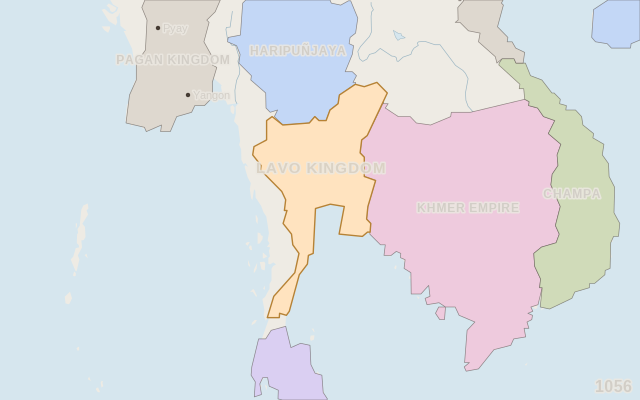
 Champa, Pagan Kingdom, Srivijaya and
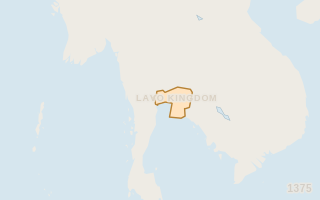
 Đại Việt.How far it reached, year by year: its ground inside the borders Cliopatria draws (CC BY 4.0), measured on an equal-area grid; the map shows it at its largest, with the cities of the year.
Its people
Lives across the Lavo Kingdom
One axis for everyone, so you can see who knew whom: the best-known, ordered by birth.
- NINarai Iking1080 – 1087
- PCPhra Chao Luangking1089 – 1111
- SNSai Nam Peungking1111 – 1165
- DDhammikarajaking1165 – 1225
- UIUthong IIking1205 – 1253
- SSuvarnarajaking1289 – 1301
- DDhammarajaking1301 – 1310
- BBaramarajaking1310 – 1344
 Uthongking1314 – 1369
- RRamesuanking
1339 – 1395
How it was governed
10 kings
10 kings on record, 1080 to 1388; a reign lasted 23.5 years at the median. Each bar is a reign, as long as it lasted.
Every term, with how it ended and its source
Rulers
The line of king.
| Ruler | Reign | Length | How it ended · source | To the ruler before |
|---|---|---|---|---|
| 11th century · 2 reigns | ||||
| Narai I | 1080 – 1087 | 7 years | ending not on record | |
| Phra Chao Luang | 1089 – 1111 | 22 years | ending not on record | |
| 12th century · 2 reigns | ||||
| Sai Nam Peung | 1111 – 1165 | 54 years | ending not on record | |
| Dhammikaraja | 1165 – 1225 | 60 years | ending not on record | |
| 13th century · 2 reigns · 1 killed or removed | ||||
| Uthong II | 1205 – 1253 | 48 years | deposedread from the ruler's own article | |
| Suvarnaraja | 1289 – 1301 | 12 years | ending not on record | |
| 14th century · 4 reigns | ||||
| Dhammaraja | 1301 – 1310 | 9 years | ending not on record | |
| Baramaraja | 1310 – 1344 | 34 years | ending not on record | |
| Uthong · aged 30 | 1344 – 1369 | 25 years | died in officeWikidata's manner of deathdied of natural causes | |
| Ramesuan · aged 30 | 1369 – 1388 | 19 years | left office aliveread off the dates alonedied of natural causes | child |
10 rulers, 10 with terms dated as terms, covering 1080 – 1388. Median reign 23.5 years. 2 of 9 handovers irregular - a killing, a deposition, a rival claimant, a rising or a coup beside it. A blank in the last column means no kin on record, which is coverage, never “unrelated”.
Longest reigns
- Dhammikaraja60 yrs
- Sai Nam Peung54 yrs
- Uthong II48 yrs
- Baramaraja34 yrs
- Uthong25 yrs
Its world
Who else stood
Meanwhile, elsewhere
The best-known states of other regions that stood while it did; the band is the Lavo Kingdom’s own years.
- Maya civilizationAmericas and Oceania
- Byzantine EmpireMiddle East and North Africa
 Abbasid CaliphateMiddle East and North Africa
 DenmarkEurope
 TibetansSouth Asia
- Ancestral PuebloansAmericas and Oceania
 SwedenEurope
- Sultanate of IfatSub-Saharan Africa
How it compares
Among 3,073 states
Each column is a share of the states; gold is the Lavo Kingdom.
Why it fell
Why did the Lavo Kingdom fall?
Historians still argue. Here is what the atlas records about its last century:
Its centuries in the record
Wars and battles in red, risings, coups and massacres beside them, everything else in grey, by the century each began in. A tall bar is partly a fact about Wikipedia: better-documented centuries hold more.
Each century’s own page:700 – 799800 – 899900 – 9991000 – 10991100 – 11991200 – 12991300 – 1399
Keep exploring
Copy link
Embed the map
Cite this page
“Lavo Kingdom”, Pastlas, a historical atlas, 2026-11-26. https://app.pastlas.com/state/lavo-kingdom/
How this page is made
Drawn from Wikidata (Q1332305, CC0), borders from Cliopatria (CC BY 4.0), coast and rivers from Natural Earth, cities from Reba, Reitsma & Seto 2016 (CC BY 4.0). Data built 2026-11-26 · Pastlas v2.47.1, by Oleh Voronko; the published atlas and its data are for non-commercial use.
How to read it
Areas are measured on an equal-area grid from borders simplified to about five kilometres. “c.” marks an approximate date, and a date known to the century is never printed to the year. Counts are what the atlas holds, and they follow Wikipedia’s coverage: a busy century is partly a fact about the record.