State · East and Southeast Asia

Jin dynasty (266–420)

266 – 420 · 154 years

Came after Three Kingdoms · became Northern and Southern dynasties and Liu Song dynasty

The Sima clan's dynasty that reunited China after the Three Kingdoms, then lost the north and ruled on from Jiankang.

Sima Yan, regent of Cao Wei, made himself emperor in 266 CE and founded the Jin dynasty. In 280 CE he conquered Eastern Wu, ending the Three Kingdoms period and reuniting China proper. Civil war among the princes and risings in the north cost the Western Jin northern China, and Han-Zhao executed Emperor Min in 318 CE. Sima Rui refounded the dynasty at Jiankang, and the Eastern Jin lasted until Liu Yu usurped it in 420 CE.

What the record holds

The Jin dynasty began in 266, after the Three Kingdoms.↓ When the borders dataset first draws it, in 265, it held 2.97 million km².↓

Its ground peaked in 283 at 4.38 million km².↓ Its highest office was held by 5 rulers, covering 266 – 316, the median reign 4 years; 3 of 4 handovers were irregular.↓ Among them, Emperor Wu of Jin, Emperor Hui of Jin and Emperor Huai of Jin are the best known.↓ The atlas files 9 rows under it, most of them people.↓

In 420, after 154 years, it was followed by Northern and Southern dynasties and the Liu Song dynasty.↓ One theory of why states fall has every condition present at its end: “Dynastic cycle and the decay of group feeling”.↓

From Wikipedia’s article, retold · CC BY-SA 4.0

154 years

Longer than the Maurya Empire, shorter than the Mongol Empire

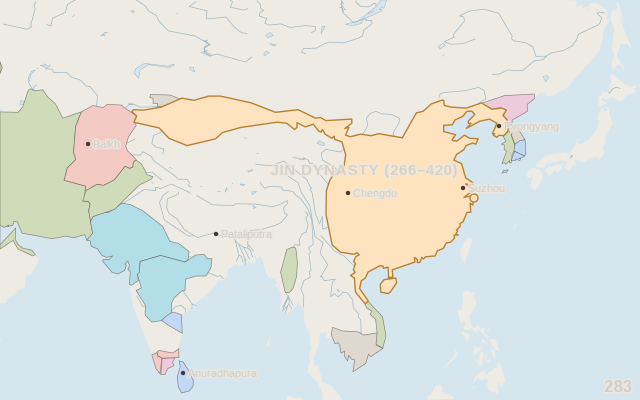
4.38 million km²

At its height in 283

5 rulers

the Emperor of China

Map: Jin dynasty (266–420) in 283, its borders in gold among its neighbours
300350400
Beside it on the map in 283: Sasanian Empire, Kushano-Sasanian Kingdom, Western Satraps, Vakataka dynasty, Kushan Empire and Kingdom of Funan.How far it reached, year by year: its ground inside the borders Cliopatria draws (CC BY 4.0), measured on an equal-area grid; the map shows it at its largest, with the cities of the year.

The story

Four acts, 266 – 420

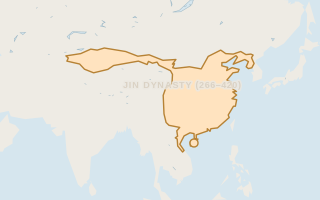
Jin dynasty (266–420) in 289, at the end of act I
I266 – 2902.97 million → 4.37 million km²

Founding and reunification

Sima Yan, regent of Cao Wei after his father, declares himself emperor in 266 CE and forces the last Wei ruler, Cao Huan, to abdicate. As Emperor Wu he conquers Eastern Wu in 280 CE, uniting China proper and closing the Three Kingdoms period. A decade of peace and prosperity follows, and the realm's mapped extent peaks in 283 CE.

Watch this act on the live map, from 266
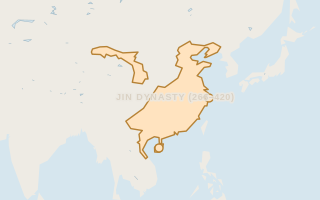
Jin dynasty (266–420) in 316, at the end of act II
II290 – 3174.37 million → 2.71 million km²

The princes' wars

Emperor Wu dies in 290 CE, and Emperor Hui's accession starts the War of the Eight Princes. Empress Jia rules behind the throne until a coup in 300 CE, and the Sima princes' wars wreck northern China. In 304 CE Cheng-Han and Han-Zhao break away; Han-Zhao sacks Luoyang in 311 CE and takes Chang'an in 316 CE.

Watch this act on the live map, from 290
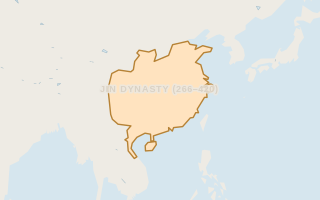
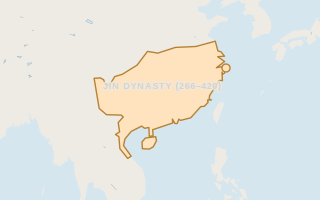
Jin dynasty (266–420) in 382, at the end of act III
III317 – 3832.71 million → 2.02 million km²

The Eastern Jin at Jiankang

Sima Rui, enthroned in 318 CE, rebuilds the Jin state at Jiankang. The Eastern Jin is the high point of rule by great gentry clans: emperors have little power while immigrant elite families run the state. Northerners flood south, clashing with local clans, and Huan Wen leads campaigns to win back the north from 354 CE to 369 CE.

Watch this act on the live map, from 317
Jin dynasty (266–420) in 419, at the end of act IV
IV383 – 4202.54 million → 2.93 million km²

Victory and usurpation

In 383 CE a heavily outnumbered Jin force crushes the Former Qin at the Fei River, winning back everything south of the Yellow River. In 403 CE Huan Xuan usurps the throne; Liu Yu topples him, restores Jin rule and recovers lost lands in campaigns from 409 CE to 416 CE. In 420 CE Sima Dewen abdicates in his favour.

Watch this act on the live map, from 383
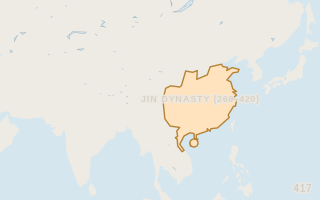
Jin dynasty (266–420) in 417, last mappedJin dynasty (266–420) in 283, at its largest
The rise and the fall in one frame: drag across it from 283, at its largest at 4.38 million km², to 417, last mapped at 2.93 million km². Open the live map in 283 or 417.

Before and after

Before it

  • Three Kingdoms · follows

After it

Where it sits in time

3000 BCE2000 BCE1000 BCE110002000Liu Song dynasty: 420 – 479Northern and Southern dynasties: 420 – 589Jin dynasty (266–420): 266 – 420

Five thousand years, 3000 BCE to 2026; the state in gold, what it replaced or followed and what replaced or followed it in grey.

Its people

Lives across the Jin dynasty

250300350400450
Statesmen and generalsWriters, artists and thinkersLived on after it endedAll its people on the timeline →

How it was governed

5 emperors

5 emperors on record, 266 to 316; a reign lasted 4 years at the median. Each bar is a reign, as long as it lasted.

Emperor Wu of Jin · 266 – 290 · died in office, manner not recordedEmperor Hui of Jin · 290 – 307 · killedSima Lun · 301 – 301 · executedEmperor Huai of Jin · 307 – 311 · left office aliveEmperor Min of Jin · 313 – 316 · left office alive300350400
a second row: a reign that began before the last had ended — rival claimants, or a shared throne
How their terms ended, where it is known (5 of 5):Killed 2Died in office 1Left office alive 2
Every term, with how it ended and its source

Rulers

How 5 reigns ended - choose one to show only those

How they died, where the record says: killed 2 · executed 2.

RulerReignLengthHow it ended · sourceTo the ruler before
3rd century · 2 reigns · 1 killed or removed
Emperor Wu of Jin · aged 30266 – 29024 yearsdied in officeWikidata's end cause on the term
Emperor Hui of Jin · aged 31290 – 30717 yearskilled in officeWikidata's manner of deathchild
4th century · 3 reigns · 1 killed or removed
Sima Lun · aged 61301 – 301under a yearexecutedWikidata's manner of death
Emperor Huai of Jin · aged 23307 – 3114 yearsleft office aliveread off the dates alonekilled
Emperor Min of Jin · aged 13313 – 3163 yearsleft office aliveread off the dates aloneexecutednephew or niece

5 rulers, 5 with terms dated as terms, covering 266 – 316. Median reign 4 years. 3 of 4 handovers irregular - a killing, a deposition, a rival claimant, a rising or a coup beside it. A blank in the last column means no kin on record, which is coverage, never “unrelated”.

Its world

Who else stood

Meanwhile, elsewhere

The best-known states of other regions that stood while it did; the band is the Jin dynasty’s own years.

250300350400

How it compares

Among 3,073 states

Stood longer than 55% of 3,073 states
Jin dynasty (266–420) · 154 yearsMaurya EmpireMongol EmpireHow long it stood, among the states with a recorded end or still standing.
Held more ground at its peak than 97% of 1,464 states
Jin dynasty (266–420) · 4,375,300 km²IndiaAustraliaThe most ground it held, among the states with a border in Cliopatria.

Why it fell

Why did the Jin dynasty fall?

Historians still argue. Here is what the atlas records about its last century:

What led to it, and what came of it

Three Kingdoms · Linked · 220 – 280Three KingdomsWestern Jin dynasty · Linked · 265 – 316Western Jin dynastyCao Fang · Coincidence · 232 – 274Cao FangCao Huan · Coincidence · 246 – 302Cao HuanLiu Can · Coincidence · 250 – 318Liu CanJin dynasty (266–420) · 266 – 420Jin dynasty (266–420)Northern and Southern dynasties · Linked · 420 – 589Northern and Southern dynastiesLiu Song dynasty · Linked · 420 – 479Liu Song dynasty300400500600
linkedcoincidence

Open the investigation: every row with its evidence, the conditions at the time, the theories condition by condition, and the succession analysed.

Theories that apply to its ending

  • Dynastic cycle and the decay of group feeling

    Ibn Khaldun 1377 · Turchin & Nefedov 2009

    Applies by its own logic: the condition it names held here, and this is the kind of outcome it predicts — adverse regime change or the state's ending.

    • the state 90 to 160 years old — ageBand 154

Its centuries in the record

200 – 299: 4 recorded — 0 wars and battles, 0 risings, regime changes and massacres, 4 other200300 – 399: 5 recorded — 0 wars and battles, 1 risings, regime changes and massacres, 4 other300400 – 499: 0 recorded — 0 wars and battles, 0 risings, regime changes and massacres, 0 other400

Wars and battles in red, risings, coups and massacres beside them, everything else in grey, by the century each began in. A tall bar is partly a fact about Wikipedia: better-documented centuries hold more.

Each century’s own page:200 – 299300 – 399400 – 499

Keep exploring

Share this page
Copy link
Embed the map
Cite this page

How this page is made

Drawn from Wikidata (Q7352, CC0), the opening and history of its English Wikipedia article retold by the atlas (CC BY-SA 4.0), borders from Cliopatria (CC BY 4.0), coast and rivers from Natural Earth, cities from Reba, Reitsma & Seto 2016 (CC BY 4.0). Data built 2026-11-26 · Pastlas v2.47.1, by Oleh Voronko; the published atlas and its data are for non-commercial use.

How to read it

Areas are measured on an equal-area grid from borders simplified to about five kilometres. “c.” marks an approximate date, and a date known to the century is never printed to the year. Counts are what the atlas holds, and they follow Wikipedia’s coverage: a busy century is partly a fact about the record.

  • Wikidata's English label: Jin dynasty.

Something wrong?

Tell us and name the entry. We fix the data, not just this page.

Report a problem