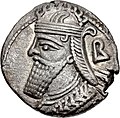
State · Middle East and North Africa

Elymais

147 BCE – 224 CE · 371 years

Became Sasanian Empire

Elymais began in 147 BCE.↑ The record names 2 rulers in its line, covering 82 BCE – 75 BCE.↓ The atlas files 3 rows under it, most of them people.↓ In 224, after 371 years, it was replaced by the Sasanian Empire.↓

Best known for

371 years

Longer than Kyivan Rus', shorter than the Spanish Empire

2 rulers

the monarch

Its borders aren’t on record

The borders dataset does not draw Elymais. The live map still shows where it stood among the states of its years.

Find it on the live map

The story

Its key moments

Before and after

After it

Where it sits in time

3000 BCE2000 BCE1000 BCE110002000Sasanian Empire: 224 – 651Elymais: 147 BCE – 224

Five thousand years, 3000 BCE to 2026; the state in gold, what it replaced or followed and what replaced or followed it in grey.

Its people

Lives across Elymais

Notable figures

How it was governed

2 monarchs

2 monarchs on record, 82 BCE to 75 BCE. Each bar is a reign, as long as it lasted.

Kamnaskires III · 82 BCE – 75 BCE · no death date to read the end against100 BCE1100200
How their terms ended, where it is known (0 of 1):Not on record 1
Every term, with how it ended and its source

Rulers

RulerReignLengthHow it ended · sourceTo the ruler before
1st century BCE · 1 reign
Kamnaskires III · aged 11982 BCE – 75 BCE7 yearsending not on record

2 rulers, 1 with terms dated as terms, covering 82 BCE – 75 BCE. Only 7 years of the line are dated - too short for a median. A blank in the last column means no kin on record, which is coverage, never “unrelated”.

Its world

Who else stood

Meanwhile, elsewhere

The best-known states of other regions that stood while it did; the band is Elymais’s own years.

200 BCE100 BCE1100200

How it compares

Among 3,073 states

Stood longer than 79% of 3,073 states
Elymais · 371 yearsKyivan Rus'Spanish EmpireHow long it stood, among the states with a recorded end or still standing.

Why it fell

Why did Elymais fall?

Historians still argue. Here is what the atlas records about its last century:

What led to it, and what came of it

Elymais · 147 BCE – 224ElymaisSasanian Empire · Linked · 224 – 651Sasanian Empire1200400600
linked

Open the investigation: every row with its evidence, the conditions at the time, the theories condition by condition, and the succession analysed.

Its centuries in the record

200 BCE – 101 BCE: 0 recorded — 0 wars and battles, 0 risings, regime changes and massacres, 0 other200 BCE100 BCE – 1 BCE: 0 recorded — 0 wars and battles, 0 risings, regime changes and massacres, 0 other100 BCE0 – 99: 0 recorded — 0 wars and battles, 0 risings, regime changes and massacres, 0 other0100 – 199: 1 recorded — 0 wars and battles, 0 risings, regime changes and massacres, 1 other100200 – 299: 0 recorded — 0 wars and battles, 0 risings, regime changes and massacres, 0 other200

Wars and battles in red, risings, coups and massacres beside them, everything else in grey, by the century each began in. A tall bar is partly a fact about Wikipedia: better-documented centuries hold more.

Each century’s own page:200 BCE – 101 BCE100 BCE – 1 BCE0 – 99100 – 199200 – 299

Keep exploring

Share this page
Copy link
Cite this page

How this page is made

Drawn from Wikidata (Q1275158, CC0). Data built 2026-11-26 · Pastlas v2.47.1, by Oleh Voronko; the published atlas and its data are for non-commercial use.

How to read it

Areas are measured on an equal-area grid from borders simplified to about five kilometres. “c.” marks an approximate date, and a date known to the century is never printed to the year. Counts are what the atlas holds, and they follow Wikipedia’s coverage: a busy century is partly a fact about the record.

Something wrong?

Tell us and name the entry. We fix the data, not just this page.

Report a problem