State · East and Southeast Asia

Tokugawa shogunate

1603 – 1867 · 264 years

Came after Toyotomi government · became Empire of Japan and Government of Meiji Japan

The Tokugawa shoguns' military government, which ruled Japan from Edo, closed it to most foreigners and fell in the Meiji Restoration.

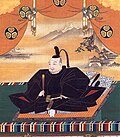
Tokugawa Ieyasu founded the Tokugawa shogunate after his victory at Sekigahara, which closed the Sengoku period of civil war; his clan ruled Japan from Edo Castle with the daimyō of the samurai class. Under sakoku most foreigners were kept out and Japanese could not leave, while the economy and cities grew fast, raising a merchant class and Ukiyo culture. From 1853 the shogunate declined, and supporters of the Imperial Court overthrew it in the Meiji Restoration of 1868.

What the record holds

The Tokugawa shogunate began in 1603, replacing Toyotomi government.↓ When the borders dataset first draws it, in 1602, it held 328,700 km².↓

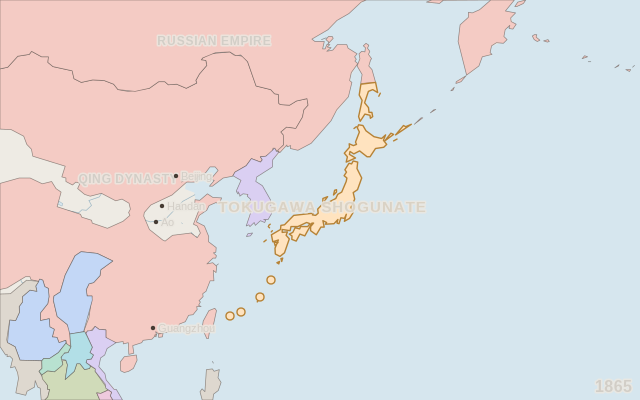
Its ground peaked in 1865 at 461,300 km².↓ Its highest office was held by 17 rulers, covering 1603 – 1868, the median reign 14 years; 2 of 16 handovers were irregular.↓ Among them, Emperor Meiji, Emperor Kōmei and Emperor Ōgimachi are the best known.↓ The atlas files 69 rows under it, most of them people.↓

In 1867, after 264 years, it was replaced by the Empire of Japan and the Government of Meiji Japan.↓ One theory of why states fall has every condition present at its end: “Elite conflict”.↓

From Wikipedia’s article, retold · CC BY-SA 4.0

264 years

Longer than the Golden Horde, shorter than the Qing dynasty

461,000 km²

At its height in 1865 · about the size of Yemen

17 rulers

the Emperor of Japan

10 wars and battles

69 entries in all

Map: Tokugawa shogunate in 1865, its borders in gold among its neighbours
Siege of Osaka, 1614 – 1615Shimabara Rebellion, 1637 – 1638Convention of Kanagawa, 1854Treaty of Shimoda, 1855Shimonoseki campaign, 1863 – 186416501700175018001850
Beside it on the map in 1865: Qing dynasty, Russian Empire, Konbaung dynasty, Panthay Rebellion, British Raj and Rattanakosin Kingdom.How far it reached, year by year: its ground inside the borders Cliopatria draws (CC BY 4.0), measured on an equal-area grid; the map shows it at its largest, with the cities of the year.

The story

Three acts, 1603 – 1867

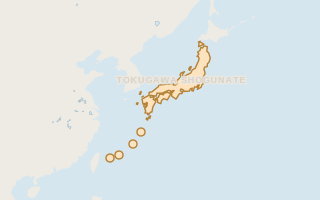
Tokugawa shogunate in 1637, at the end of act I
I1603 – 1638329,000 → 329,000 km²

Ieyasu and the new order

Victorious at Sekigahara, Tokugawa Ieyasu becomes shōgun and rules from Edo Castle; Tokugawa Hidetada succeeds him in 1605. The clan governs through the daimyō, each running a han, though the country is still divided into imperial provinces in name. War returns at the Siege of Osaka in 1614–1615, and revolt at Shimabara in 1637–1638.

Watch this act on the live map, from 1603
Tokugawa shogunate in 1852, at the end of act II
II1638 – 1853329,000 → 329,000 km²

The closed country

Under sakoku most foreigners are barred and Japanese may not leave, while a strict class system orders society. The economy and cities grow quickly, a merchant class rises and Ukiyo culture flourishes in the age of the poet Matsuo Bashō and the painter Katsushika Hokusai. Shakushain's revolt, the Hōei eruption and the Tenmei and Tenpō famines bring hardship.

Watch this act on the live map, from 1638
Tokugawa shogunate in 1866, at the end of act III
III1853 – 1867329,000 → 461,000 km²

Bakumatsu and the opening

A U.S. Navy fleet under Matthew C. Perry forces Japan open, ending sakoku, and the Convention of Kanagawa follows in 1854. Tozama daimyō resent the shogunate and anti-Western feeling spreads, as the pro-imperial Ishin Shishi confront the shogunate's forces. Violence mounts, from the Sakuradamon Incident to the bombardment of Kagoshima and the Chōshū expeditions.

Watch this act on the live map, from 1853
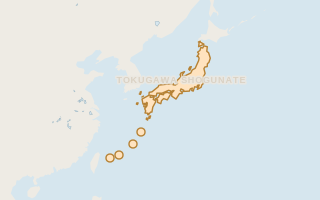
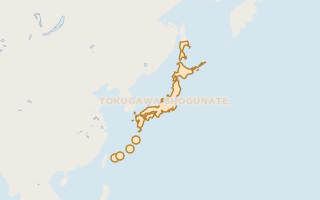
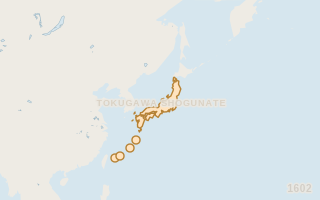
Tokugawa shogunate in 1865, at its largestTokugawa shogunate in 1602, first mapped
The rise and the fall in one frame: drag across it from 1602, first mapped at 328,700 km², to 1865, at its largest at 461,300 km². Open the live map in 1602 or 1865.

Before and after

Before it

  • Toyotomi government · replaces

After it

Where it sits in time

3000 BCE2000 BCE1000 BCE110002000Government of Meiji Japan: 1868 – 1912Empire of Japan: 1868 – 1947Tokugawa shogunate: 1603 – 1867

Five thousand years, 3000 BCE to 2026; the state in gold, what it replaced or followed and what replaced or followed it in grey.

Its people

Lives across the Tokugawa shogunate

1600170018001900
Statesmen and generalsWriters, artists and thinkersScientists and explorersLived on after it endedAll its people on the timeline →

How it was governed

17 emperors

17 emperors on record, 1603 to 1868; a reign lasted 14 years at the median. Each bar is a reign, as long as it lasted.

Emperor Ōgimachi · 1603 – 1611 · no death date to read the end againstEmperor Go-Yōzei · 1603 – 1611 · no death date to read the end againstEmperor Go-Mizunoo · 1611 – 1629 · left office aliveEmpress Meishō · 1629 – 1643 · left office aliveGo-Kōmyō · 1643 – 1654 · died in office, manner not recordedGo-Sai · 1655 – 1663 · left office aliveEmperor Reigen · 1663 – 1687 · left office aliveHigashiyama · 1687 – 1709 · left office aliveNakamikado · 1709 – 1735 · left office aliveSakuramachi · 1735 – 1747 · left office aliveMomozono · 1747 – 1762 · died in office, manner not recordedGo-Sakuramachi · 1762 – 1771 · left office aliveGo-Momozono · 1771 – 1779 · died in office, manner not recordedEmperor Kōkaku · 1779 – 1817 · left office aliveEmperor Ninkō · 1817 – 1846 · died in office, manner not recordedEmperor Kōmei · 1846 – 1867 · died in office of natural causesEmperor Meiji · 1867 – 1868 · no death date to read the end against16501700175018001850
a second row: a reign that began before the last had ended — rival claimants, or a shared throne
How their terms ended, where it is known (14 of 17):Died in office 5Left office alive 9Not on record 3
Every term, with how it ended and its source

Rulers

14 terms are shared from Japan.

How 17 reigns ended - choose one to show only those

How they died, where the record says: died of natural causes 2.

RulerReignLengthHow it ended · sourceTo the ruler before
17th century · 8 reigns
Emperor Ōgimachi1603 – 16118 yearsending not on record
Emperor Go-Yōzei1603 – 16118 yearsending not on recordgrandchild
Emperor Go-Mizunoo · from the line of Japan · aged 151611 – 162918 yearsleft office aliveread off the dates alone
Empress Meishō · from the line of Japan · aged 51629 – 164314 yearsleft office aliveread off the dates alone
Go-Kōmyō · from the line of Japan · aged 101643 – 165411 yearsdied in officeread off the dates alone
Go-Sai · from the line of Japan · aged 171655 – 16638 yearsleft office aliveread off the dates alone
Emperor Reigen · from the line of Japan · aged 91663 – 168724 yearsleft office aliveread off the dates alone
Higashiyama · from the line of Japan · aged 121687 – 170922 yearsleft office aliveread off the dates alone
18th century · 6 reigns
Nakamikado · from the line of Japan · aged 71709 – 173526 yearsleft office aliveread off the dates alone
Sakuramachi · from the line of Japan · aged 151735 – 174712 yearsleft office aliveread off the dates alone
Momozono · from the line of Japan · aged 61747 – 176215 yearsdied in officeread off the dates alone
Go-Sakuramachi · from the line of Japan · aged 221762 – 17719 yearsleft office aliveread off the dates alone
Go-Momozono · from the line of Japan · aged 131771 – 17798 yearsdied in officeread off the dates alone
Emperor Kōkaku · from the line of Japan · aged 81779 – 181738 yearsleft office aliveread off the dates alone
19th century · 3 reigns
Emperor Ninkō · from the line of Japan · aged 171817 – 184629 yearsdied in officeread off the dates alone
Emperor Kōmei · from the line of Japan · aged 151846 – 186721 yearsdied in officeWikidata's manner of deathdied of natural causes
Emperor Meiji1867 – 18681 yearending not on recorddied of natural causeschild

17 rulers, 17 with terms dated as terms, covering 1603 – 1868. Median reign 14 years. 2 of 16 handovers irregular - a killing, a deposition, a rival claimant, a rising or a coup beside it. A blank in the last column means no kin on record, which is coverage, never “unrelated”.

Heads of government

The line of Shōgun, drawn and never measured: a cabinet is not a reign.

Tokugawa Ieyasu1603 – 1605
Tokugawa Hidetada1605 – 1623
Tokugawa Iemitsu1623 – 1651
Tokugawa Ietsuna1651 – 1680
Tokugawa Tsunayoshi1680 – 1709
Tokugawa Ienobu1709 – 1712
Tokugawa Ietsugu1713 – 1716
Tokugawa Yoshimune1716 – 1745
Tokugawa Ieshige1745 – 1760
Tokugawa Ieharu1760 – 1786
Tokugawa Ienari1787 – 1837
Tokugawa Ieyoshi1837 – 1853
Tokugawa Iesada1853 – 1858
Tokugawa Iemochi1858 – 1866
Tokugawa Yoshinobu1866 – 1868

Flag or arms

  • Tokugawa family crest
    coat of arms, undatedTokugawa family crest · Public domain

Longest reigns

  • Emperor Kōkaku38 yrs
  • Emperor Ninkō29 yrs
  • Nakamikado26 yrs
  • Emperor Reigen24 yrs
  • Higashiyama22 yrs
All 17 terms, year by year, in the atlas →

Its world

Rivals, and who else stood

Who it fought most

Wars and battles both took part in, on whichever side: the record names who took part, not who fought whom.

Meanwhile, elsewhere

The best-known states of other regions that stood while it did; the band is the Tokugawa shogunate’s own years.

1600170018001900

How it compares

Among 3,073 states

Stood longer than 70% of 3,073 states
Tokugawa shogunate · 264 yearsGolden HordeQing dynastyHow long it stood, among the states with a recorded end or still standing.
Held more ground at its peak than 73% of 1,464 states
Tokugawa shogunate · 461,300 km²SwedenYemenThe most ground it held, among the states with a border in Cliopatria.

Why it fell

Why did the Tokugawa shogunate fall?

Historians still argue. Here is what the atlas records about its last century:

4

wars and battles in its last century

What led to it, and what came of it

Toyotomi government · Linked · 1585 – 1603Toyotomi governmentAshikaga shogunate · In the article · 1336 · “The Tokugawa shogunate, also known as the Edo shogunate, was the military government of Japan during the Edo period from 1603 to 1868. The Tokugawa shogunate …”Ashikaga shogunateHosokawa Tadaoki · Coincidence · 1563 – 1646Hosokawa TadaokiEmperor Go-Yōzei · Coincidence · 1572 – 1617Emperor Go-YōzeiToyotomi Hideyori · Coincidence · 1593 – 1615Toyotomi HideyoriTokugawa shogunate · 1603 – 1867Tokugawa shogunateBoshin War · Linked · 1868 – 1869Boshin WarEmpire of Japan · Linked · 1868 – 1947Empire of JapanGovernment of Meiji Japan · Linked · 1868 – 1912Government of Meiji Japan140016001800
in the articlelinkedcoincidence

Open the investigation: every row with its evidence, the conditions at the time, the theories condition by condition, and the succession analysed.

Theories that apply to its ending

  • Elite conflict

    Lachmann 2000 · Lachmann 2010

    Applies by its own logic: 2 of its 2 conditions held here (it needs all of them), and this is the kind of outcome it predicts — adverse regime change, unrest or the state's ending.

    • 2 or more elite groups in the regime's support, or a parliament met within 100 y — the aristocracy, civil servants, the military (1860)
    • an elite group among the regime's opposition within 5 y, or an elite group left the regime's support over 10 y, or a monarch deposed or killed by others within 20 y, or overlapping reigns — rival claimants — within 20 y — agrarian elites (1867)

Its centuries in the record

1600 – 1699: 9 recorded — 6 wars and battles, 1 risings, regime changes and massacres, 2 other16001700 – 1799: 5 recorded — 0 wars and battles, 0 risings, regime changes and massacres, 5 other17001800 – 1899: 49 recorded — 4 wars and battles, 2 risings, regime changes and massacres, 43 other1800

Wars and battles in red, risings, coups and massacres beside them, everything else in grey, by the century each began in. A tall bar is partly a fact about Wikipedia: better-documented centuries hold more.

Each century’s own page:1600 – 16991700 – 17991800 – 1899

Keep exploring

Share this page
Copy link
Embed the map
Cite this page

How this page is made

Drawn from Wikidata (Q205662, CC0), the opening and history of its English Wikipedia article retold by the atlas (CC BY-SA 4.0), borders from Cliopatria (CC BY 4.0), coast and rivers from Natural Earth, cities from Reba, Reitsma & Seto 2016 (CC BY 4.0), symbols from Wikimedia Commons, each under its own licence. Data built 2026-11-26 · Pastlas v2.47.1, by Oleh Voronko; the published atlas and its data are for non-commercial use.

How to read it

Areas are measured on an equal-area grid from borders simplified to about five kilometres. “c.” marks an approximate date, and a date known to the century is never printed to the year. Counts are what the atlas holds, and they follow Wikipedia’s coverage: a busy century is partly a fact about the record.

Something wrong?

Tell us and name the entry. We fix the data, not just this page.

Report a problem