Burmese–Siamese War (1765–1767)
war · 1765 – 1767
State · East and Southeast Asia
1752 – 1885 · 133 years
The record dates its beginning to 1752.↑ In 1752, the first year its borders are mapped, it covered 112,800 km².↓ Over the years of the Sino-Burmese War, 1765 – 1769, its ground went from 523,600 km² to 671,100 km².↓
Its ground peaked in 1822 at 800,000 km².↓ Its highest office was held by 11 rulers, covering 1752 – 1885, the median reign 8 years; 2 of 10 handovers were irregular.↓ Among them,  Thibaw Min,
 Alaungpaya and
 Mindon Min are the best known.↓ The atlas files 22 rows under it, most of them people.↓
It ended in 1885, 133 years after it began.↑ One theory of why states fall has every condition present at its end: “Dynastic cycle and the decay of group feeling”.↓
Best known for
133 years
Longer than Nizhny Novgorod, shorter than the Maurya Empire
800,000 km²
At its height in 1822 · about the size of Chile
11 rulers
the King of Burma
8 wars and battles
More per century than 99% of states · 22 entries in all
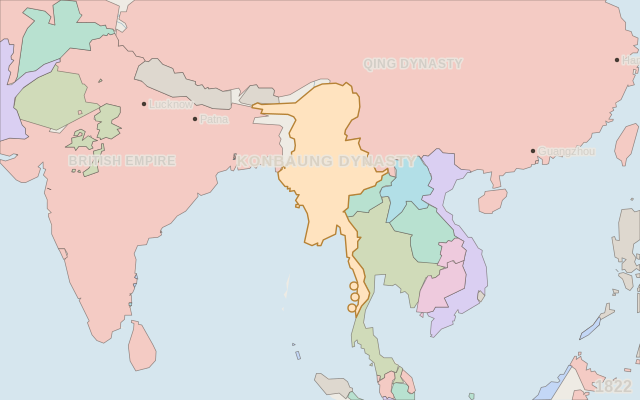
 Qing dynasty,
 British Empire,
 Rattanakosin Kingdom,
 Nguyễn dynasty,
 Sikh Empire and
 Mughal Empire.How far it reached, year by year: its ground inside the borders Cliopatria draws (CC BY 4.0), measured on an equal-area grid; the map shows it at its largest, with the cities of the year.
The story
The best-known wars, battles, risings and changes of regime the record files under it; a war within a war is folded into it.
war · 1765 – 1767
war · 1765 – 1769
Ground held: 523,600 km² → 671,100 km²
treaty · 31 December 1802
war · 1824 – 1886
With First Anglo-Burmese War, Second Anglo-Burmese War and Third Anglo-Burmese War within it.
treaty · 24 February 1826
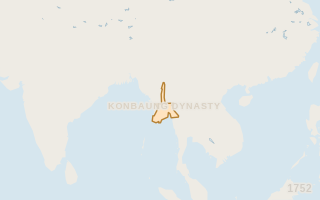
Five thousand years, 3000 BCE to 2026; the state in gold.
Its people
One axis for everyone, so you can see who knew whom: the best-known, ordered by birth.
 Alaungpayaking1714 – 1760
 Bodawpayaking1745 – 1819
 Maha Bandulamilitary personnel1782 – 1825
 Mindon Minking1808 – 1878
 Thibaw Minking
How it was governed
11 kings on record, 1752 to 1885; a reign lasted 8 years at the median. Each bar is a reign, as long as it lasted.
The line of King of Burma.
| Ruler | Reign | Length | How it ended · source | To the ruler before |
|---|---|---|---|---|
| 18th century · 6 reigns · 1 killed or removed | ||||
| Alaungpaya · aged 38 | 1752 – 1760 | 8 years | died in officeread off the dates alone | |
| Naungdawgyi · aged 26 | 1760 – 1763 | 3 years | died in officeWikidata's manner of deathdied of natural causes | child |
| Hsinbyushin · aged 27 | 1763 – 1776 | 13 years | died in officeread off the dates alone | sibling |
| Singu Min · aged 20 | 1776 – 1782 | 6 years | deposedread from the ruler's own article | child |
| Phaungkaza Maung Maung · aged 19 | 1782 – 1782 | under a year | died in officeread off the dates alone | |
| Bodawpaya · aged 37 | 1782 – 1819 | 37 years | died in officeread off the dates alone | |
| 19th century · 5 reigns · 1 killed or removed | ||||
| Bagyidaw · aged 35 | 1819 – 1837 | 18 years | deposedread from the ruler's own article | grandchild |
| Tharrawaddy Min · aged 50 | 1837 – 1846 | 9 years | died in officeread off the dates alone | sibling |
| Pagan Min · aged 35 | 1846 – 1853 | 7 years | left office aliveread off the dates alone | child |
| Mindon Min · aged 45 | 1853 – 1878 | 25 years | died in officeread off the dates alone | sibling |
| Thibaw Min · aged 19 | 1878 – 1885 | 7 years | left office aliveread off the dates alone | child |
11 rulers, 11 with terms dated as terms, covering 1752 – 1885. Median reign 8 years. 2 of 10 handovers irregular - a killing, a deposition, a rival claimant, a rising or a coup beside it. A blank in the last column means no kin on record, which is coverage, never “unrelated”.
Each symbol with the years its own statement gives; the timeline flies the one of the year on screen.
 Bodawpaya37 yrsMindon Min25 yrs
Its world
Wars and battles both took part in, on whichever side: the record names who took part, not who fought whom.
British EmpireFirst Anglo-Burmese War4 Ayutthaya KingdomBurmese–Siamese War (1765–1767)2
The best-known states of other regions that stood while it did; the band is the Konbaung dynasty’s own years.
 SwedenEurope
 Ottoman EmpireMiddle East and North Africa
 SpainEuropeMughal EmpireSouth Asia
 MoroccoMiddle East and North Africa
 DahomeySub-Saharan Africa
 United StatesAmericas and Oceania
 HaitiAmericas and Oceania
How it compares
Each column is a share of the states; gold is the Konbaung dynasty.
Why it fell
Historians still argue. Here is what the atlas records about its last century:
4
wars and battles in its last century
1837
Bagyidaw, deposed or removed in office
The investigation's own picture: 1 cause the record names and 0 results, the strongest six of each at their own years, joined to the state by the kind of claim - a recorded statement solid, the article's sentence dashed, a theory dash-dot.
Open the investigation: every row with its evidence, the conditions at the time, the theories condition by condition, and the succession analysed.
Of 5 theories of why states fall, 1 has every condition present at this ending and 2 some of them; each is applied by its own logic, condition by condition, and whether its authors named this case is a footnote.
Ibn Khaldun 1377 · Turchin & Nefedov 2009
Applies by its own logic: the condition it names held here, and this is the kind of outcome it predicts — adverse regime change or the state's ending.
Wars and battles in red, risings, coups and massacres beside them, everything else in grey, by the century each began in. A tall bar is partly a fact about Wikipedia: better-documented centuries hold more.
Each century’s own page:1700 – 17991800 – 1899
“Konbaung dynasty”, Pastlas, a historical atlas, 2026-11-26. https://app.pastlas.com/state/konbaung-dynasty/
Drawn from Wikidata (Q1062422, CC0), borders from Cliopatria (CC BY 4.0), coast and rivers from Natural Earth, cities from Reba, Reitsma & Seto 2016 (CC BY 4.0), symbols from Wikimedia Commons, each under its own licence. Data built 2026-11-26 · Pastlas v2.47.1, by Oleh Voronko; the published atlas and its data are for non-commercial use.
Areas are measured on an equal-area grid from borders simplified to about five kilometres. “c.” marks an approximate date, and a date known to the century is never printed to the year. Counts are what the atlas holds, and they follow Wikipedia’s coverage: a busy century is partly a fact about the record.