State · East and Southeast Asia

Tây Sơn dynasty

1778 – 1802 · 24 years

Came after Later Lê dynasty · became Nguyễn dynasty

The Tây Sơn dynasty began in 1778, after the Later Lê dynasty.↓ Its borders are first mapped in 1778, around 102,500 km².↓

Continue reading

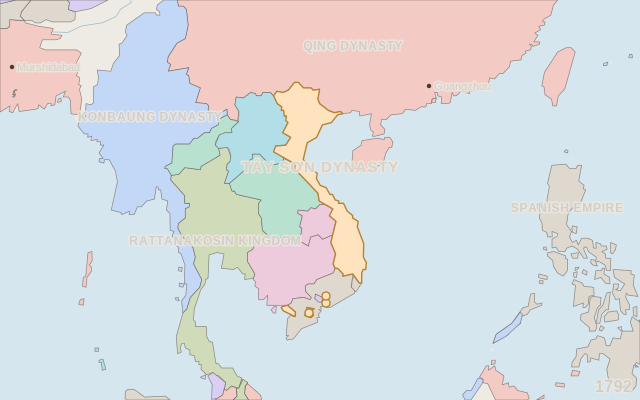
Its ground peaked in 1792 at 214,500 km².↓ Its highest office was held by 3 rulers, covering 1778 – 1802; none of its 2 handovers was irregular.↓ Among them, Quang Trung, Nguyễn Nhạc and Nguyễn Quang Toản are the best known.↓ The atlas files 3 rows under it, most of them people.↓

In 1802, after 24 years, it was followed by the Nguyễn dynasty.↓

Best known for

24 years

Longer than South Vietnam, shorter than the Republic of Artsakh

215,000 km²

At its height in 1792 · about the size of Uganda

3 rulers

the emperor

Map: Tây Sơn dynasty in 1792, its borders in gold among its neighbours
17801785179017951800
Beside it on the map in 1792: Qing dynasty, Konbaung dynasty, Rattanakosin Kingdom, Spanish Empire, British Empire and Khmer Empire.How far it reached, year by year: its ground inside the borders Cliopatria draws (CC BY 4.0), measured on an equal-area grid; the map shows it at its largest, with the cities of the year.

The story

Its key moments

Before and after

Before it

  • Later Lê dynasty · follows

After it

Where it sits in time

3000 BCE2000 BCE1000 BCE110002000Nguyễn dynasty: 1802 – 1945Tây Sơn dynasty: 1778 – 1802

Five thousand years, 3000 BCE to 2026; the state in gold, what it replaced or followed and what replaced or followed it in grey.

Its people

Lives across the Tây Sơn dynasty

Notable figures

How it was governed

3 emperors

3 emperors on record, 1778 to 1802. Each bar is a reign, as long as it lasted.

Nguyễn Nhạc · 1778 – 1788 · resigned or stood down, the article saysQuang Trung · 1788 – 1792 · died in office, manner not recordedNguyễn Quang Toản · 1792 – 1802 · executed17801785179017951800
How their terms ended, where it is known (3 of 3):Killed 1Died in office 1Left office alive 1
Every term, with how it ended and its source

Rulers

How 3 reigns ended - choose one to show only those

How they died, where the record says: executed 1.

RulerReignLengthHow it ended · sourceTo the ruler before
18th century · 3 reigns · 1 killed or removed
Nguyễn Nhạc · aged 351778 – 178810 yearsresignedread from the ruler's own article
Quang Trung · aged 361788 – 17924 yearsdied in officeread off the dates alonesibling
Nguyễn Quang Toản · aged 91792 – 180210 yearsexecutedWikidata's manner of deathchild

3 rulers, 3 with terms dated as terms, covering 1778 – 1802. Only 24 years of the line are dated - too short for a median. 0 of 2 handovers irregular - a killing, a deposition, a rival claimant, a rising or a coup beside it. A blank in the last column means no kin on record, which is coverage, never “unrelated”.

Flag or arms

  • Triều đường chi ấn
    coat of arms, undatedTriều đường chi ấn · Public domain

Its world

Who else stood

Meanwhile, elsewhere

The best-known states of other regions that stood while it did; the band is the Tây Sơn dynasty’s own years.

17701780179018001810

How it compares

Among 3,073 states

Stood longer than 24% of 3,073 states
Tây Sơn dynasty · 24 yearsSouth VietnamRepublic of ArtsakhHow long it stood, among the states with a recorded end or still standing.
Held more ground at its peak than 60% of 1,464 states
Tây Sơn dynasty · 214,500 km²UgandaLaosThe most ground it held, among the states with a border in Cliopatria.

Why it fell

Why did the Tây Sơn dynasty fall?

Historians still argue. Here is what the atlas records about its last century:

1802

Nguyễn Quang Toản, killed in office

What led to it, and what came of it

Later Lê dynasty · Linked · 1428 – 1789Later Lê dynastyTây Sơn dynasty · 1778 – 1802Tây Sơn dynastyNguyễn dynasty · Linked · 1802 – 1945Nguyễn dynasty15001600170018001900
linked

Open the investigation: every row with its evidence, the conditions at the time, the theories condition by condition, and the succession analysed.

Its centuries in the record

1700 – 1799: 3 recorded — 0 wars and battles, 0 risings, regime changes and massacres, 3 other17001800 – 1899: 0 recorded — 0 wars and battles, 0 risings, regime changes and massacres, 0 other1800

Wars and battles in red, risings, coups and massacres beside them, everything else in grey, by the century each began in. A tall bar is partly a fact about Wikipedia: better-documented centuries hold more.

Each century’s own page:1700 – 17991800 – 1899

Keep exploring

Share this page
Copy link
Embed the map
Cite this page

How this page is made

Drawn from Wikidata (Q1034173, CC0), borders from Cliopatria (CC BY 4.0), coast and rivers from Natural Earth, cities from Reba, Reitsma & Seto 2016 (CC BY 4.0), symbols from Wikimedia Commons, each under its own licence. Data built 2026-11-26 · Pastlas v2.47.1, by Oleh Voronko; the published atlas and its data are for non-commercial use.

How to read it

Areas are measured on an equal-area grid from borders simplified to about five kilometres. “c.” marks an approximate date, and a date known to the century is never printed to the year. Counts are what the atlas holds, and they follow Wikipedia’s coverage: a busy century is partly a fact about the record.

Something wrong?

Tell us and name the entry. We fix the data, not just this page.

Report a problem