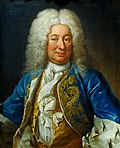
State · Europe

Swedish Empire

1611 – 1721 · 110 years

Came after history of Sweden (1523–1611) · became Age of Liberty

The Swedish Empire began in 1611, after the history of Sweden.↓ The record names 7 rulers in its line, covering 1611 – 1721, the median reign 21 years; none of its 6 handovers was irregular.↓ Among them, Christina, Queen of Sweden, Gustavus Adolphus and Charles XII of Sweden are the best known.↓

Continue reading

It was followed by the Age of Liberty in 1721, 110 years after it began.↓ One theory of why states fall has every condition present at its end: “Dynastic cycle and the decay of group feeling”.↓

110 years

Longer than Nizhny Novgorod, shorter than the Maurya Empire

7 rulers

the King/Queen

1 war or battle

1 entries in all

Its borders aren’t on record

The borders dataset does not draw the Swedish Empire. The live map still shows where it stood among the states of its years.

Find it on the live map

The story

Its key moments

Before and after

Before it

  • history of Sweden (1523–1611) · follows

After it

  • Age of Liberty · followed by

Where it sits in time

3000 BCE2000 BCE1000 BCE110002000Swedish Empire: 1611 – 1721

Five thousand years, 3000 BCE to 2026; the state in gold.

How it was governed

7 king/queens

7 king/queens on record, 1611 to 1721; a reign lasted 21 years at the median. Each bar is a reign, as long as it lasted.

Gustavus Adolphus · 1611 – 1632 · ended otherwise, as coded — neither deposed nor a natural deathChristina, Queen of Sweden · 1632 – 1654 · ended otherwise, as coded — neither deposed nor a natural deathCharles X Gustav · 1654 – 1660 · died a natural deathCharles XI of Sweden · 1660 – 1697 · died a natural deathCharles XII of Sweden · 1697 – 1718 · ended otherwise, as coded — neither deposed nor a natural deathUlrika Eleonora of Sweden · 1718 – 1720 · ended otherwise, as coded — neither deposed nor a natural deathFrederick I of Sweden · 1720 – 1721 · died a natural death162016401660168017001720
How their terms ended, where it is known (7 of 7):Died in office 3Left office alive 4
Every term, with how it ended and its source

Rulers

How 7 reigns ended - choose one to show only those

How they died, where the record says: died of natural causes 3 · died in battle 2.

RulerReignLengthHow it ended · sourceTo the ruler before
17th century · 5 reigns
Gustavus Adolphus1611 – 163221 yearsended otherwisecoded by Kokkonen & Sundelldied in battle
Christina, Queen of Sweden1632 – 165422 yearsended otherwisecoded by Kokkonen & Sundellchild
Charles X Gustav1654 – 16606 yearsnatural deathcoded by Kokkonen & Sundelldied of natural causes
Charles XI of Sweden1660 – 169737 yearsnatural deathcoded by Kokkonen & Sundelldied of natural causeschild
Charles XII of Sweden1697 – 171821 yearsended otherwisecoded by Kokkonen & Sundelldied in battlechild
18th century · 2 reigns
Ulrika Eleonora of Sweden1718 – 17202 yearsended otherwisecoded by Kokkonen & Sundelldied of natural causessibling
Frederick I of Sweden1720 – 17211 yearnatural deathcoded by Kokkonen & Sundellspouse

7 rulers, 7 with terms dated as terms, covering 1611 – 1721. Median reign 21 years. 0 of 6 handovers irregular - a killing, a deposition, a rival claimant, a rising or a coup beside it. A blank in the last column means no kin on record, which is coverage, never “unrelated”.

Flags and arms, in order

  • Arms of the House of Vasa
    coat of arms, undatedArms of the House of Vasa · CC BY-SA 3.0 · Armoiries_rois_Vasa_de_Suède.svg : derivative work: Fry1989 ( talk ) 20:04, 14 February 2…
  • Flag of Sweden (1562–1650)
    flag, undatedFlag of Sweden (1562–1650) · Public domain

Its world

Rivals, and who else stood

Who it fought most

Wars and battles both took part in, on whichever side: the record names who took part, not who fought whom.

Meanwhile, elsewhere

The best-known states of other regions that stood while it did; the band is the Swedish Empire’s own years.

160016251650167517001725

How it compares

Among 3,073 states

Stood longer than 49% of 3,073 states
Swedish Empire · 110 yearsNizhny NovgorodMaurya EmpireHow long it stood, among the states with a recorded end or still standing.

Why it fell

Why did the Swedish Empire fall?

Historians still argue. Here is what the atlas records about its last century:

1

wars and battles in its last century, more than in any before it

What led to it, and what came of it

Treaty of Teusina · Linked · 1595Treaty of Teusinahistory of Sweden (1523–1611) · Linked · 1523 – 1611history of Sweden (1523–1611)Polish–Russian War (1609–1618) · Linked · 1605 – 1618Polish–Russian War (1609–1618)Ingrian War · Linked · 1610 – 1617Ingrian WarSwedish Empire · 1611 – 1721Swedish EmpireAge of Liberty · Linked · 1718 – 1772Age of Liberty15501600165017001750
linked

Open the investigation: every row with its evidence, the conditions at the time, the theories condition by condition, and the succession analysed.

Theories that apply to its ending

  • Dynastic cycle and the decay of group feeling

    Ibn Khaldun 1377 · Turchin & Nefedov 2009

    Applies by its own logic: the condition it names held here, and this is the kind of outcome it predicts — adverse regime change or the state's ending.

    • the state 90 to 160 years old — ageBand 110

Its centuries in the record

1600 – 1699: 0 recorded — 0 wars and battles, 0 risings, regime changes and massacres, 0 other16001700 – 1799: 1 recorded — 1 wars and battles, 0 risings, regime changes and massacres, 0 other1700

Wars and battles in red, risings, coups and massacres beside them, everything else in grey, by the century each began in. A tall bar is partly a fact about Wikipedia: better-documented centuries hold more.

Each century’s own page:1600 – 16991700 – 1799

Keep exploring

Share this page
Copy link
Cite this page

How this page is made

Drawn from Wikidata (Q215443, CC0), symbols from Wikimedia Commons, each under its own licence. Data built 2026-11-26 · Pastlas v2.47.1, by Oleh Voronko; the published atlas and its data are for non-commercial use.

How to read it

Areas are measured on an equal-area grid from borders simplified to about five kilometres. “c.” marks an approximate date, and a date known to the century is never printed to the year. Counts are what the atlas holds, and they follow Wikipedia’s coverage: a busy century is partly a fact about the record.

Something wrong?

Tell us and name the entry. We fix the data, not just this page.

Report a problem