State · Europe

Saxe-Coburg and Gotha

1826 – 1918 · 92 years

Came after Duchy of Saxe-Gotha-Altenburg and Duchy of Saxe-Hildburghausen · became Free State of Coburg and Free State of Saxe-Gotha

Saxe-Coburg and Gotha began in 1826, replacing the Duchy of Saxe-Gotha-Altenburg and the Duchy of Saxe-Hildburghausen.↓ When the borders dataset first draws it, in 1836, it held 2,900 km².↓

Continue reading

The record names 4 rulers in its line, covering 1826 – 1918, the median reign 18 years; none of its 3 handovers was irregular.↓ The best known of them are Alfred, Duke of Saxe-Coburg and Gotha, Ernest I of Saxe-Coburg and Gotha and Charles Edward, Duke of Saxe-Coburg and Gotha.↓ Most of the 5 rows the atlas files under it are people.↓

In 1918, after 92 years, it was replaced by the Free State of Coburg and the Free State of Saxe-Gotha.↓ Its end fits “Dynastic cycle and the decay of group feeling” and “Elite conflict”, every condition present.↓

92 years

Longer than the British Raj, shorter than the Inca Empire

2,900 km²

At its height in 1836 · a little larger than Luxembourg

4 rulers

the Duke of Saxe-Coburg and Gotha

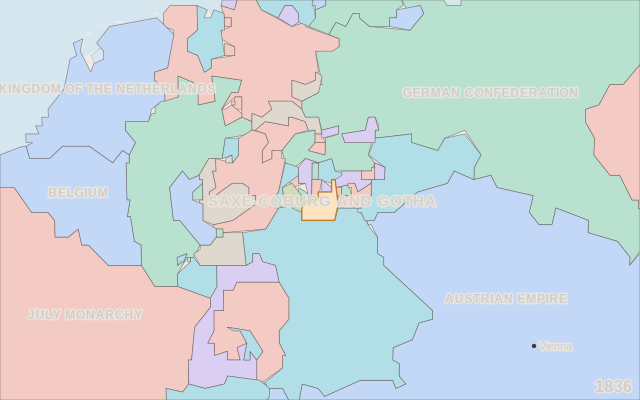
Map: Saxe-Coburg and Gotha in 1836, its borders in gold among its neighbours
Beside it on the map in 1836: German Confederation, Austrian Empire, July Monarchy, Kingdom of Bavaria, United Kingdom of Great Britain and Ireland and Kingdom of the Netherlands.How far it reached, year by year: its ground inside the borders Cliopatria draws (CC BY 4.0), measured on an equal-area grid; the map shows it at its largest, with the cities of the year.

The story

Its key moments

Before and after

Before it

After it

Where it sits in time

3000 BCE2000 BCE1000 BCE110002000Duchy of Saxe-Hildburghausen: 1680 – 1826Duchy of Saxe-Gotha-Altenburg: 1680 – 1826Free State of Saxe-Gotha: 1918 – 1920Free State of Coburg: 1918 – 1920Saxe-Coburg and Gotha: 1826 – 1918

Five thousand years, 3000 BCE to 2026; the state in gold, what it replaced or followed and what replaced or followed it in grey.

Its people

Lives across Saxe-Coburg and Gotha

Notable figures

How it was governed

4 dukes

4 dukes on record, 1826 to 1918; a reign lasted 18 years at the median. Each bar is a reign, as long as it lasted.

Ernest I of Saxe-Coburg and Gotha · 1826 – 1844 · no death date to read the end againstErnest II of Saxe-Coburg and Gotha · 1844 – 1893 · no death date to read the end againstAlfred, Duke of Saxe-Coburg and Gotha · 1893 – 1900 · no death date to read the end againstCharles Edward, Duke of Saxe-Coburg and Gotha · 1900 – 1918 · deposed, the article says1840186018801900
How their terms ended, where it is known (1 of 4):Deposed or removed 1Not on record 3
Every term, with how it ended and its source

Rulers

How 4 reigns ended - choose one to show only those

How they died, where the record says: died of natural causes 1.

RulerReignLengthHow it ended · sourceTo the ruler before
19th century · 4 reigns · 1 killed or removed
Ernest I of Saxe-Coburg and Gotha1826 – 184418 yearsending not on record
Ernest II of Saxe-Coburg and Gotha1844 – 189349 yearsending not on recordchild
Alfred, Duke of Saxe-Coburg and Gotha1893 – 19007 yearsending not on recorddied of natural causesnephew or niece
Charles Edward, Duke of Saxe-Coburg and Gotha1900 – 191818 yearsdeposedread from the ruler's own articlenephew or niece

4 rulers, 4 with terms dated as terms, covering 1826 – 1918. Median reign 18 years. 0 of 3 handovers irregular - a killing, a deposition, a rival claimant, a rising or a coup beside it. A blank in the last column means no kin on record, which is coverage, never “unrelated”.

Flags and arms, in order

  • Flagge Herzogtum Sachsen-Coburg-Gotha (1911-1920)
    flag, undatedFlagge Herzogtum Sachsen-Coburg-Gotha (1911-1920) · Public domain
  • Coat of Arms of the Duchy of Saxe-Coburg and Gotha
    coat of arms, undatedCoat of Arms of the Duchy of Saxe-Coburg and Gotha · CC BY-SA 4.0 · Glasshouse using elements by Sodacan, Trondivers and katepanomegas

Its world

Who else stood

Meanwhile, elsewhere

The best-known states of other regions that stood while it did; the band is Saxe-Coburg and Gotha’s own years.

182018401860188019001920

How it compares

Among 3,073 states

Stood longer than 44% of 3,073 states
Saxe-Coburg and Gotha · 92 yearsBritish RajInca EmpireHow long it stood, among the states with a recorded end or still standing.
Held more ground at its peak than 6% of 1,464 states
Saxe-Coburg and Gotha · 2,900 km²LuxembourgCyprusThe most ground it held, among the states with a border in Cliopatria.

Why it fell

Why did Saxe-Coburg and Gotha fall?

Historians still argue. Here is what the atlas records about its last century:

1918

Charles Edward, Duke of Saxe-Coburg and Gotha, deposed or removed in office

What led to it, and what came of it

Duchy of Saxe-Gotha-Altenburg · Linked · 1680 – 1826Duchy of Saxe-Gotha-AltenburgDuchy of Saxe-Hildburghausen · Linked · 1680 – 1826Duchy of Saxe-HildburghausenGerman Confederation · Coincidence · 1815 – 1866German ConfederationPrincipality of Lichtenberg · Coincidence · 1816 – 1834Principality of LichtenbergSaxe-Coburg and Gotha · 1826 – 1918Saxe-Coburg and GothaFree State of Coburg · Linked · 1918 – 1920Free State of CoburgFree State of Saxe-Gotha · Linked · 1918 – 1920Free State of Saxe-Gotha17001750180018501900
linkedcoincidence

Open the investigation: every row with its evidence, the conditions at the time, the theories condition by condition, and the succession analysed.

Theories that apply to its ending

  • Dynastic cycle and the decay of group feeling

    Ibn Khaldun 1377 · Turchin & Nefedov 2009

    Applies by its own logic: the condition it names held here, and this is the kind of outcome it predicts — adverse regime change or the state's ending.

    • the state 90 to 160 years old — ageBand 92
  • Elite conflict

    Lachmann 2000 · Lachmann 2010

    Applies by its own logic: 2 of its 2 conditions held here (it needs all of them), and this is the kind of outcome it predicts — adverse regime change, unrest or the state's ending.

    • 2 or more elite groups in the regime's support, or a parliament met within 100 y — the aristocracy, agrarian elites, civil servants, the military (1917)
    • an elite group among the regime's opposition within 5 y, or an elite group left the regime's support over 10 y, or a monarch deposed or killed by others within 20 y, or overlapping reigns — rival claimants — within 20 y — business elites (1918)

Its centuries in the record

1800 – 1899: 4 recorded — 0 wars and battles, 0 risings, regime changes and massacres, 4 other18001900 – 1999: 0 recorded — 0 wars and battles, 0 risings, regime changes and massacres, 0 other1900

Wars and battles in red, risings, coups and massacres beside them, everything else in grey, by the century each began in. A tall bar is partly a fact about Wikipedia: better-documented centuries hold more.

Each century’s own page:1800 – 18991900 – 1999

Keep exploring

Share this page
Copy link
Embed the map
Cite this page

How this page is made

Drawn from Wikidata (Q3462133, CC0), borders from Cliopatria (CC BY 4.0), coast and rivers from Natural Earth, cities from Reba, Reitsma & Seto 2016 (CC BY 4.0), symbols from Wikimedia Commons, each under its own licence. Data built 2026-11-26 · Pastlas v2.47.1, by Oleh Voronko; the published atlas and its data are for non-commercial use.

How to read it

Areas are measured on an equal-area grid from borders simplified to about five kilometres. “c.” marks an approximate date, and a date known to the century is never printed to the year. Counts are what the atlas holds, and they follow Wikipedia’s coverage: a busy century is partly a fact about the record.

  • Wikidata's English label: Duchy of Saxe-Coburg and Gotha.

Something wrong?

Tell us and name the entry. We fix the data, not just this page.

Report a problem