State · South Asia
Samanid Empire
819 – 999 · 180 years
Continue readingShow less
Its ground peaked in 911 at 3.10 million km².↓ Its highest office was held by 9 rulers, covering 819 – 1004, the median reign 15 years; 1 of 8 handovers was irregular.↓ Among them,  Ismail Samani,
 Ahmad Samani and Nasr I are the best known.↓ The atlas files 17 rows under it, most of them people.↓ It ended in 999, 180 years after it began.↑
180 years
Longer than the Mongol Empire, shorter than the Russian Empire
3.1 million km²
At its height in 911 · about the size of India
9 rulers
the Amir of the Samanids
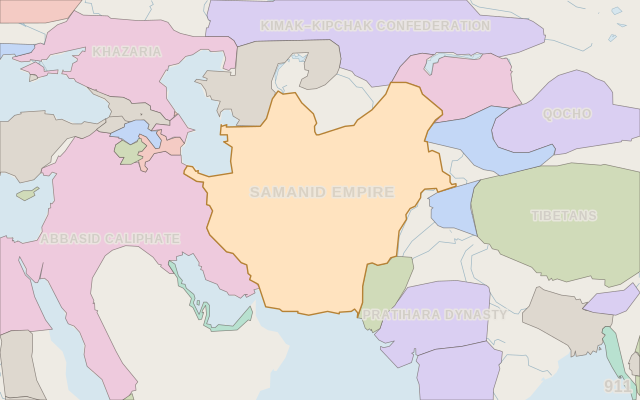
 Abbasid Caliphate,
 Tibetans, Kimak–Kipchak confederation, Khazaria, Qocho and
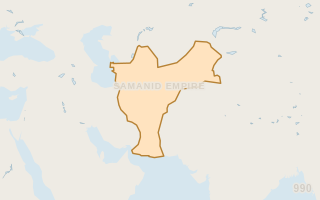
 Gurjara-Pratihara.How far it reached, year by year: its ground inside the borders Cliopatria draws (CC BY 4.0), measured on an equal-area grid; the map shows it at its largest, with the cities of the year.
Its people
Lives across the Samanid Empire
One axis for everyone, so you can see who knew whom: the best-known, ordered by birth.
- AAAhmad ibn Asadamir810 – 865
- NINasr Iamir840 – 892
 Ismail Samaniamir · military leader849 – 907
- IIstakhriscientist850 – 957
 Ahmad Samaniamir880 – 914
 Alp-Tegincommander901 – 963
- IMIbn Miskawayhphilosopher · politician
932 – 1030  Ferdowsipoet · writer
940 – 1020 Mansur Iamir940 – 976
- AIAbd al-Malik Iamir944 – 961
- AAl-Tha'alibipoet · writer
961 – 1038  Nuh IIamir963 – 997
 Al-Biruniastronomer · physicist
973 – 1048 Avicennaastronomer · physicist
980 – 1037- IMIsma'il Muntasiramir
980 – 1005 - AIAbd al-Malik IIamir980 – 999
- HAHamza ibn Aliphilosopher · theologian
985 – 1041
How it was governed
9 amirs
9 amirs on record, 819 to 1004; a reign lasted 15 years at the median. Each bar is a reign, as long as it lasted.
Every term, with how it ended and its source
Rulers
Read from the state’s own English article and its rulers’ articles, where Wikidata names no ruler.
| Ruler | Reign | Length | How it ended · source | To the ruler before |
|---|---|---|---|---|
| 9th century · 3 reigns | ||||
| Ahmad ibn Asad | 819 – 865 | 46 years | ending not on record | |
| Nasr I | 864 – 892 | 28 years | ending not on record | child |
| Ismail Samani | 892 – 907 | 15 years | ending not on record | sibling |
| 10th century · 6 reigns | ||||
| Ahmad Samani | 907 – 914 | 7 years | ending not on record | child |
| Abd al-Malik I | 954 – 961 | 7 years | ending not on recorddied by accident | |
| Mansur I | 961 – 976 | 15 years | ending not on record | sibling |
| Nuh II | 976 – 997 | 21 years | ending not on record | child |
| Abd al-Malik II | 999 – 999 | under a year | ending not on record | child |
| Isma'il Muntasir | 1000 – 1004 | 4 years | ending not on record | sibling |
9 rulers, 9 with terms dated as terms, covering 819 – 1004. Median reign 15 years. 1 of 8 handovers irregular - a killing, a deposition, a rival claimant, a rising or a coup beside it. A blank in the last column means no kin on record, which is coverage, never “unrelated”.
Longest reigns
- Ahmad ibn Asad46 yrs
- Nasr I28 yrs
- Nuh II21 yrs
- Ismail Samani15 yrs
- Mansur I15 yrs
Its world
Who else stood
Meanwhile, elsewhere
The best-known states of other regions that stood while it did; the band is the Samanid Empire’s own years.
- Maya civilizationAmericas and Oceania
 San MarinoEurope
- Byzantine EmpireMiddle East and North Africa
- SrivijayaEast and Southeast Asia
- Abbasid CaliphateMiddle East and North Africa
 DenmarkEurope
- Khmer EmpireEast and Southeast Asia
- Ancestral PuebloansAmericas and Oceania
How it compares
Among 3,073 states
Each column is a share of the states; gold is the Samanid Empire.
Why it fell
Why did the Samanid Empire fall?
Historians still argue. Here is what the atlas records about its last century:
×6.8
its land, between 899 and 998
What led to it, and what came of it
The investigation's own picture: 1 cause the record names and 0 results, the strongest six of each at their own years, joined to the state by the kind of claim - a recorded statement solid, the article's sentence dashed, a theory dash-dot.
Open the investigation: every row with its evidence, the conditions at the time, the theories condition by condition, and the succession analysed.
Keep exploring
Copy link
Embed the map
Cite this page
“Samanid Empire”, Pastlas, a historical atlas, 2026-11-26. https://app.pastlas.com/state/samanid-empire/
How this page is made
Drawn from Wikidata (Q12150341, CC0), borders from Cliopatria (CC BY 4.0), coast and rivers from Natural Earth, cities from Reba, Reitsma & Seto 2016 (CC BY 4.0). Data built 2026-11-26 · Pastlas v2.47.1, by Oleh Voronko; the published atlas and its data are for non-commercial use.
How to read it
Areas are measured on an equal-area grid from borders simplified to about five kilometres. “c.” marks an approximate date, and a date known to the century is never printed to the year. Counts are what the atlas holds, and they follow Wikipedia’s coverage: a busy century is partly a fact about the record.
- Held with the record of Samanid dynasty, merged into this one.