Civilisation · Europe

Minoan civilization

3300 – 1100 BCE · 2,200 years

Became Mycenaean Greece

Bronze Age Crete's culture of labyrinthine palaces, frescoes and far-reaching trade, often counted as the first civilization in Europe.

A Bronze Age culture of Crete, the Minoan civilization is often called the first civilization in Europe. It grew from the island's Neolithic culture c. 3100 BCE, built complex towns from c. 2000 BCE, and carried its influence across the Aegean and the eastern Mediterranean through trade. Its great buildings at Knossos and Phaistos served religious and economic ends, and whether a single Minoan state ever existed is unknown.

What the record holds

Its record opens in 3300 BCE.↑ In 1600 BCE, the first year its borders are mapped, it covered 5,500 km².↓ In 1100 BCE, after 2,200 years, it was replaced by Mycenaean Greece.↓

From Wikipedia’s article, retold · CC BY-SA 4.0

Best known for

2,200 years

Longer than Ancient Greece, shorter than Babylon

5,500 km²

At its height in 1600 BCE · almost the size of Cyprus

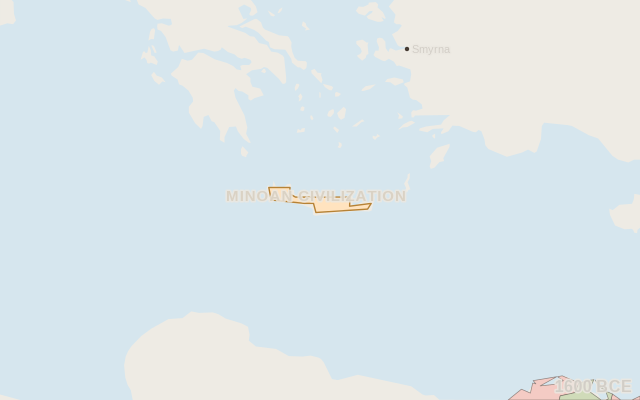
Map: Minoan civilization in 1600 BCE, its borders in gold among its neighbours
1600 BCE1550 BCE1500 BCE1450 BCE
Beside it on the map in 1600 BCE: Fifteenth Dynasty of Egypt and Sixteenth Dynasty of Egypt.How far it reached, year by year: its ground inside the borders Cliopatria draws (CC BY 4.0), measured on an equal-area grid; the map shows it at its largest, with the cities of the year.

The story

Three acts, 3300 – 1100 BCE

I3300 – 2000 BCE

From Neolithic villages

Crete has been farmed since c. 7000 BCE by Neolithic villagers living in open settlements, with fishermen's huts on the shore and fields on the fertile Messara Plain. Out of this local culture the Minoan civilization develops c. 3100 BCE.

Watch this act on the live map, from 3300 BCE
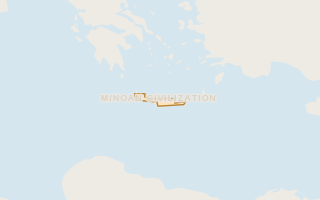
Minoan civilization in 1451 BCE, at the end of act II
II2000 – 1450 BCE

Towns, scripts and trade

Complex urban settlements appear from c. 2000 BCE. The Minoans write in Cretan hieroglyphs and Linear A, neither of them fully deciphered, and their traders exchange farm produce and luxury crafts for metals that Crete lacks. The Minoan eruption follows in 1601 BCE.

Watch this act on the live map, from 2000 BCE
III1450 – 1100 BCE

Under Mycenaean dominance

After c. 1450 BCE mainland Mycenaean Greeks dominate Crete, in culture and perhaps in politics. A modified Linear A, known as Linear B, now records Mycenaean Greek, the language of administration on the island, and a hybrid culture lasts until c. 1100 BCE.

Watch this act on the live map, from 1450 BCE

Before and after

After it

Where it sits in time

3000 BCE2000 BCE1000 BCE110002000Mycenaean Greece: 1600 BCE – 1100 BCEMinoan civilization: 3300 BCE – 1100 BCE

Five thousand years, 3000 BCE to 2026; the state in gold, what it replaced or followed and what replaced or followed it in grey.

Its world

Who else stood

Meanwhile, elsewhere

The best-known states of other regions that stood while it did; the band is the Minoan civilization’s own years.

3500 BCE3000 BCE2500 BCE2000 BCE1500 BCE1000 BCE

How it compares

Among 3,073 states

Stood longer than 99% of 3,073 states
Minoan civilization · 2,200 yearsAncient GreeceBabylonHow long it stood, among the states with a recorded end or still standing.
Held more ground at its peak than 11% of 1,464 states
Minoan civilization · 5,500 km²LuxembourgCyprusThe most ground it held, among the states with a border in Cliopatria.

Why it fell

Why did the Minoan civilization fall?

Historians still argue. Here is what the atlas records about its last century:

What led to it, and what came of it

Minoan civilization · 3300 BCE – 1100 BCEMinoan civilizationMycenaean Greece · Linked · 1600 BCE – 1100 BCEMycenaean Greece3000 BCE2500 BCE2000 BCE1500 BCE
linked

Open the investigation: every row with its evidence, the conditions at the time, the theories condition by condition, and the succession analysed.

Its centuries in the record

3300 BCE – 3201 BCE: 0 recorded — 0 wars and battles, 0 risings, regime changes and massacres, 0 other3300 BCE3200 BCE – 3101 BCE: 0 recorded — 0 wars and battles, 0 risings, regime changes and massacres, 0 other3100 BCE – 3001 BCE: 0 recorded — 0 wars and battles, 0 risings, regime changes and massacres, 0 other3100 BCE3000 BCE – 2901 BCE: 0 recorded — 0 wars and battles, 0 risings, regime changes and massacres, 0 other2900 BCE – 2801 BCE: 0 recorded — 0 wars and battles, 0 risings, regime changes and massacres, 0 other2900 BCE2800 BCE – 2701 BCE: 0 recorded — 0 wars and battles, 0 risings, regime changes and massacres, 0 other2700 BCE – 2601 BCE: 0 recorded — 0 wars and battles, 0 risings, regime changes and massacres, 0 other2700 BCE2600 BCE – 2501 BCE: 0 recorded — 0 wars and battles, 0 risings, regime changes and massacres, 0 other2500 BCE – 2401 BCE: 0 recorded — 0 wars and battles, 0 risings, regime changes and massacres, 0 other2500 BCE2400 BCE – 2301 BCE: 0 recorded — 0 wars and battles, 0 risings, regime changes and massacres, 0 other2300 BCE – 2201 BCE: 0 recorded — 0 wars and battles, 0 risings, regime changes and massacres, 0 other2300 BCE2200 BCE – 2101 BCE: 0 recorded — 0 wars and battles, 0 risings, regime changes and massacres, 0 other2100 BCE – 2001 BCE: 0 recorded — 0 wars and battles, 0 risings, regime changes and massacres, 0 other2100 BCE2000 BCE – 1901 BCE: 0 recorded — 0 wars and battles, 0 risings, regime changes and massacres, 0 other1900 BCE – 1801 BCE: 0 recorded — 0 wars and battles, 0 risings, regime changes and massacres, 0 other1900 BCE1800 BCE – 1701 BCE: 0 recorded — 0 wars and battles, 0 risings, regime changes and massacres, 0 other1700 BCE – 1601 BCE: 1 recorded — 0 wars and battles, 0 risings, regime changes and massacres, 1 other1700 BCE1600 BCE – 1501 BCE: 0 recorded — 0 wars and battles, 0 risings, regime changes and massacres, 0 other1500 BCE – 1401 BCE: 0 recorded — 0 wars and battles, 0 risings, regime changes and massacres, 0 other1500 BCE1400 BCE – 1301 BCE: 0 recorded — 0 wars and battles, 0 risings, regime changes and massacres, 0 other1300 BCE – 1201 BCE: 0 recorded — 0 wars and battles, 0 risings, regime changes and massacres, 0 other1300 BCE1200 BCE – 1101 BCE: 0 recorded — 0 wars and battles, 0 risings, regime changes and massacres, 0 other1100 BCE – 1001 BCE: 0 recorded — 0 wars and battles, 0 risings, regime changes and massacres, 0 other1100 BCE

Wars and battles in red, risings, coups and massacres beside them, everything else in grey, by the century each began in. A tall bar is partly a fact about Wikipedia: better-documented centuries hold more.

Each century’s own page:3300 BCE – 3201 BCE3200 BCE – 3101 BCE3100 BCE – 3001 BCE3000 BCE – 2901 BCE2900 BCE – 2801 BCE2800 BCE – 2701 BCE2700 BCE – 2601 BCE2600 BCE – 2501 BCE2500 BCE – 2401 BCE2400 BCE – 2301 BCE2300 BCE – 2201 BCE2200 BCE – 2101 BCE2100 BCE – 2001 BCE2000 BCE – 1901 BCE1900 BCE – 1801 BCE1800 BCE – 1701 BCE1700 BCE – 1601 BCE1600 BCE – 1501 BCE1500 BCE – 1401 BCE1400 BCE – 1301 BCE1300 BCE – 1201 BCE1200 BCE – 1101 BCE1100 BCE – 1001 BCE

Keep exploring

Share this page
Copy link
Embed the map
Cite this page

How this page is made

Drawn from Wikidata (Q134178, CC0), the opening and history of its English Wikipedia article retold by the atlas (CC BY-SA 4.0), borders from Cliopatria (CC BY 4.0), coast and rivers from Natural Earth, cities from Reba, Reitsma & Seto 2016 (CC BY 4.0). Data built 2026-11-26 · Pastlas v2.47.1, by Oleh Voronko; the published atlas and its data are for non-commercial use.

How to read it

Areas are measured on an equal-area grid from borders simplified to about five kilometres. “c.” marks an approximate date, and a date known to the century is never printed to the year. Counts are what the atlas holds, and they follow Wikipedia’s coverage: a busy century is partly a fact about the record.

  • Wikidata records foundings in 3300 BCE and 2001 BCE; the atlas draws the earliest founding.

Something wrong?

Tell us and name the entry. We fix the data, not just this page.

Report a problem