People · Middle East and North Africa

Hittites

1701 – 1201 BCE · 500 years

An Indo-European people of Anatolia who ruled from Hattusa, fought Egypt at Kadesh, and fell apart in the Late Bronze Age collapse.

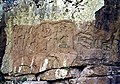
The Hittites, an Anatolian Indo-European people, settled in north-central Anatolia early in the 2nd millennium BCE and built an empire around their capital, Hattusa. At its peak under Šuppiluliuma I in the mid-14th century BCE it ruled most of Anatolia and reached into northern Syria and Upper Mesopotamia, contending with Egypt, Assyria and Mitanni. Their language, with Luwian, is the oldest attested Indo-European tongue. The empire splintered in the Late Bronze Age collapse.

What the record holds

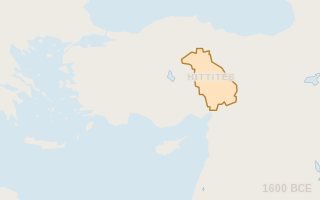
Hittites began in the 18th century BCE.↑ Its borders are first mapped in 1600 BCE, around 58,800 km².↓

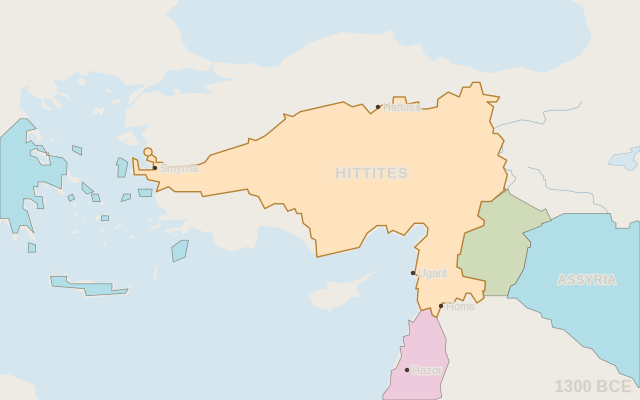
Its ground peaked in 1300 BCE at 321,400 km².↓ Its highest office was held by 6 rulers, covering 1650 BCE – 1178 BCE, the median reign 30 years; 1 of 5 handovers was irregular.↓ Among them, Ḫattušili III, Mursili I and Šuppiluliuma II are the best known.↓ The atlas files 8 rows under it, most of them people.↓ It ended in 1201 BCE, 500 years after it began.↑

From Wikipedia’s article, retold · CC BY-SA 4.0

500 years

Longer than Scythians, shorter than the Abbasid Caliphate

321,000 km²

At its height in 1300 BCE · about the size of Ivory Coast

6 rulers

the King of the Hittites

2 wars and battles

8 entries in all

Map: Hittites in 1300 BCE, its borders in gold among its neighbours
1500 BCE1400 BCE1300 BCE
Beside it on the map in 1300 BCE: Assyria, Mitanni, Mycenaean Greece and New Kingdom of Egypt.How far it reached, year by year: its ground inside the borders Cliopatria draws (CC BY 4.0), measured on an equal-area grid; the map shows it at its largest, with the cities of the year.

The story

Three acts, 1701 – 1201 BCE

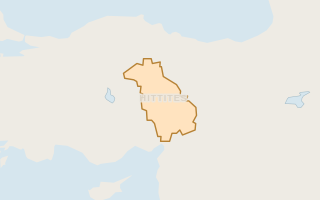
Hittites in 1501 BCE, at the end of act I
I1701 – 1500 BCE

The Old Kingdom

The kingdom's founding is credited to Labarna I or Hattusili I. Hattusili wins lands north and south of Hattusa, takes the city itself and campaigns as far as Aleppo, capital of the Amorite kingdom of Yamkhad, without capturing it. Mursili I reigns from 1620 to 1590 BCE, and the Old Kingdom ends with Telepinu c. 1500 BCE.

Watch this act on the live map, from 1701 BCE
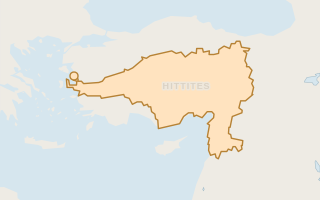
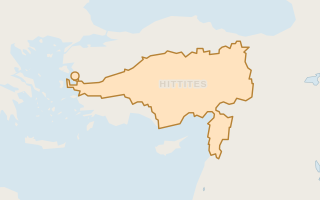
Hittites in 1275 BCE, at the end of act II
II1500 – 1274 BCE57,800 → 321,000 km²

From obscurity to empire

The 15th century BCE is a weak, ill-recorded Middle Kingdom: Kaskians from the Black Sea shores attack constantly, and the capital moves to Sapinuwa and then Samuha. Under Tudhaliya I the kingdom re-emerges, kingship becomes hereditary and takes on a superhuman aura, and under Šuppiluliuma I it reaches its peak.

Watch this act on the live map, from 1500 BCE
Hittites in 1202 BCE, at the end of act III
III1274 – 1201 BCE321,000 → 301,000 km²

Kadesh and the fall

At Kadesh c. 1274 BCE the Hittites fight the Egypt of Ramesses II to an uncertain result. The Assyrian Shalmaneser I overruns Mitanni and threatens Hittite trade routes, and Hattusili III ousts his nephew Mursili III in a brief civil war. By the 12th century BCE Assyria has annexed much of the empire and Phrygian newcomers sack the rest.

Watch this act on the live map, from 1274 BCE
Hittites in 1300 BCE, at its largestHittites in 1600 BCE, first mapped
The rise and the fall in one frame: drag across it from 1600 BCE, first mapped at 58,800 km², to 1300 BCE, at its largest at 321,400 km². Open the live map in 1600 BCE or 1300 BCE.

Where it sits in time

3000 BCE2000 BCE1000 BCE110002000Hittites: 1701 BCE – 1201 BCE

Five thousand years, 3000 BCE to 2026; the state in gold.

Its people

Lives across Hittites

Notable figures

How it was governed

6 kings

6 kings on record, 1650 BCE to 1178 BCE; a reign lasted 30 years at the median. Each bar is a reign, as long as it lasted.

Labarna I · 1650 BCE – 1650 BCE · no death date to read the end againstḪattušili I · 1650 BCE – 1620 BCE · no death date to read the end againstMursili I · 1620 BCE – 1590 BCE · killed, the article saysḪattušili III · 1275 BCE – 1245 BCE · no death date to read the end againstTudḫaliya IV · 1245 BCE – 1215 BCE · no death date to read the end againstŠuppiluliuma II · 1207 BCE – 1178 BCE · no death date to read the end against1700 BCE1600 BCE1500 BCE1400 BCE1300 BCE
How their terms ended, where it is known (1 of 6):Killed 1Not on record 5
Every term, with how it ended and its source

Rulers

How 6 reigns ended - choose one to show only those
RulerReignLengthHow it ended · sourceTo the ruler before
17th century BCE · 3 reigns · 1 killed or removed
Labarna I1650 BCE – 1650 BCEunder a yearending not on record
Ḫattušili I1650 BCE – 1620 BCE30 yearsending not on record
Mursili I1620 BCE – 1590 BCE30 yearskilledread from the ruler's own article
13th century BCE · 3 reigns
Ḫattušili III1275 BCE – 1245 BCE30 yearsending not on record
Tudḫaliya IV1245 BCE – 1215 BCE30 yearsending not on recordchild
Šuppiluliuma II1207 BCE – 1178 BCE29 yearsending not on recordchild

6 rulers, 6 with terms dated as terms, covering 1650 BCE – 1178 BCE. Median reign 30 years. 1 of 5 handovers irregular - a killing, a deposition, a rival claimant, a rising or a coup beside it. A blank in the last column means no kin on record, which is coverage, never “unrelated”.

Its world

Rivals, and who else stood

Who it fought most

Wars and battles both took part in, on whichever side: the record names who took part, not who fought whom.

Meanwhile, elsewhere

The best-known states of other regions that stood while it did; the band is Hittites’s own years.

1600 BCE1400 BCE1200 BCE

How it compares

Among 3,073 states

Stood longer than 86% of 3,073 states
Hittites · 500 yearsScythiansAbbasid CaliphateHow long it stood, among the states with a recorded end or still standing.
Held more ground at its peak than 67% of 1,464 states
Hittites · 321,400 km²OmanIvory CoastThe most ground it held, among the states with a border in Cliopatria.

Why it fell

Why did Hittites fall?

Historians still argue. Here is what the atlas records about its last century:

2

wars and battles in its last century, more than in any before it

×1.8

its land, between 1301 BCE and 1202 BCE

Its centuries in the record

1800 BCE – 1701 BCE: 2 recorded — 0 wars and battles, 0 risings, regime changes and massacres, 2 other1800 BCE1700 BCE – 1601 BCE: 0 recorded — 0 wars and battles, 0 risings, regime changes and massacres, 0 other1700 BCE1600 BCE – 1501 BCE: 0 recorded — 0 wars and battles, 0 risings, regime changes and massacres, 0 other1600 BCE1500 BCE – 1401 BCE: 0 recorded — 0 wars and battles, 0 risings, regime changes and massacres, 0 other1500 BCE1400 BCE – 1301 BCE: 4 recorded — 0 wars and battles, 0 risings, regime changes and massacres, 4 other1400 BCE1300 BCE – 1201 BCE: 2 recorded — 2 wars and battles, 0 risings, regime changes and massacres, 0 other1300 BCE

Wars and battles in red, risings, coups and massacres beside them, everything else in grey, by the century each began in. A tall bar is partly a fact about Wikipedia: better-documented centuries hold more.

Each century’s own page:1800 BCE – 1701 BCE1700 BCE – 1601 BCE1600 BCE – 1501 BCE1500 BCE – 1401 BCE1400 BCE – 1301 BCE1300 BCE – 1201 BCE

Keep exploring

Share this page
Copy link
Embed the map
Cite this page

How this page is made

Drawn from Wikidata (Q5406, CC0), the opening and history of its English Wikipedia article retold by the atlas (CC BY-SA 4.0), borders from Cliopatria (CC BY 4.0), coast and rivers from Natural Earth, cities from Reba, Reitsma & Seto 2016 (CC BY 4.0). Data built 2026-11-26 · Pastlas v2.47.1, by Oleh Voronko; the published atlas and its data are for non-commercial use.

How to read it

Areas are measured on an equal-area grid from borders simplified to about five kilometres. “c.” marks an approximate date, and a date known to the century is never printed to the year. Counts are what the atlas holds, and they follow Wikipedia’s coverage: a busy century is partly a fact about the record.

Something wrong?

Tell us and name the entry. We fix the data, not just this page.

Report a problem