Dynasty · East and Southeast Asia
Mạc dynasty
1527 – 1677 · 150 years
Continue readingShow less
Its highest office was held by 12 rulers, covering 1527 – 1683, the median reign 8 years; 3 of 11 handovers were irregular.↓ Among them,  Mạc Đăng Dung,
 Mạc Thái Tông and
 Mạc Tuyên Tông are the best known.↓ The atlas files 10 rows under it, most of them people.↓
It ended in 1677, 150 years after it began.↑ One theory of why states fall has every condition present at its end: “Dynastic cycle and the decay of group feeling”.↓
150 years
Longer than the Maurya Empire, shorter than the Mongol Empire
191,000 km²
At its height in 1529 · about the size of Kyrgyzstan
12 rulers
the emperor
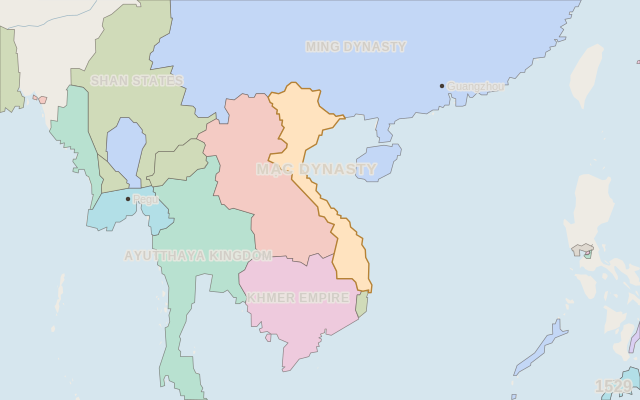
 Ming dynasty, Shan States,
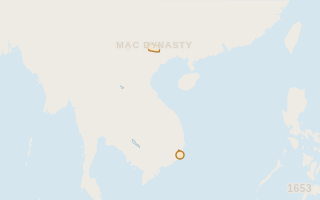
 Ayutthaya Kingdom, Lan Xang, Khmer Empire and Kingdom of Mrauk U.How far it reached, year by year: its ground inside the borders Cliopatria draws (CC BY 4.0), measured on an equal-area grid; the map shows it at its largest, with the cities of the year.
Its people
Lives across the Mạc dynasty
One axis for everyone, so you can see who knew whom: the best-known, ordered by birth.
 Mạc Đăng Dungemperor1483 – 1541
 Mạc Thái Tôngemperor1500 – 1540
- MHMạc Hiến Tôngemperor1540 – 1546
 Mạc Mậu Hợpemperor1560 – 1592
- MTMạc Toànemperor1585 – 1593
- MKMạc Kính Chỉemperor1592 – 1593
- MKMạc Kính Vũemperor1638 – 1677
How it was governed
12 emperors
12 emperors on record, 1527 to 1683; a reign lasted 8 years at the median. Each bar is a reign, as long as it lasted.
Every term, with how it ended and its source
Rulers
The line of emperor.
| Ruler | Reign | Length | How it ended · source | To the ruler before |
|---|---|---|---|---|
| 16th century · 8 reigns · 1 killed or removed | ||||
| Mạc Đăng Dung · aged 44 | 1527 – 1529 | 2 years | left office aliveread off the dates alone | |
| Mạc Thái Tông · aged 30 | 1530 – 1540 | 10 years | died in officeread off the dates alone | child |
| Mạc Hiến Tông | 1540 – 1546 | 6 years | died in officeread off the dates alone | child |
 Mạc Tuyên Tông | 1546 – 1561 | 15 years | left office aliveread off the dates alonedied of natural causes | child |
| Mạc Mậu Hợp · aged 2 | 1562 – 1592 | 30 years | died in officeread off the dates alone | child |
| Mạc Toàn · aged 7 | 1592 – 1593 | 1 year | died in officeread off the dates alone | child |
| Mạc Kính Chỉ | 1592 – 1593 | 1 year | ending not on record | |
| Mạc Kính Cung · aged 42 | 1592 – 1625 | 33 years | executedread from the ruler's own article | sibling |
| 17th century · 4 reigns | ||||
| Mạc Kính Khoan · aged 73 | 1623 – 1638 | 15 years | died in officeread off the dates alone | |
| Mạc Kính Vũ | 1638 – 1677 | 39 years | ending not on record | child |
| Mạc Kính Hẻ | 1677 – 1681 | 4 years | ending not on record | |
| Mạc Kính Quang | 1681 – 1683 | 2 years | ending not on record | |
12 rulers, 12 with terms dated as terms, covering 1527 – 1683. Median reign 8 years. 3 of 11 handovers irregular - a killing, a deposition, a rival claimant, a rising or a coup beside it. A blank in the last column means no kin on record, which is coverage, never “unrelated”.
Longest reigns
- Mạc Kính Vũ39 yrs
- Mạc Kính Cung33 yrs
- Mạc Mậu Hợp30 yrs
- Mạc Kính Khoan15 yrs
- Mạc Tuyên Tông15 yrs
Its world
Who else stood
Meanwhile, elsewhere
The best-known states of other regions that stood while it did; the band is the Mạc dynasty’s own years.
 SwedenEurope
 KathmanduSouth Asia
- Mali EmpireSub-Saharan Africa
 Ottoman EmpireMiddle East and North Africa
 HaudenosauneeAmericas and Oceania
 SpainEurope
 Mughal EmpireSouth Asia
 MoroccoMiddle East and North Africa
How it compares
Among 3,073 states
Each column is a share of the states; gold is the Mạc dynasty.
Why it fell
Why did the Mạc dynasty fall?
Historians still argue. Here is what the atlas records about its last century:
÷5.0
its land, between 1577 and 1676
1625
Mạc Kính Cung, killed in office
Theories that apply to its ending
Of 5 theories of why states fall, 1 has every condition present at this ending and 1 some of them; each is applied by its own logic, condition by condition, and whether its authors named this case is a footnote.
Dynastic cycle and the decay of group feeling
Ibn Khaldun 1377 · Turchin & Nefedov 2009
Applies by its own logic: the condition it names held here, and this is the kind of outcome it predicts — adverse regime change or the state's ending.
- the state 90 to 160 years old — ageBand 150
Its centuries in the record
Wars and battles in red, risings, coups and massacres beside them, everything else in grey, by the century each began in. A tall bar is partly a fact about Wikipedia: better-documented centuries hold more.
Each century’s own page:1500 – 15991600 – 1699
Keep exploring
Copy link
Embed the map
Cite this page
“Mạc dynasty”, Pastlas, a historical atlas, 2026-11-26. https://app.pastlas.com/state/mac-dynasty/
How this page is made
Drawn from Wikidata (Q1317991, CC0), borders from Cliopatria (CC BY 4.0), coast and rivers from Natural Earth, cities from Reba, Reitsma & Seto 2016 (CC BY 4.0). Data built 2026-11-26 · Pastlas v2.47.1, by Oleh Voronko; the published atlas and its data are for non-commercial use.
How to read it
Areas are measured on an equal-area grid from borders simplified to about five kilometres. “c.” marks an approximate date, and a date known to the century is never printed to the year. Counts are what the atlas holds, and they follow Wikipedia’s coverage: a busy century is partly a fact about the record.