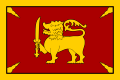
State · South Asia

Kingdom of Kandy

1469 – 1815 · 346 years

Came after Kingdom of Kotte and Kingdom of Sitawaka · became British Ceylon

It was founded in 1469, replacing the Kingdom of Kotte and the Kingdom of Sitawaka.↓ Its highest office was held by 14 rulers, covering 1469 – 1815, the median reign 25 years; 1 of 13 handovers was irregular.↓ The best known of them are Sri Vikrama Rajasinha, Kusumasana Devi and Rajasinha I.↓ Most of the 16 rows the atlas files under it are people.↓

Continue reading

Its own article says it was conquered by the British Empire, in 1815.↓ British Ceylon replaced it in 1815, after 346 years.↓

346 years

Longer than the Mughal Empire, shorter than Kyivan Rus'

14 rulers

the King of Kandy

2 wars and battles

16 entries in all

Its borders aren’t on record

The borders dataset does not draw the Kingdom of Kandy. The live map still shows where it stood among the states of its years.

Find it on the live map

The story

Its key moments

Before and after

Before it

After it

  • British Ceylon · replaced by

Where it sits in time

3000 BCE2000 BCE1000 BCE110002000Kingdom of Kotte: 1412 – 1597Kingdom of Sitawaka: 1521 – 1594Kingdom of Kandy: 1469 – 1815

Five thousand years, 3000 BCE to 2026; the state in gold, what it replaced or followed and what replaced or followed it in grey.

Its people

Lives across the Kingdom of Kandy

1500160017001800
Statesmen and generalsLived on after it endedAll its people on the timeline →

How it was governed

14 kings

14 kings on record, 1469 to 1815; a reign lasted 25 years at the median. Each bar is a reign, as long as it lasted.

Senasammata Vikramabahu · 1469 – 1511 · no death date to read the end againstJayavira · 1511 – 1552 · died in office, manner not recordedKaralliyadde Bandara · 1552 – 1582 · left office aliveKusumasana Devi · 1581 – 1581 · left office aliveRajasinha I · 1581 – 1591 · left office aliveVimaladharmasuriya I · 1592 – 1604 · died in office, manner not recordedSenarat of Kandy · 1604 – 1635 · died in office, manner not recordedRajasinha II · 1635 – 1687 · died in office, manner not recordedVimaladharmasuriya II · 1687 – 1707 · died in office, manner not recordedVira Narendra Sinha · 1707 – 1739 · died in office, manner not recordedSri Vijaya Rajasinha · 1739 – 1747 · died in office, manner not recordedKirti Sri Rajasinha · 1747 – 1782 · died by accidentSri Rajadhi Rajasinha · 1782 – 1798 · died in office, manner not recordedSri Vikrama Rajasinha · 1798 – 1815 · deposed, the article says1500160017001800
a second row: a reign that began before the last had ended — rival claimants, or a shared throne
How their terms ended, where it is known (13 of 14):Deposed or removed 1Died in office 9Left office alive 3Not on record 1
Every term, with how it ended and its source

Rulers

How 14 reigns ended - choose one to show only those

How they died, where the record says: died by accident 1 · died of natural causes 1.

RulerReignLengthHow it ended · sourceTo the ruler before
15th century · 1 reign
Senasammata Vikramabahu1469 – 151142 yearsending not on record
16th century · 5 reigns
Jayavira1511 – 155241 yearsdied in officeread off the dates alonechild
Karalliyadde Bandara1552 – 158230 yearsleft office aliveread off the dates alonechild
Kusumasana Devi · aged 211581 – 1581under a yearleft office aliveread off the dates alonechild
Rajasinha I · aged 371581 – 159110 yearsleft office aliveread off the dates alone
Vimaladharmasuriya I · aged 421592 – 160412 yearsdied in officeread off the dates alone
17th century · 3 reigns
Senarat of Kandy1604 – 163531 yearsdied in officeread off the dates alone
Rajasinha II · aged 271635 – 168752 yearsdied in officeread off the dates alonechild
Vimaladharmasuriya II · aged 371687 – 170720 yearsdied in officeread off the dates alonechild
18th century · 5 reigns · 1 killed or removed
Vira Narendra Sinha1707 – 173932 yearsdied in officeread off the dates alonechild
Sri Vijaya Rajasinha1739 – 17478 yearsdied in officeread off the dates alone
Kirti Sri Rajasinha · aged 131747 – 178235 yearsdied by accidentWikidata's manner of deathdied by accident
Sri Rajadhi Rajasinha1782 – 179816 yearsdied in officeread off the dates alone
Sri Vikrama Rajasinha · aged 181798 – 181517 yearsdeposedread from the ruler's own articledied of natural causes

14 rulers, 14 with terms dated as terms, covering 1469 – 1815. Median reign 25 years. 1 of 13 handovers irregular - a killing, a deposition, a rival claimant, a rising or a coup beside it. A blank in the last column means no kin on record, which is coverage, never “unrelated”.

Flag or arms

  • King of Kandy
    flag, undatedKing of Kandy · Public domain

Its world

Rivals, and who else stood

Who it fought most

Wars and battles both took part in, on whichever side: the record names who took part, not who fought whom.

Meanwhile, elsewhere

The best-known states of other regions that stood while it did; the band is the Kingdom of Kandy’s own years.

1500160017001800

How it compares

Among 3,073 states

Stood longer than 77% of 3,073 states
Kingdom of Kandy · 346 yearsMughal EmpireKyivan Rus'How long it stood, among the states with a recorded end or still standing.

Why it fell

Why did the Kingdom of Kandy fall?

Historians still argue. Here is what the atlas records about its last century:

1815

Sri Vikrama Rajasinha, deposed or removed in office

How it ended, as its article says

Conquered by British Empire, 1815. Read from the article's section “lead” by its grammar; the claim is only that the article says so.

The kingdom was absorbed into the British Empire as a protectorate following the Kandyan Convention of 1815, and definitively lost its autonomy following the Uva Rebellion of 1817.

One sentence of the English Wikipedia article, CC BY-SA 4.0.

What led to it, and what came of it

Kingdom of Kotte · Linked · 1412 – 1597Kingdom of KotteKingdom of Kandy · 1469 – 1815Kingdom of KandyBritish Ceylon · Linked · 1815 – 1948British Ceylon140015001600170018001900
linked

Open the investigation: every row with its evidence, the conditions at the time, the theories condition by condition, and the succession analysed.

Its centuries in the record

1400 – 1499: 1 recorded — 0 wars and battles, 0 risings, regime changes and massacres, 1 other14001500 – 1599: 5 recorded — 0 wars and battles, 0 risings, regime changes and massacres, 5 other15001600 – 1699: 3 recorded — 0 wars and battles, 0 risings, regime changes and massacres, 3 other16001700 – 1799: 7 recorded — 2 wars and battles, 0 risings, regime changes and massacres, 5 other17001800 – 1899: 0 recorded — 0 wars and battles, 0 risings, regime changes and massacres, 0 other1800

Wars and battles in red, risings, coups and massacres beside them, everything else in grey, by the century each began in. A tall bar is partly a fact about Wikipedia: better-documented centuries hold more.

Each century’s own page:1400 – 14991500 – 15991600 – 16991700 – 17991800 – 1899

Keep exploring

Share this page
Copy link
Cite this page

How this page is made

Drawn from Wikidata (Q1530762, CC0), symbols from Wikimedia Commons, each under its own licence, and one sentence of the article, quoted. Data built 2026-11-26 · Pastlas v2.47.1, by Oleh Voronko; the published atlas and its data are for non-commercial use.

How to read it

Areas are measured on an equal-area grid from borders simplified to about five kilometres. “c.” marks an approximate date, and a date known to the century is never printed to the year. Counts are what the atlas holds, and they follow Wikipedia’s coverage: a busy century is partly a fact about the record.

Something wrong?

Tell us and name the entry. We fix the data, not just this page.

Report a problem