 Charles I of Anjou,
 Charles II of Naples and
 Philip I of Taranto.
The story
Its key moments
Where it sits in time
Five thousand years, 3000 BCE to 2026; the state in gold.
State · Europe
1272 – 1368 · 96 years
Best known for
96 years
Longer than the Inca Empire, shorter than the Yuan dynasty
8 rulers
the King of Albania
Its borders aren’t on record
The borders dataset does not draw the Kingdom of Albania. The live map still shows where it stood among the states of its years.
Find it on the live mapThe story
Five thousand years, 3000 BCE to 2026; the state in gold.
Its people
One axis for everyone, so you can see who knew whom: the best-known, ordered by birth.
 Philip I of Tarantoking1276 – 1331
 John of Gravinaking1294 – 1336
How it was governed
8 kings on record, 1272 to 1368; a reign lasted 10.5 years at the median. Each bar is a reign, as long as it lasted.
Read from the state’s own English article and its rulers’ articles, where Wikidata names no ruler.
| Ruler | Reign | Length | How it ended · source | To the ruler before |
|---|---|---|---|---|
| 13th century · 3 reigns | ||||
 Charles I of Anjou | 1272 – 1285 | 13 years | ending not on record | |
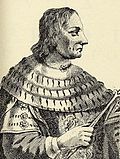 Charles II of Naples | 1285 – 1294 | 9 years | ending not on record | child |
| Philip I of Taranto | 1294 – 1331 | 37 years | ending not on record | child |
| 14th century · 5 reigns | ||||
| Robert of Taranto | 1331 – 1332 | 1 year | ending not on record | child |
| John of Gravina | 1332 – 1336 | 4 years | ending not on record | |
| Charles, Duke of Durazzo | 1336 – 1348 | 12 years | ending not on record | child |
| Joanna, Duchess of Durazzo | 1348 – 1368 | 20 years | ending not on record | child |
| Louis, Duke of Durazzo | 1365 – 1368 | 3 years | ending not on record | spouse |
8 rulers, 8 with terms dated as terms, covering 1272 – 1368. Median reign 10.5 years. 1 of 7 handovers irregular - a killing, a deposition, a rival claimant, a rising or a coup beside it. A blank in the last column means no kin on record, which is coverage, never “unrelated”.
Each symbol with the years its own statement gives; the timeline flies the one of the year on screen.
 Philip I of Taranto37 yrsCharles I of Anjou13 yrsCharles II of Naples9 yrs
Its world
The best-known states of other regions that stood while it did; the band is the Kingdom of Albania’s own years.
 KathmanduSouth Asia
 Mongol EmpireEast and Southeast Asia
 Delhi SultanateSouth Asia
 Ottoman EmpireMiddle East and North Africa
How it compares
Each column is a share of the states; gold is the Kingdom of Albania.
Why it fell
Historians still argue. Here is what the atlas records about its last century:
The investigation's own picture: 1 cause the record names and 0 results, the strongest six of each at their own years, joined to the state by the kind of claim - a recorded statement solid, the article's sentence dashed, a theory dash-dot.
Open the investigation: every row with its evidence, the conditions at the time, the theories condition by condition, and the succession analysed.
Of 5 theories of why states fall, 1 has every condition present at this ending and 2 some of them; each is applied by its own logic, condition by condition, and whether its authors named this case is a footnote.
Ibn Khaldun 1377 · Turchin & Nefedov 2009
Applies by its own logic: the condition it names held here, and this is the kind of outcome it predicts — adverse regime change or the state's ending.
Wars and battles in red, risings, coups and massacres beside them, everything else in grey, by the century each began in. A tall bar is partly a fact about Wikipedia: better-documented centuries hold more.
Each century’s own page:1200 – 12991300 – 1399
“Kingdom of Albania”, Pastlas, a historical atlas, 2026-11-26. https://app.pastlas.com/state/kingdom-of-albania/
Drawn from Wikidata (Q2657134, CC0), symbols from Wikimedia Commons, each under its own licence. Data built 2026-11-26 · Pastlas v2.47.1, by Oleh Voronko; the published atlas and its data are for non-commercial use.
Areas are measured on an equal-area grid from borders simplified to about five kilometres. “c.” marks an approximate date, and a date known to the century is never printed to the year. Counts are what the atlas holds, and they follow Wikipedia’s coverage: a busy century is partly a fact about the record.